Showing posts with label frivolity. Show all posts
Showing posts with label frivolity. Show all posts
Thursday, May 24, 2012
Brodie the feline fig enthusiast


Monday, March 7, 2011
Gooseberry Green
Apparently there's an actual name for Brodie's eye color: gooseberry green. I learned this while reading about Egyptian Mau cats. My guys are mutts, not Maus, but seeing as the distinguishing features of all known cat "breeds" came from random-bred populations originally it's totally unsurprising to see modern random-bred kitties expressing traits commonly associated with particular types of cats.
It's difficult to get good photos of cats' eyes, but the one below (of Brodie, if that wasn't obvious!) is pretty accurate color-wise:

Cats' eyes commonly change color as they grow. My youngsters all had greyish eyes when first adopted, and like most kittens probably had blue eyes at birth. Now they've all got different hues going on in the ocular region: Cora's eyes are a deep amber, Shadow's are bright yellow with greenish bits toward the center, and Brodie's are, well, gooseberry (or, as I've previously described them, "clear limeade green").
Brodie also does actually look vaguely Mau-ish in other respects too...these Flickr Mau-cats remind me of him a fair bit. He's more striped than spotted but he's definitely got the long body and the wedge-with-rounded-points head shape.
Anyway, definitely a frivolous observation but cat traits and genetics are just something that fascinates me, so I thought I'd post about it.
It's difficult to get good photos of cats' eyes, but the one below (of Brodie, if that wasn't obvious!) is pretty accurate color-wise:
Cats' eyes commonly change color as they grow. My youngsters all had greyish eyes when first adopted, and like most kittens probably had blue eyes at birth. Now they've all got different hues going on in the ocular region: Cora's eyes are a deep amber, Shadow's are bright yellow with greenish bits toward the center, and Brodie's are, well, gooseberry (or, as I've previously described them, "clear limeade green").
Brodie also does actually look vaguely Mau-ish in other respects too...these Flickr Mau-cats remind me of him a fair bit. He's more striped than spotted but he's definitely got the long body and the wedge-with-rounded-points head shape.
Anyway, definitely a frivolous observation but cat traits and genetics are just something that fascinates me, so I thought I'd post about it.
Monday, September 6, 2010
Cat Cognition Capers: Knocking Stuff Over Edition
Cross-posted from Existence is Wonderful
(A sort-of followup to Cats, Dogs, Strings, and Causality and A Small, Informal Cat Cognition Experiment)
Recently I tried looking up studies and/or scholarly articles on the phenomenon of Cats Knocking Things Over, but didn't come up with any interesting results. The majority of writing on this subject seems to be in the context of advice on "cat behavior problems", e.g., Dealing With Cats That Knock Things Down, How can I get my cat to stop knocking stuff over?, etc.
(Of course, if anyone has any links to papers on this subject please feel free to share!)
But anyway. It occurred to me, upon seeing Shadow (one of three ex-feral littermates sharing my home) push a container of cat treats off my desk for the nth time earlier today, that (if it was indeed being done deliberately) such an action might represent a fairly well-developed understanding of certain physical principles. I.e., the fact that if one cannot readily access the contents of a treat-containing object, one might be able to gain access via utilizing the tendency of objects to fall over when pushed or similarly manipulated.
(Full disclosure: as a person on the autistic spectrum who is also interested in neuroscience and relevant cognitive research, I must admit it tends to catch my attention whenever I encounter what to me looks like an interesting ability or trait, in any species, being largely written off as a "behavior problem". Often it seems to me something is being missed when this occurs, so I'm driven to investigate in situations like this!)
Certainly the standard "I am not a professional researcher, this was all done completely informally, my home is not a laboratory, etc." disclaimer must be applied to these results. Moreover, I am well aware that interpretation is not data (and vice versa), and in truth the only thing that can be said for sure is that at least one of my cats pretty consistently knocks over objects when is is conceivable that he has reason to believe these objects could contain treats.
The following three videos appear in chronological order. All were filmed on 5 September 2010, in the afternoon, within the space of maybe twenty minutes.
In this first video ("Cats and Gravity I"), Shadow is shown pushing a sealed container of treats off my desk.
He had precedent for doing this, as this particular container is the usual one I put the kitties' daily allotment of treats in. Once, about a week ago, I left the lid part-way off, to see what he would do (seeing as he'd definitely be able to smell the treats within). And in that case he proceeded to nudge the container around with his nose until it fell off the table, scattering treats hither and thither, much to his and his siblings' delight.
Now, I am fairly certain that this first knockdown was an accident. However, since then, Shadow has pushed the treat container off multiple other surfaces (besides the coffee table), on multiple separate occasions. "Cats and Gravity I", then, seems like it could very well represent Shadow's having learned that "if I push this container, sometimes treats fall out!" I don't know that anyone in the cognitive research field actually believes this level of reasoning is beyond the domestic feline (I suspect not) but in any event, it makes for a good "baseline" data point in terms of the variables I am interested in observing.
In this next video ("Cats and Gravity II"), we have an interesting situation involving three cats. You may remember Coraline and Brodie from all those string and zip-tie trials I ran as a rough check of what experimental design conditions might be improved so that cats could better demonstrate their actual cognitive capacities in string-pulling tasks. In the case of that set of puzzles, Cora and Brodie were the only participating felines; Shadow preferred to simply watch.
However, in "Cats and Gravity II", you will observe that Brodie "experiments" with the treat-containing bottle but doesn't succeed in getting anything out of it, whereas Shadow makes one single decisive swipe and sends the thing crashing down. Note that this bottle is different from the treat container in the first video, but it is one that I've put treats in several times prior to this, so the cats would definitely be familiar with it.
(Coraline, meanwhile, is ignoring the whole business and seems more excited about the fact that I've gotten up from my computer chair, giving her an opening to steal it. To me this mainly suggests that at different points in time, different cats may have very different priorities!)
And then we come to "Cats and Gravity III". The outcome of this scenario completely caught me off guard (you may even be able to hear me exclaim "HOLY CRAP!" at one point). In this case I took a treat container that would be new to all the cats (another empty vitamin bottle, this time a dark purple one slightly larger than the white one used in "Cats and Gravity II"). I let them watch me putting treats into it, and then placed this bottle on top of a small end table in the living room (a different surface in a different part of the house than my desk, to control for position habit).
In this case, the video shows that initially none of the cats really showed interest in the new treat bottle when I first placed it on the end table. However, after I went over and shook it a bit, Shadow went over to the table, put his front paws on the top surface, and then proceeded to lift the bottle up with his mouth and throw it down onto the floor. (That's where I exclaimed "HOLY CRAP!", by the way.)
So...what to make of this?
Subjectively speaking (yes, I'm about to offer an interpretation), it looked to me like Shadow spontaneously came up with a really creative way of getting the treats he knew were inside the purple bottle. Which would suggest that he's learned to generalize beyond "if I paw at this maybe it will fall and treats will come out" and now understands that it is not the mechanical motion of pawing or nosing that's important, but rather, the falling of the bottle itself, if one's goal is to get the treats out of the bottle. This, to me, seems pretty significant, and again I'm curious to know if there's any literature out there saying one thing or another about this type of cognition in felines.
However, this was of course a tiny sample set. And I did not do this series of "mini-trials" in response to another study I'd be able to cite and/or comment on -- like I said at the beginning, I couldn't find any studies about cats knocking stuff over. No peer-reviewed references = not "ResearchBlogging". Plus, for all I know, cats' understanding of gravitational cause-and-effect is already well documented and known and I just fail at searching for this documentation.
That said, at the very least, I think anyone who really wants to study cats' understanding of cause-and-effect as it pertains to objects in a broader sense would do well to try out a variety of different scenarios involving different types of objects, and requiring different types of attentiveness and planning on the cats' part.
I find it terribly problematic (and this goes back to my discussion of the string experiments again) when a single particular test is taken (whether by the study authors, the media, or both) as meaning something globally significant about a given population's abilities or lack thereof. In the absence of a single task (or task type) with huge amounts of existing data backing up its ability to test "general" cognitive ability in a given domain, multiple tasks of varying attributes would seem to me required for appropriate levels of rigor.
Also, I have to say that another reason I wanted to post these videos is because now more than ever I am beginning to think it is very important to have as much of an experiment on record (for multiple parties to view and evaluate) as possible. Even though I (hopefully) disclaimered the heck out of my string experiments, I still would rather do things as close to "right" as possible for a layperson -- just because I'm not a real researcher doesn't mean I can't practice holding my informal stuff to higher standards.
Finally, I would just like to say that I would be extremely interested to get people's comments on what it looks like is actually happening in the videos above. As in, if you think Shadow is doing what he's doing deliberately, what aspects of his actions lead you to think that? I'm curious about this because I see my cats doing all sorts of things all the time, some of which (to me) look "deliberate", whereas other things they do look thoroughly "accidental". Only I haven't come up with a good way to describe what "deliberateness" looks like in quantitative terms.
I suspect that in general this sort of issue comes up a lot in animal cognition research, which has me curious as to whether there even exists any kind of objective way to measure something so "internal". Behaviorism (in my opinion) fails miserably to account for everything that could potentially be important (for one thing it often seems to completely fail to account for, say, different sensory and perceptual modalities on the part of the researcher vs. subject), and much of what I hear from "evolutionary psychology" sounds like it's been pulled straight from someone's nether orifice, to put it politely. So I'd be really intrigued to know what other tools or paradigms may currently be out there that might be more promising.
(A sort-of followup to Cats, Dogs, Strings, and Causality and A Small, Informal Cat Cognition Experiment)
Recently I tried looking up studies and/or scholarly articles on the phenomenon of Cats Knocking Things Over, but didn't come up with any interesting results. The majority of writing on this subject seems to be in the context of advice on "cat behavior problems", e.g., Dealing With Cats That Knock Things Down, How can I get my cat to stop knocking stuff over?, etc.
(Of course, if anyone has any links to papers on this subject please feel free to share!)
But anyway. It occurred to me, upon seeing Shadow (one of three ex-feral littermates sharing my home) push a container of cat treats off my desk for the nth time earlier today, that (if it was indeed being done deliberately) such an action might represent a fairly well-developed understanding of certain physical principles. I.e., the fact that if one cannot readily access the contents of a treat-containing object, one might be able to gain access via utilizing the tendency of objects to fall over when pushed or similarly manipulated.
(Full disclosure: as a person on the autistic spectrum who is also interested in neuroscience and relevant cognitive research, I must admit it tends to catch my attention whenever I encounter what to me looks like an interesting ability or trait, in any species, being largely written off as a "behavior problem". Often it seems to me something is being missed when this occurs, so I'm driven to investigate in situations like this!)
Certainly the standard "I am not a professional researcher, this was all done completely informally, my home is not a laboratory, etc." disclaimer must be applied to these results. Moreover, I am well aware that interpretation is not data (and vice versa), and in truth the only thing that can be said for sure is that at least one of my cats pretty consistently knocks over objects when is is conceivable that he has reason to believe these objects could contain treats.
The following three videos appear in chronological order. All were filmed on 5 September 2010, in the afternoon, within the space of maybe twenty minutes.
In this first video ("Cats and Gravity I"), Shadow is shown pushing a sealed container of treats off my desk.
He had precedent for doing this, as this particular container is the usual one I put the kitties' daily allotment of treats in. Once, about a week ago, I left the lid part-way off, to see what he would do (seeing as he'd definitely be able to smell the treats within). And in that case he proceeded to nudge the container around with his nose until it fell off the table, scattering treats hither and thither, much to his and his siblings' delight.
Now, I am fairly certain that this first knockdown was an accident. However, since then, Shadow has pushed the treat container off multiple other surfaces (besides the coffee table), on multiple separate occasions. "Cats and Gravity I", then, seems like it could very well represent Shadow's having learned that "if I push this container, sometimes treats fall out!" I don't know that anyone in the cognitive research field actually believes this level of reasoning is beyond the domestic feline (I suspect not) but in any event, it makes for a good "baseline" data point in terms of the variables I am interested in observing.
In this next video ("Cats and Gravity II"), we have an interesting situation involving three cats. You may remember Coraline and Brodie from all those string and zip-tie trials I ran as a rough check of what experimental design conditions might be improved so that cats could better demonstrate their actual cognitive capacities in string-pulling tasks. In the case of that set of puzzles, Cora and Brodie were the only participating felines; Shadow preferred to simply watch.
However, in "Cats and Gravity II", you will observe that Brodie "experiments" with the treat-containing bottle but doesn't succeed in getting anything out of it, whereas Shadow makes one single decisive swipe and sends the thing crashing down. Note that this bottle is different from the treat container in the first video, but it is one that I've put treats in several times prior to this, so the cats would definitely be familiar with it.
(Coraline, meanwhile, is ignoring the whole business and seems more excited about the fact that I've gotten up from my computer chair, giving her an opening to steal it. To me this mainly suggests that at different points in time, different cats may have very different priorities!)
And then we come to "Cats and Gravity III". The outcome of this scenario completely caught me off guard (you may even be able to hear me exclaim "HOLY CRAP!" at one point). In this case I took a treat container that would be new to all the cats (another empty vitamin bottle, this time a dark purple one slightly larger than the white one used in "Cats and Gravity II"). I let them watch me putting treats into it, and then placed this bottle on top of a small end table in the living room (a different surface in a different part of the house than my desk, to control for position habit).
In this case, the video shows that initially none of the cats really showed interest in the new treat bottle when I first placed it on the end table. However, after I went over and shook it a bit, Shadow went over to the table, put his front paws on the top surface, and then proceeded to lift the bottle up with his mouth and throw it down onto the floor. (That's where I exclaimed "HOLY CRAP!", by the way.)
So...what to make of this?
Subjectively speaking (yes, I'm about to offer an interpretation), it looked to me like Shadow spontaneously came up with a really creative way of getting the treats he knew were inside the purple bottle. Which would suggest that he's learned to generalize beyond "if I paw at this maybe it will fall and treats will come out" and now understands that it is not the mechanical motion of pawing or nosing that's important, but rather, the falling of the bottle itself, if one's goal is to get the treats out of the bottle. This, to me, seems pretty significant, and again I'm curious to know if there's any literature out there saying one thing or another about this type of cognition in felines.
However, this was of course a tiny sample set. And I did not do this series of "mini-trials" in response to another study I'd be able to cite and/or comment on -- like I said at the beginning, I couldn't find any studies about cats knocking stuff over. No peer-reviewed references = not "ResearchBlogging". Plus, for all I know, cats' understanding of gravitational cause-and-effect is already well documented and known and I just fail at searching for this documentation.
That said, at the very least, I think anyone who really wants to study cats' understanding of cause-and-effect as it pertains to objects in a broader sense would do well to try out a variety of different scenarios involving different types of objects, and requiring different types of attentiveness and planning on the cats' part.
I find it terribly problematic (and this goes back to my discussion of the string experiments again) when a single particular test is taken (whether by the study authors, the media, or both) as meaning something globally significant about a given population's abilities or lack thereof. In the absence of a single task (or task type) with huge amounts of existing data backing up its ability to test "general" cognitive ability in a given domain, multiple tasks of varying attributes would seem to me required for appropriate levels of rigor.
Also, I have to say that another reason I wanted to post these videos is because now more than ever I am beginning to think it is very important to have as much of an experiment on record (for multiple parties to view and evaluate) as possible. Even though I (hopefully) disclaimered the heck out of my string experiments, I still would rather do things as close to "right" as possible for a layperson -- just because I'm not a real researcher doesn't mean I can't practice holding my informal stuff to higher standards.
Finally, I would just like to say that I would be extremely interested to get people's comments on what it looks like is actually happening in the videos above. As in, if you think Shadow is doing what he's doing deliberately, what aspects of his actions lead you to think that? I'm curious about this because I see my cats doing all sorts of things all the time, some of which (to me) look "deliberate", whereas other things they do look thoroughly "accidental". Only I haven't come up with a good way to describe what "deliberateness" looks like in quantitative terms.
I suspect that in general this sort of issue comes up a lot in animal cognition research, which has me curious as to whether there even exists any kind of objective way to measure something so "internal". Behaviorism (in my opinion) fails miserably to account for everything that could potentially be important (for one thing it often seems to completely fail to account for, say, different sensory and perceptual modalities on the part of the researcher vs. subject), and much of what I hear from "evolutionary psychology" sounds like it's been pulled straight from someone's nether orifice, to put it politely. So I'd be really intrigued to know what other tools or paradigms may currently be out there that might be more promising.
Friday, September 3, 2010
The Cat-Monitor Sandwich
I've been seeing a lot of this lately:

This being an image of my desk. That's Brodie curled up behind the monitor, and Shadow snoozing in front of it. My whole desk is basically a glorified cat tower at this point. Of course I am fine with this!
This being an image of my desk. That's Brodie curled up behind the monitor, and Shadow snoozing in front of it. My whole desk is basically a glorified cat tower at this point. Of course I am fine with this!
Monday, May 17, 2010
In Which I Sort The Kitties Into Alpha, Beta, and Gamma Personalities In Addition To Hogwarts Houses
Disclaimer: this post is completely un-scientific and not even remotely meant to suggest ANY of my cats (or any cats, period) can be easily summed up by placement in a simplistic categorization system. This sort of thing, to me, is just for fun -- along the lines of, say, trying to sort your siblings into Hogwarts houses, or in a likewise manner, attempting to determine what the D&D alignments of various characters in Buffy the Vampire Slayer would be. (Yes, I've actually done this.)
Ahem. Anyway. Where was I?
Ah yes. Cats!
I recently read an article describing three types of cat personalities, nominally Alpha, Beta, and Gamma. Which, in this parlance, do not imply hierarcical designations (such as would be the case in wolf or dog packs), have nothing to do with fraternities, and do not in any way refer to the dysfunctional socio-eugenics structuring as described in Huxley's Brave New World.
Rather, the article describes the three cat types thusly:
(Note: I've only quoted partially from each section in the linked article -- hopefully this puts things here in accordance with copyright etiquette).
So, while there are aspects of these descriptions that certainly do not apply to my kitties, roughly, when reading the article I found myself figuring Nikki and Shadow to be Betas, Coraline to be an Alpha, and Brodie to be a Gamma. (And when I later described the article to Matt, he agreed with my sorting results).
It is interesting to think about the felines-in-residence in this way in part because these Alpha-Beta-Gamma designations, frivolous and unscientific as they may be, do sort of bring out patterns I might not have noticed otherwise. I actually nearly laughed out loud this morning when I was preparing breakfast for the feline lot, whilst noting that:
- Cora had jumped up onto the counter and was trying to get the food straight out of the can, before I'd even had the chance to distribute it onto individual dishes,
- Brodie was sitting over on the kitchen cat-platform thing, looking proper-as-you-please and waiting quietly,
- Shadow was weaving around my legs, looking up at me periodically, and meowing, and
- Nikki was likewise yelling at me from the patio (as she could see what was going on re. the can of food I had open in the kitchen)
Hee. So yeah. Again, totally silly, frivolous, unscientific, but interesting and funny nonetheless. E.g., Shadow and Nikki are very different people; they have unique demeanors, interests, priorities, and so on.
In Hogwarts terms, for instance, Nikki would almost certainly be a (non-evil!) Slytherin.
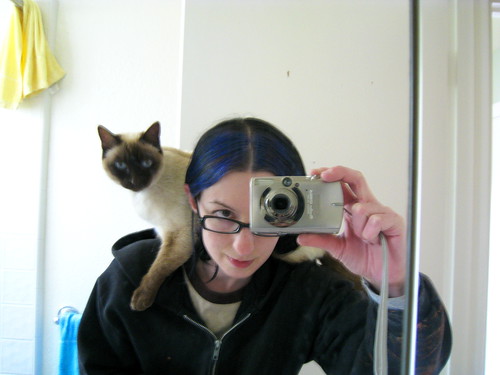
She has a certain air of ruthlessness about her (though is definitely not "mean"). She gives off a tremendous impression of having a whole lot of terribly important work to do (and I do actually believe she does, in cat terms, which are not terms to be taken lightly!). Hence she has no patience whatsoever for time-wasting frivolousness, unnecessary noise, etc. If she were human my guess would be she'd be the type people would accuse of having "no sense of humor", when really, it's just that her wit is so dry (and often dark) that people miss it even when she's being totally obvious about it.
Whereas Shadow, on the other hand, is Captain Hufflepuff all the way.
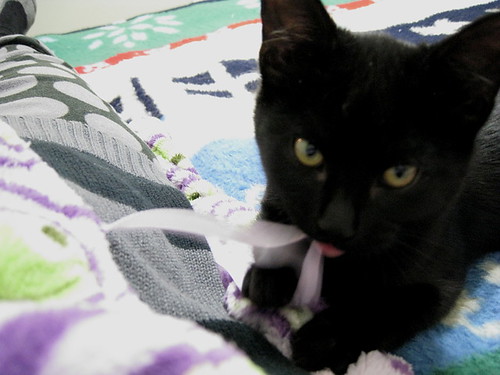
Loyal to those he trusts, presumes all other cats want to (or should want to) be his friend. Unflappable in the face of swats, hisses, and so on. Stands his ground no matter what. Energetic, easily entertained and prone to being altogether silly. If he were human he seems like he'd be sort of this very gung-ho, earnest boy-scout sort of guy (think Russell from the film 'Up').
Nevertheless, both these very different kitties definitely share the whole "Come quick! Timmy's fallen in the well! quality that is apparently a "Beta" thing.
They're both very vocal, and lately it's been the two of them howling at my bedroom door (which is a "no kitty zone" at night, per Matt's desire not to have his sensitive bits pounced on by 30-plus pounds of crepuscular athletics-team) at 5 in the morning. They both share the habit of following me from room to room when they want something (and sitting outside the door yelling at me when I'm in the bathroom).
They are also both highly adept at figuring out how to communicate with the ape contingent -- as in, if their first attempt doesn't visibly get my attention, they will amp up the volume, and if that doesn't work, they will move on to physical reminders (Nikki will jump up onto my shoulder, Shadow will attempt to climb up my pants leg!). And so on.
Overall, while again you'd never mistake one for the other character-wise (Shadow is about as silly as Nikki is serious, for one thing), I definitely see significant aspects of both of them in the "beta" description.
As for Coraline, she is so Alpha (and a Ravenclaw, all the way).
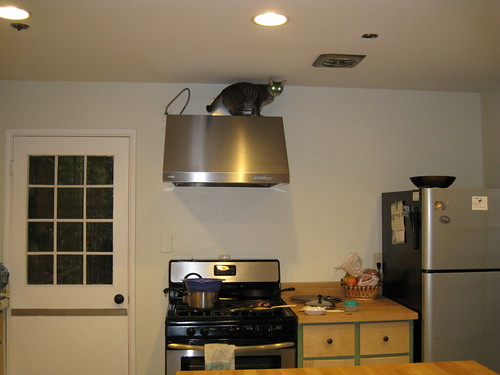
Ever since she was a tiny kitten, she's given off this incredible sense of what I would call "gears turning constantly in her head". She plans things. If she were a cartoon character, she'd be the one always saying, "According to my calculations...".
She's always been patient and careful (yet bold at the same time), and highly attuned to how she might employ objects in her environment to her advantage (or in the service of her entertainment). She's not so much into persuading humans to do her bidding so much as getting things done herself (though she can certainly be very persuasive when it suits her!).
In other words, Cora (as a baby) was the one escaping from the kitten-pen, hiding in the bookshelves, climbing part-way up the chimney (I kid you not), working her way through every cardboard-and-tape assembly I employed to keep the kittens out from under the bed (when they were teeny and feral I had to give them medication for their coccidia parasite infections, and it was this ridiculous ordeal to catch them if they got under the bed -- but eventually I just gave up and dealt with the ridiculous ordeal because, short of sealing up the space with concrete, I could not figure out an adequate barrier design), and tearing individual paper towels off the roll to make herself neat little sleeping-mats under the bed.
She has since "graduated" to such feats as jumping at door handles (she knows exactly what they are for and how they work -- it seems to be only a lack of opposable thumbs that thwarts her in using them), scaling every vertical structure in the house (and getting to places I never expected to see a cat, such as the top of the stove's fume hood!), caching favorite toys under the rug, pulling my sweaters off their hangers and into the laundry basket (which she has claimed as a DIY cat-bed) and so on. So yeah. I would honestly only be half surprised to come home and find her using my computer to order "supplies" (fish, explosives, jet-packs, etc.) via the Internet.
And then there's Brodie.
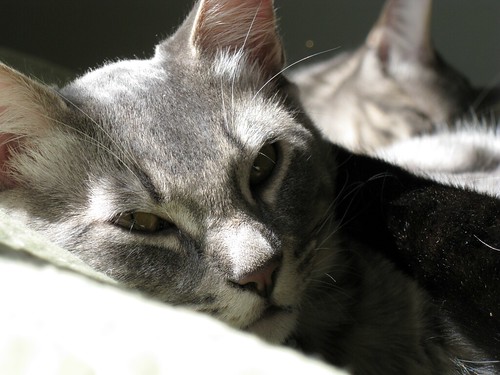
While he looks nothing like any of the "Gamma-associated" breeds (Persian, Birman, etc.) listed in the aforementioned article -- if anything, as a feral-born mutt, he resembles a short-haired variant of Maine Coon crossed with an Oriental Shorthair -- his overall bearing is very much along the lines of what I'd definitely term "sweet" (though I don't mean that in a patronizing or infantilizing sense at all).
He also has this quality of seeming to sort of...fade into the background, for lack of a better phrase. It's not like I ever forget he's there, it's just that he generally isn't making a point of announcing his presence constantly. He reminds me a little bit of my brother Paul (I actually have four younger siblings; Paul is closest in age to me), who has a similarly "unobtrusive" character about him. If Brodie were a child attending school, he would be one of the quiet kids in the back of the class who just sort of did his work and was described as "no trouble" -- despite being perfectly capable of the occasional bit of mischief! He also has the (apparently) "Gamma" trait of being initially shy, but extremely affectionate once he knows and trusts you.
Oh, and the bit in the article about how you (meaning you, human) need to be the one to make time for [GammaKitty] is definitely true in Brodie's case. He is quite content to nap off in a corner somewhere for hours (the unobtrusiveness thing again), but if I go find him, pet him a bit, and then walk off somewhere else and sit down, he will more than likely come find me in a matter of minutes, mew at me, jump up, and settle into my lap and purr for as long as I'm willing to sit there.
(Hogwarts-wise he'd be a Gryffindor of the Neville Longbottom variety, in the sense that a lot of people might wonder what he's doing there at first, but then when it really comes down to taking a stand, he astounds people.)
...so, yeah, I definitely live with a very interesting mix of feline characters here. I know I am very lucky that they all get along reasonably well, as it's always such a crap-shoot (thankfully not a literal one in our case -- everyone here is great about litterbox use) bringing a group of small carnivores together under one roof. And I also feel privileged to have this opportunity to watch a very particular group of individuals each seeing, feeling, and generally experiencing life and reality in his or her own way, thus helping do justice to an amazing universe containing far too much for any one person to possibly perceive, let alone comprehend.
Ahem. Anyway. Where was I?
Ah yes. Cats!
I recently read an article describing three types of cat personalities, nominally Alpha, Beta, and Gamma. Which, in this parlance, do not imply hierarcical designations (such as would be the case in wolf or dog packs), have nothing to do with fraternities, and do not in any way refer to the dysfunctional socio-eugenics structuring as described in Huxley's Brave New World.
Rather, the article describes the three cat types thusly:
Alpha cats are the mad scientists of the cat world.
They want to manipulate their environment to suit them. Their lack of thumbs is the only factor keeping them from World Domination. That, and those naps.
Alphas are marvelous cats, but they are not for everyone. As kittens, they are the reason china cabinets have doors and kitchen cabinets have baby locks. If something can be opened, unfastened, switched, rearranged, or button pressed, it was an Alpha who did it. Their boundless curiosity and free running intelligence is fastened on their reason for being; experimentation. If a thing does interesting stuff when dumped in the water dish, it will be dumped in the water dish.(...)
Beta cats see us [humans] as the way to get their environment the way they want it. So they are great talkers, or if not, big on the "Lassie Move" where they catch your attention and try to get you to follow them to the object of interest...
...Betas love companionship, whether it be respectful dogs or properly coached children. They are the most likely cat to meet strangers [note: not true in Shadow's case, but I can see it becoming true as he gets older and more confident], especially if the guests are sensible enough to admire them. If your business needs a "greeter cat," look for a Beta. This outgoing quality makes them especially easy to care for, because if the food dish is getting low or the litter box isn't being kept up, you will know about it right away. Always be swift to correct problems, and Betas will shower you with love and attention in return.
Gamma cats are sweet and mellow. They are somewhat shy, but once their trust is won, they love affection and have winning little ways.
They always have time for you. The challenge of the Gamma is not immediately apparent. You must make time for them.
Gammas are teddy bears, so deferential and unassuming that they will not assert themselves except in an emergency. It's up to you, as a responsible Gamma owner, to keep tabs on them, making sure the water bowl is fresh, and the food keeps coming.
(Note: I've only quoted partially from each section in the linked article -- hopefully this puts things here in accordance with copyright etiquette).
So, while there are aspects of these descriptions that certainly do not apply to my kitties, roughly, when reading the article I found myself figuring Nikki and Shadow to be Betas, Coraline to be an Alpha, and Brodie to be a Gamma. (And when I later described the article to Matt, he agreed with my sorting results).
It is interesting to think about the felines-in-residence in this way in part because these Alpha-Beta-Gamma designations, frivolous and unscientific as they may be, do sort of bring out patterns I might not have noticed otherwise. I actually nearly laughed out loud this morning when I was preparing breakfast for the feline lot, whilst noting that:
- Cora had jumped up onto the counter and was trying to get the food straight out of the can, before I'd even had the chance to distribute it onto individual dishes,
- Brodie was sitting over on the kitchen cat-platform thing, looking proper-as-you-please and waiting quietly,
- Shadow was weaving around my legs, looking up at me periodically, and meowing, and
- Nikki was likewise yelling at me from the patio (as she could see what was going on re. the can of food I had open in the kitchen)
Hee. So yeah. Again, totally silly, frivolous, unscientific, but interesting and funny nonetheless. E.g., Shadow and Nikki are very different people; they have unique demeanors, interests, priorities, and so on.
In Hogwarts terms, for instance, Nikki would almost certainly be a (non-evil!) Slytherin.
She has a certain air of ruthlessness about her (though is definitely not "mean"). She gives off a tremendous impression of having a whole lot of terribly important work to do (and I do actually believe she does, in cat terms, which are not terms to be taken lightly!). Hence she has no patience whatsoever for time-wasting frivolousness, unnecessary noise, etc. If she were human my guess would be she'd be the type people would accuse of having "no sense of humor", when really, it's just that her wit is so dry (and often dark) that people miss it even when she's being totally obvious about it.
Whereas Shadow, on the other hand, is Captain Hufflepuff all the way.
Loyal to those he trusts, presumes all other cats want to (or should want to) be his friend. Unflappable in the face of swats, hisses, and so on. Stands his ground no matter what. Energetic, easily entertained and prone to being altogether silly. If he were human he seems like he'd be sort of this very gung-ho, earnest boy-scout sort of guy (think Russell from the film 'Up').
Nevertheless, both these very different kitties definitely share the whole "Come quick! Timmy's fallen in the well! quality that is apparently a "Beta" thing.
They're both very vocal, and lately it's been the two of them howling at my bedroom door (which is a "no kitty zone" at night, per Matt's desire not to have his sensitive bits pounced on by 30-plus pounds of crepuscular athletics-team) at 5 in the morning. They both share the habit of following me from room to room when they want something (and sitting outside the door yelling at me when I'm in the bathroom).
They are also both highly adept at figuring out how to communicate with the ape contingent -- as in, if their first attempt doesn't visibly get my attention, they will amp up the volume, and if that doesn't work, they will move on to physical reminders (Nikki will jump up onto my shoulder, Shadow will attempt to climb up my pants leg!). And so on.
Overall, while again you'd never mistake one for the other character-wise (Shadow is about as silly as Nikki is serious, for one thing), I definitely see significant aspects of both of them in the "beta" description.
As for Coraline, she is so Alpha (and a Ravenclaw, all the way).
Ever since she was a tiny kitten, she's given off this incredible sense of what I would call "gears turning constantly in her head". She plans things. If she were a cartoon character, she'd be the one always saying, "According to my calculations...".
She's always been patient and careful (yet bold at the same time), and highly attuned to how she might employ objects in her environment to her advantage (or in the service of her entertainment). She's not so much into persuading humans to do her bidding so much as getting things done herself (though she can certainly be very persuasive when it suits her!).
In other words, Cora (as a baby) was the one escaping from the kitten-pen, hiding in the bookshelves, climbing part-way up the chimney (I kid you not), working her way through every cardboard-and-tape assembly I employed to keep the kittens out from under the bed (when they were teeny and feral I had to give them medication for their coccidia parasite infections, and it was this ridiculous ordeal to catch them if they got under the bed -- but eventually I just gave up and dealt with the ridiculous ordeal because, short of sealing up the space with concrete, I could not figure out an adequate barrier design), and tearing individual paper towels off the roll to make herself neat little sleeping-mats under the bed.
She has since "graduated" to such feats as jumping at door handles (she knows exactly what they are for and how they work -- it seems to be only a lack of opposable thumbs that thwarts her in using them), scaling every vertical structure in the house (and getting to places I never expected to see a cat, such as the top of the stove's fume hood!), caching favorite toys under the rug, pulling my sweaters off their hangers and into the laundry basket (which she has claimed as a DIY cat-bed) and so on. So yeah. I would honestly only be half surprised to come home and find her using my computer to order "supplies" (fish, explosives, jet-packs, etc.) via the Internet.
And then there's Brodie.
While he looks nothing like any of the "Gamma-associated" breeds (Persian, Birman, etc.) listed in the aforementioned article -- if anything, as a feral-born mutt, he resembles a short-haired variant of Maine Coon crossed with an Oriental Shorthair -- his overall bearing is very much along the lines of what I'd definitely term "sweet" (though I don't mean that in a patronizing or infantilizing sense at all).
He also has this quality of seeming to sort of...fade into the background, for lack of a better phrase. It's not like I ever forget he's there, it's just that he generally isn't making a point of announcing his presence constantly. He reminds me a little bit of my brother Paul (I actually have four younger siblings; Paul is closest in age to me), who has a similarly "unobtrusive" character about him. If Brodie were a child attending school, he would be one of the quiet kids in the back of the class who just sort of did his work and was described as "no trouble" -- despite being perfectly capable of the occasional bit of mischief! He also has the (apparently) "Gamma" trait of being initially shy, but extremely affectionate once he knows and trusts you.
Oh, and the bit in the article about how you (meaning you, human) need to be the one to make time for [GammaKitty] is definitely true in Brodie's case. He is quite content to nap off in a corner somewhere for hours (the unobtrusiveness thing again), but if I go find him, pet him a bit, and then walk off somewhere else and sit down, he will more than likely come find me in a matter of minutes, mew at me, jump up, and settle into my lap and purr for as long as I'm willing to sit there.
(Hogwarts-wise he'd be a Gryffindor of the Neville Longbottom variety, in the sense that a lot of people might wonder what he's doing there at first, but then when it really comes down to taking a stand, he astounds people.)
...so, yeah, I definitely live with a very interesting mix of feline characters here. I know I am very lucky that they all get along reasonably well, as it's always such a crap-shoot (thankfully not a literal one in our case -- everyone here is great about litterbox use) bringing a group of small carnivores together under one roof. And I also feel privileged to have this opportunity to watch a very particular group of individuals each seeing, feeling, and generally experiencing life and reality in his or her own way, thus helping do justice to an amazing universe containing far too much for any one person to possibly perceive, let alone comprehend.
Subscribe to:
Posts (Atom)
