Showing posts with label attitudes. Show all posts
Showing posts with label attitudes. Show all posts
Wednesday, May 30, 2012
Figuring out why (when it isn't immediately obvious)
One thing that makes living with cats especially interesting is the way they generally have a reason for everything they do, but not necessarily one that their humans can immediately perceive (if we're even capable of perceiving it).
That said, a lot of what cats do makes sense to me. I can identify with them a fair bit, especially when it comes to things like needing to carefully explore a new area before I can be comfortable there. I also have relatively hyperacute hearing (for a human) and therefore don't tend to find it remotely strange or offputting when a cat runs to hide under the bed in response to a sudden loud noise, etc.
Still, none of this means that it is always or instantly obvious to me why a cat does a particular thing. I am not a Cat Whisperer and I don't tend to trust anyone who claims to be. More often than not, when I have managed to figure something out that seems random or inexplicable at first, it's because I've happened upon a bit of evidence that shifts my brain into considering the situation from a more feline-focused perspective.
Case in point: the other night Shadow seemed to be attacking Cora in a manner that went beyond their usual vigorous play-wrestling. Cora, meanwhile, was slinking around the living room with her tail down and her eyes wide, both of which suggested to me that she was very anxious. And they were both running back and forth across the house to stare out different windows.
I was, needless to say, a bit alarmed and ended up separating them into different rooms at one point in the hopes that this would calm them both down. This is not something I have to do often, as none of the cats here are in the habit of going after their housemates in a manner that seems liable to cause injury, but something about this situation seemed "funny", and not in a humorous way.
Thankfully the siblings did actually eventually settle down, but not until after I'd already had to get out of bed once the same evening to disrupt another bout of epic SCREAMCHASEGRABSNARLing. They were better, if a bit jumpy, the next morning, so I chalked it up to "one of those random cat things" and went about my morning business.
In the course of this, however, I happened to go out the kitchen door to dump some coffee grounds into the compost pile. I looked down at the outside of the door and suddenly everything made sense. There is no mistaking the smell (or appearance, if you know what to look for) of cat spray, and lo and behold, it turned out that some neighborhood interloper had apparently paid a recent visit. More to the point, the bottom exterior of the kitchen door was covered with a fine, stinky, sticky mist of feline urine.
Spraying the HOUSE of another cat, particularly a territorially significant part of the house -- like a door -- is an extremely aggressive act. It's no wonder Shadow was so upset! He must have been able to see the other cat outside despite it being too dark for me to make anything out when I looked, and he sure as heck would have smelled the spray long before I did. In other words, beating up his sister wasn't personal; it was redirected aggression since he couldn't get at the offending neighbor-cat encroaching on his space.
Needless to say, the door got a thorough dousing with enzyme cleaner as soon as I realized what had happened. And I am pleased to report that the household has since returned to baseline, with Cora and Shadow having resumed their normal harmonious (if somewhat competitive) sibling relationship. The enzyme spray should help remove any residual anxiety-promoting pheromones, but you can bet I will be on the lookout for the "invader" and if necessary will set something up to deter him or her (I'm thinking maybe a pan of water in front of the back door).


Monday, November 28, 2011
In Which Cora And Shadow Join Forces
Coraline and Shadow are definitely both very high-energy cats. In Coraline's case this has been apparent since she was tiny. Shadow, however, has taken over a year to get to the point of enough confidence in his environment to really express the extent of his exuberant nature. He's still Brodie's favorite snuggle-buddy, of course, and can nap like a pro when he finally manages to wear himself out -- but that can take a while!
Accordingly (and much to my delight), he and Cora have actually become much more closely bonded over the past few months. As some may recall, Coraline and Brodie were actually adopted three weeks before Shadow simply due to the uncertainty inherent in trapping from a feral colony.
Brodie and Shadow got along famously from the moment the brothers were re-united, but Cora spent the first few weeks after her briefly-estranged sibling's arrival hissing and growling at him whenever he entered her sight. Eventually she came to accept him, but for ages she and Shadow were both closer friends with Brodie than with each other. Now, though, I'm seeing something different in shape but equal in (positive) magnitude developing between this particular sibling pair.

(Above image - Cora surveys the yard this past weekend, when I let her and Shadow out to run around a bit while I worked on my laptop on the patio.)
Brodie remains the go-to sibling for cuddles and free ear-washing (and the occasional but vigorous round of CHASEWRESTLEGRR, which even cats of the Garfield persuasion enjoy sometimes) but Cora has definitely gotten to the point where she knows that if she needs a partner in mischief or someone to tear randomly around the house with, Shadow is her guy.
It's also been neat seeing these two teach each other things. Cora has always been the most mechanically inclined and apt to experiment with objects of her own accord, while Shadow took months longer than either of his siblings to get to where he'd (for instance) bat treat-puzzle balls around just-so to dispense the crunchies within. It wasn't that he lacked the brainpower to operate the treat puzzles -- he's just always had the natural predisposition toward persuading others to do things for him (a trait he actually shares with Nikki).
Lately, though, he seems to have come around to the idea that there are some things he can better accomplish without running immediately to ask for help. E.g., he's become quite the expert at opening any door that isn't latched, and has managed to sneak into the bedroom behind me quite a few times recently!
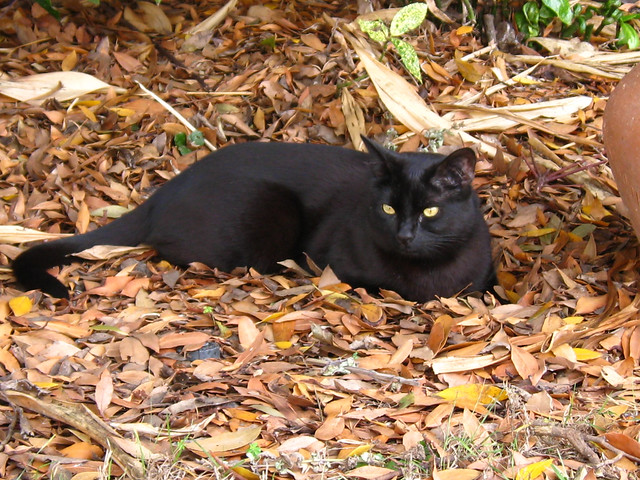
(Above image - Shadow rests a while in the leaves after a vigorous game of Garden Tag with Cora. None of the kitties here have unrestricted outdoor access but on nice days these two really appreciate a chance to run off some of their energy in the back garden.)
Cora, in turn, seems to have experienced something of an epiphany in the opposite direction, as she seems to have become a lot more vocal all of a sudden, and has even adopted some of Shadow's "super secret weapons of human persuasion" (such as what I refer to as the "kittens of the damned stare" in addition to the "Lassie move" where the cat basically orders the human into a different part of the house and looks pointedly at the thing they're interested in, which in Cora's case is usually the back door!).
Of course both of these kitties have maintained their innate inclinations toward Explorer/Engineer (Cora) and Mr. Charisma (Shadow), but it's abundantly apparent that their growing friendship has led to a really neat expansion of both of their respective skill-sets. Which is just super cool to see.
Accordingly (and much to my delight), he and Cora have actually become much more closely bonded over the past few months. As some may recall, Coraline and Brodie were actually adopted three weeks before Shadow simply due to the uncertainty inherent in trapping from a feral colony.
Brodie and Shadow got along famously from the moment the brothers were re-united, but Cora spent the first few weeks after her briefly-estranged sibling's arrival hissing and growling at him whenever he entered her sight. Eventually she came to accept him, but for ages she and Shadow were both closer friends with Brodie than with each other. Now, though, I'm seeing something different in shape but equal in (positive) magnitude developing between this particular sibling pair.
(Above image - Cora surveys the yard this past weekend, when I let her and Shadow out to run around a bit while I worked on my laptop on the patio.)
Brodie remains the go-to sibling for cuddles and free ear-washing (and the occasional but vigorous round of CHASEWRESTLEGRR, which even cats of the Garfield persuasion enjoy sometimes) but Cora has definitely gotten to the point where she knows that if she needs a partner in mischief or someone to tear randomly around the house with, Shadow is her guy.
It's also been neat seeing these two teach each other things. Cora has always been the most mechanically inclined and apt to experiment with objects of her own accord, while Shadow took months longer than either of his siblings to get to where he'd (for instance) bat treat-puzzle balls around just-so to dispense the crunchies within. It wasn't that he lacked the brainpower to operate the treat puzzles -- he's just always had the natural predisposition toward persuading others to do things for him (a trait he actually shares with Nikki).
Lately, though, he seems to have come around to the idea that there are some things he can better accomplish without running immediately to ask for help. E.g., he's become quite the expert at opening any door that isn't latched, and has managed to sneak into the bedroom behind me quite a few times recently!
(Above image - Shadow rests a while in the leaves after a vigorous game of Garden Tag with Cora. None of the kitties here have unrestricted outdoor access but on nice days these two really appreciate a chance to run off some of their energy in the back garden.)
Cora, in turn, seems to have experienced something of an epiphany in the opposite direction, as she seems to have become a lot more vocal all of a sudden, and has even adopted some of Shadow's "super secret weapons of human persuasion" (such as what I refer to as the "kittens of the damned stare" in addition to the "Lassie move" where the cat basically orders the human into a different part of the house and looks pointedly at the thing they're interested in, which in Cora's case is usually the back door!).
Of course both of these kitties have maintained their innate inclinations toward Explorer/Engineer (Cora) and Mr. Charisma (Shadow), but it's abundantly apparent that their growing friendship has led to a really neat expansion of both of their respective skill-sets. Which is just super cool to see.
Monday, September 6, 2010
Cat Cognition Capers: Knocking Stuff Over Edition
Cross-posted from Existence is Wonderful
(A sort-of followup to Cats, Dogs, Strings, and Causality and A Small, Informal Cat Cognition Experiment)
Recently I tried looking up studies and/or scholarly articles on the phenomenon of Cats Knocking Things Over, but didn't come up with any interesting results. The majority of writing on this subject seems to be in the context of advice on "cat behavior problems", e.g., Dealing With Cats That Knock Things Down, How can I get my cat to stop knocking stuff over?, etc.
(Of course, if anyone has any links to papers on this subject please feel free to share!)
But anyway. It occurred to me, upon seeing Shadow (one of three ex-feral littermates sharing my home) push a container of cat treats off my desk for the nth time earlier today, that (if it was indeed being done deliberately) such an action might represent a fairly well-developed understanding of certain physical principles. I.e., the fact that if one cannot readily access the contents of a treat-containing object, one might be able to gain access via utilizing the tendency of objects to fall over when pushed or similarly manipulated.
(Full disclosure: as a person on the autistic spectrum who is also interested in neuroscience and relevant cognitive research, I must admit it tends to catch my attention whenever I encounter what to me looks like an interesting ability or trait, in any species, being largely written off as a "behavior problem". Often it seems to me something is being missed when this occurs, so I'm driven to investigate in situations like this!)
Certainly the standard "I am not a professional researcher, this was all done completely informally, my home is not a laboratory, etc." disclaimer must be applied to these results. Moreover, I am well aware that interpretation is not data (and vice versa), and in truth the only thing that can be said for sure is that at least one of my cats pretty consistently knocks over objects when is is conceivable that he has reason to believe these objects could contain treats.
The following three videos appear in chronological order. All were filmed on 5 September 2010, in the afternoon, within the space of maybe twenty minutes.
In this first video ("Cats and Gravity I"), Shadow is shown pushing a sealed container of treats off my desk.
He had precedent for doing this, as this particular container is the usual one I put the kitties' daily allotment of treats in. Once, about a week ago, I left the lid part-way off, to see what he would do (seeing as he'd definitely be able to smell the treats within). And in that case he proceeded to nudge the container around with his nose until it fell off the table, scattering treats hither and thither, much to his and his siblings' delight.
Now, I am fairly certain that this first knockdown was an accident. However, since then, Shadow has pushed the treat container off multiple other surfaces (besides the coffee table), on multiple separate occasions. "Cats and Gravity I", then, seems like it could very well represent Shadow's having learned that "if I push this container, sometimes treats fall out!" I don't know that anyone in the cognitive research field actually believes this level of reasoning is beyond the domestic feline (I suspect not) but in any event, it makes for a good "baseline" data point in terms of the variables I am interested in observing.
In this next video ("Cats and Gravity II"), we have an interesting situation involving three cats. You may remember Coraline and Brodie from all those string and zip-tie trials I ran as a rough check of what experimental design conditions might be improved so that cats could better demonstrate their actual cognitive capacities in string-pulling tasks. In the case of that set of puzzles, Cora and Brodie were the only participating felines; Shadow preferred to simply watch.
However, in "Cats and Gravity II", you will observe that Brodie "experiments" with the treat-containing bottle but doesn't succeed in getting anything out of it, whereas Shadow makes one single decisive swipe and sends the thing crashing down. Note that this bottle is different from the treat container in the first video, but it is one that I've put treats in several times prior to this, so the cats would definitely be familiar with it.
(Coraline, meanwhile, is ignoring the whole business and seems more excited about the fact that I've gotten up from my computer chair, giving her an opening to steal it. To me this mainly suggests that at different points in time, different cats may have very different priorities!)
And then we come to "Cats and Gravity III". The outcome of this scenario completely caught me off guard (you may even be able to hear me exclaim "HOLY CRAP!" at one point). In this case I took a treat container that would be new to all the cats (another empty vitamin bottle, this time a dark purple one slightly larger than the white one used in "Cats and Gravity II"). I let them watch me putting treats into it, and then placed this bottle on top of a small end table in the living room (a different surface in a different part of the house than my desk, to control for position habit).
In this case, the video shows that initially none of the cats really showed interest in the new treat bottle when I first placed it on the end table. However, after I went over and shook it a bit, Shadow went over to the table, put his front paws on the top surface, and then proceeded to lift the bottle up with his mouth and throw it down onto the floor. (That's where I exclaimed "HOLY CRAP!", by the way.)
So...what to make of this?
Subjectively speaking (yes, I'm about to offer an interpretation), it looked to me like Shadow spontaneously came up with a really creative way of getting the treats he knew were inside the purple bottle. Which would suggest that he's learned to generalize beyond "if I paw at this maybe it will fall and treats will come out" and now understands that it is not the mechanical motion of pawing or nosing that's important, but rather, the falling of the bottle itself, if one's goal is to get the treats out of the bottle. This, to me, seems pretty significant, and again I'm curious to know if there's any literature out there saying one thing or another about this type of cognition in felines.
However, this was of course a tiny sample set. And I did not do this series of "mini-trials" in response to another study I'd be able to cite and/or comment on -- like I said at the beginning, I couldn't find any studies about cats knocking stuff over. No peer-reviewed references = not "ResearchBlogging". Plus, for all I know, cats' understanding of gravitational cause-and-effect is already well documented and known and I just fail at searching for this documentation.
That said, at the very least, I think anyone who really wants to study cats' understanding of cause-and-effect as it pertains to objects in a broader sense would do well to try out a variety of different scenarios involving different types of objects, and requiring different types of attentiveness and planning on the cats' part.
I find it terribly problematic (and this goes back to my discussion of the string experiments again) when a single particular test is taken (whether by the study authors, the media, or both) as meaning something globally significant about a given population's abilities or lack thereof. In the absence of a single task (or task type) with huge amounts of existing data backing up its ability to test "general" cognitive ability in a given domain, multiple tasks of varying attributes would seem to me required for appropriate levels of rigor.
Also, I have to say that another reason I wanted to post these videos is because now more than ever I am beginning to think it is very important to have as much of an experiment on record (for multiple parties to view and evaluate) as possible. Even though I (hopefully) disclaimered the heck out of my string experiments, I still would rather do things as close to "right" as possible for a layperson -- just because I'm not a real researcher doesn't mean I can't practice holding my informal stuff to higher standards.
Finally, I would just like to say that I would be extremely interested to get people's comments on what it looks like is actually happening in the videos above. As in, if you think Shadow is doing what he's doing deliberately, what aspects of his actions lead you to think that? I'm curious about this because I see my cats doing all sorts of things all the time, some of which (to me) look "deliberate", whereas other things they do look thoroughly "accidental". Only I haven't come up with a good way to describe what "deliberateness" looks like in quantitative terms.
I suspect that in general this sort of issue comes up a lot in animal cognition research, which has me curious as to whether there even exists any kind of objective way to measure something so "internal". Behaviorism (in my opinion) fails miserably to account for everything that could potentially be important (for one thing it often seems to completely fail to account for, say, different sensory and perceptual modalities on the part of the researcher vs. subject), and much of what I hear from "evolutionary psychology" sounds like it's been pulled straight from someone's nether orifice, to put it politely. So I'd be really intrigued to know what other tools or paradigms may currently be out there that might be more promising.
Sunday, August 1, 2010
With Sideways Mind: On Listening To Cats
Scene: computer room, my house, around 7:30 PM this evening
Shadow (from the floor behind my chair): "YAAAAAAOW! YAAAAOW! MYOOOOOUUUU! MRRREW!"
Anne: "What?"
Shadow: "YAAAAAOW! REEEE! MIEW! MMMMM!"
Anne: "What, little guy?"
Shadow: "Nrrrrrrr. Miew. YAAAO!"
Anne (gets up from chair): "Okay, fine, Lassie, show me what you want."
Shadow: *gets up, trots into the hallway*
Anne: *follows, waits to see which direction Shadow seems to be going in*
Shadow: *heads toward kitchen*
Anne: *follows*
Shadow: *plunks self down on linoleum, looks at Anne, looks out window*
Anne: "You want me to sit down?"
Shadow: *motions in the affirmative*
***
So, I sit down, right on the linoleum (which is actually linoleum and not vinyl). Shadow proceeds to snuggle up against my leg. I hear the purr motor start going.
Seated there, I notice that there's quite a lovely breeze coming through the back screen door. The air smells fresh and carries little notes of back-yard with it: tomato leaves, pepper, dry grass. Then I look out the large window overlooking the patio.
Through the trellised semi-roof over the concrete surface next to the garden I see a huge flock of birds making their way across the sky. They're too far away for me to tell what type of bird they are; all I can see is that they're dark-colored, too small to be crows, too large to be sparrows.
Shadow and I both sit there for a while. I don't keep track of exactly how long. The birds pass in waves: one group, then another, then another. The breeze continues to blow. Shadow climbs into my lap, still purring.
Eventually, of course, I have to get up, so I do. But not before thanking Shadow.
***
Cats communicate. They may not speak (in English or any other human language) but they certainly have plenty to say. I do not claim to understand cats in general, or any specific cat, perfectly, and I find it unnerving (and often a sign of bad ethics) when any human makes such a claim.
However, in living with cats and noting the patterns of how they interact with me, with other cats, with objects in their environment, etc., I have definitely come to realize certain things about listening. Not listening with ears, per se. -- more like (and readers of Michael Ende will know what I mean here) Momo-listening.
What cats have to say can be very subtle. Shadow meows loudly and often but that is only a miniscule part of what he says. Yes, he often wants a snack, and sometimes it's clear he wants me to get one of those wand-type toys he loves and wiggle the string so he can chase the feather-tailed mouse or whatever happen to be attached. But other times he just plain surprises me.
***
The incident related above is foremost in my mind as I write this, yet it is far from isolated. I have been astounded more times than I can count at the complexity and delicacy of what my cats tell me, how their actions illustrate what they're noticing and paying attention to in the world around them.
There is just not much in the human culture with which I am most familiar (or its common vocabularies) that prepares someone for this kind of thing.
For listening to cats involves a lot of what I would call "the cognitive equivalent of peripheral vision".
It involves a lot of not as well: as in, not immediately assuming the cat just wants food, or even play, or generalized "attention". It involves not placing fixed, arbitrary limits on your idea of what cats are capable of thinking, experiencing, and doing.
This is, in part, because cats are so good at being cats, they don't actively require our approval or permission to continue doing so throughout their lives. In other words, their catness is not dependent on being judged proper or sufficent by humans; catness simply is, and cats are surely cats even when no-one is looking.
This means that a human might "keep" a cat, feed her, change her litter, pat her head and call her a good cat on occasion -- presuming the whole while that their human view of their coexistence encompasses the whole of the cat's existence and experience. When in fact nothing could be further from the truth. The truth is that only cats have subjective knowledge of what being a cat feels like, and the truth is also that cattish priorities very often differ from typical human ones.
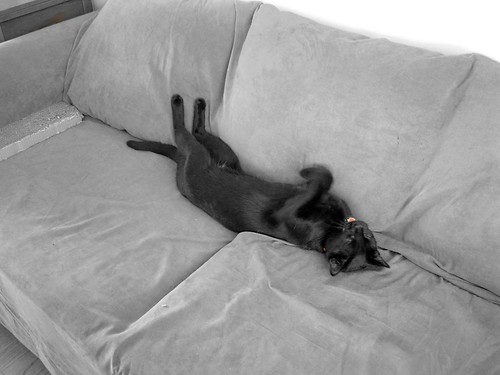
As for me, while certainly I am not a cat, I am very interested in what they have to say. I want very much for them to feel like they can show me where to sit to let a nice breeze wash over one, and where one might get to witness a dazzling display of avian migration. I want them to know that I see their priorities and interests as valid and genuine. I do not know the degree to which this will ultimately be possible, but I am sure as heck willing to keep trying my darndest to listen.
Shadow (from the floor behind my chair): "YAAAAAAOW! YAAAAOW! MYOOOOOUUUU! MRRREW!"
Anne: "What?"
Shadow: "YAAAAAOW! REEEE! MIEW! MMMMM!"
Anne: "What, little guy?"
Shadow: "Nrrrrrrr. Miew. YAAAO!"
Anne (gets up from chair): "Okay, fine, Lassie, show me what you want."
Shadow: *gets up, trots into the hallway*
Anne: *follows, waits to see which direction Shadow seems to be going in*
Shadow: *heads toward kitchen*
Anne: *follows*
Shadow: *plunks self down on linoleum, looks at Anne, looks out window*
Anne: "You want me to sit down?"
Shadow: *motions in the affirmative*
***
So, I sit down, right on the linoleum (which is actually linoleum and not vinyl). Shadow proceeds to snuggle up against my leg. I hear the purr motor start going.
Seated there, I notice that there's quite a lovely breeze coming through the back screen door. The air smells fresh and carries little notes of back-yard with it: tomato leaves, pepper, dry grass. Then I look out the large window overlooking the patio.
Through the trellised semi-roof over the concrete surface next to the garden I see a huge flock of birds making their way across the sky. They're too far away for me to tell what type of bird they are; all I can see is that they're dark-colored, too small to be crows, too large to be sparrows.
Shadow and I both sit there for a while. I don't keep track of exactly how long. The birds pass in waves: one group, then another, then another. The breeze continues to blow. Shadow climbs into my lap, still purring.
Eventually, of course, I have to get up, so I do. But not before thanking Shadow.
***
Cats communicate. They may not speak (in English or any other human language) but they certainly have plenty to say. I do not claim to understand cats in general, or any specific cat, perfectly, and I find it unnerving (and often a sign of bad ethics) when any human makes such a claim.
However, in living with cats and noting the patterns of how they interact with me, with other cats, with objects in their environment, etc., I have definitely come to realize certain things about listening. Not listening with ears, per se. -- more like (and readers of Michael Ende will know what I mean here) Momo-listening.
What cats have to say can be very subtle. Shadow meows loudly and often but that is only a miniscule part of what he says. Yes, he often wants a snack, and sometimes it's clear he wants me to get one of those wand-type toys he loves and wiggle the string so he can chase the feather-tailed mouse or whatever happen to be attached. But other times he just plain surprises me.
***
The incident related above is foremost in my mind as I write this, yet it is far from isolated. I have been astounded more times than I can count at the complexity and delicacy of what my cats tell me, how their actions illustrate what they're noticing and paying attention to in the world around them.
There is just not much in the human culture with which I am most familiar (or its common vocabularies) that prepares someone for this kind of thing.
For listening to cats involves a lot of what I would call "the cognitive equivalent of peripheral vision".
It involves a lot of not as well: as in, not immediately assuming the cat just wants food, or even play, or generalized "attention". It involves not placing fixed, arbitrary limits on your idea of what cats are capable of thinking, experiencing, and doing.
This is, in part, because cats are so good at being cats, they don't actively require our approval or permission to continue doing so throughout their lives. In other words, their catness is not dependent on being judged proper or sufficent by humans; catness simply is, and cats are surely cats even when no-one is looking.
This means that a human might "keep" a cat, feed her, change her litter, pat her head and call her a good cat on occasion -- presuming the whole while that their human view of their coexistence encompasses the whole of the cat's existence and experience. When in fact nothing could be further from the truth. The truth is that only cats have subjective knowledge of what being a cat feels like, and the truth is also that cattish priorities very often differ from typical human ones.
As for me, while certainly I am not a cat, I am very interested in what they have to say. I want very much for them to feel like they can show me where to sit to let a nice breeze wash over one, and where one might get to witness a dazzling display of avian migration. I want them to know that I see their priorities and interests as valid and genuine. I do not know the degree to which this will ultimately be possible, but I am sure as heck willing to keep trying my darndest to listen.
Monday, July 5, 2010
Not Just About The Food
Over at Way Of Cats, there is a post entitled The Meaning of Mealtime. I really like this post; it very closely matches my own sentiments on the subject, which is to say that like the author, I am really irked when people go around saying things like "oh, cats only [seem to] love you because you're a food source". Quoting briefly:
The key thing here for me is the bit about cats' interest in relationships (with humans, or with other cats or animals for that matter) not being dependent on their 'dependence'. I ran into this notion a lot back when I first adopted Coraline, Brodie, and Shadow. Since they were born and raised completely feral (no human contact or handling) until the day I took them home with me from their outdoor colony I knew they would not be snuggling up into my lap right away (or possibly ever). Which of course I was fine with. My main priority in adopting them was to give them a home they could thrive and be happy in.
So, I read a lot about feral kittens, hoping to get some guidelines that could help me figure out how to provide them with a place they felt safe and comfortable in. A lot of these resources were helpful in many ways. However, one thing I found a little unnerving about even some very practical "Kitten Socialization Guidelines" was the way they all seemed to suggest that you had to sort of bribe the kittens with food in order to "tame" them.
Something about that just rubbed me the wrong way, so to speak. I have never liked the concept of "taming" in the first place, at least not to the extent that it implies submission. I am painfully aware I have a lot of power over my cats, but this is not something I enjoy. Consequently I would feel very uncomfortable "taking credit" for their current or future human-friendliness (which varies according to the individual cat, the day of the week, etc.). Of course I offered the kittens food when they arrived, but this was never done in a "I'll bribe you to love me" sense. I did NOT want a bunch of cats with Stockholm Syndrome running around -- I wanted the choice to approach me or my partner or any visitors to be theirs.
So? There was definitely some "kitten socialization guidelines" I did NOT follow. I did NOT withhold food for hours and hours so they would "have" to come to me physically to eat. Initially, Coraline and Brodie did not want to eat at all unless Matt and I were either out of the room or lying in bed. I did offer them bits of baby food on a spoon between regular meals, and they varied in their responses to this, but to me this was not about getting them to "associate me with a pleasurable stimulus" but rather about sharing as a gesture of friendship. Many animals share food to demonstrate trust and friendly intentions, so this is more along the lines of what I was thinking.
As for Shadow, initially he was so scared he did not touch any food for nearly two days. When I realized he (unlike his siblings) was not eating when we were out of the room, I figured I would try hand-feeding him, as I did not want him to get liver problems or anything (which cats can get if they don't eat for too long). And in Shadow's case he actually did take food from my hand almost immediately. Matter of fact, for his first week here he would only eat off my hand, or at the very least when he could see me. It was almost as if he didn't feel safe eating unless someone else was there, and he didn't care whether that "someone" was human or feline. Whereas his siblings would eat in front of each other, but not me and Matt initially.
Anyway, that was all a bit tangential, but my point is that while nowadays I certainly see a lot of excitement at mealtime (I must upload a video of the Morning Meow Chorus soon!) it does not seem like they're just after food. Sometimes they want to play, other times they want to nap curled up with someone, and still other times they simply want to be acknowledged. And beyond these generic categories they have their own individual preferences and favorite games, etc., as well, and each has his or her own way of communicating specifics.
I encourage this, of course. I want them all to feel comfortable having their own minds and ideas about life, their own agendas. I do realize they depend on me for some things, but the idea of either trying to cultivate "dependence" (in the emotional sense) or presuming that they only would ever hang around anyone else because of said dependence fills me with a kind of sickening dread.
[This sort of thing does not just apply to food-related matters, either. Another guideline I did not follow (popular in kitten-socialization manuals) was to separate siblings "so they will be forced to depend on you" (see a theme here?).
Coraline and Brodie cried whenever they couldn't see each other during their first few weeks here, and gah, there was just no way I could ignore or disregard that. I figured they had enough stress in their lives without having to endure forced separation!
And Shadow was still with MomCat at that point, so he was not alone, and when I finally brought him home three weeks later I only kept him apart from his littermates until he'd seen the vet and gotten flea treatments, etc. (which worked out to being maybe 4 days).]
Of course there ARE times when I have used food as a tool to "get the cats to do something" -- see my last post, for instance, on tossing treats into the house in order to get a herd of escaped kitties back into the kitchen before leaving home myself. But that has nothing to do with trying to foster dependence -- but rather (in that case) with safety. Moreover, the cats had already been fed their wet food that morning, less than an hour prior to their patio excursion, so they were not starving!
We should never feel that our cats only love us at mealtimes, or have their interest in us dependent on their dependence. Cats have two reasons for being so excited about food.
One is the strong survival drive we share; food is a necessary part of living. Eating tasty food will always make them happy.
The other is that they feel we must care as much as they do.
That makes them just as happy.
The key thing here for me is the bit about cats' interest in relationships (with humans, or with other cats or animals for that matter) not being dependent on their 'dependence'. I ran into this notion a lot back when I first adopted Coraline, Brodie, and Shadow. Since they were born and raised completely feral (no human contact or handling) until the day I took them home with me from their outdoor colony I knew they would not be snuggling up into my lap right away (or possibly ever). Which of course I was fine with. My main priority in adopting them was to give them a home they could thrive and be happy in.
So, I read a lot about feral kittens, hoping to get some guidelines that could help me figure out how to provide them with a place they felt safe and comfortable in. A lot of these resources were helpful in many ways. However, one thing I found a little unnerving about even some very practical "Kitten Socialization Guidelines" was the way they all seemed to suggest that you had to sort of bribe the kittens with food in order to "tame" them.
Something about that just rubbed me the wrong way, so to speak. I have never liked the concept of "taming" in the first place, at least not to the extent that it implies submission. I am painfully aware I have a lot of power over my cats, but this is not something I enjoy. Consequently I would feel very uncomfortable "taking credit" for their current or future human-friendliness (which varies according to the individual cat, the day of the week, etc.). Of course I offered the kittens food when they arrived, but this was never done in a "I'll bribe you to love me" sense. I did NOT want a bunch of cats with Stockholm Syndrome running around -- I wanted the choice to approach me or my partner or any visitors to be theirs.
So? There was definitely some "kitten socialization guidelines" I did NOT follow. I did NOT withhold food for hours and hours so they would "have" to come to me physically to eat. Initially, Coraline and Brodie did not want to eat at all unless Matt and I were either out of the room or lying in bed. I did offer them bits of baby food on a spoon between regular meals, and they varied in their responses to this, but to me this was not about getting them to "associate me with a pleasurable stimulus" but rather about sharing as a gesture of friendship. Many animals share food to demonstrate trust and friendly intentions, so this is more along the lines of what I was thinking.
As for Shadow, initially he was so scared he did not touch any food for nearly two days. When I realized he (unlike his siblings) was not eating when we were out of the room, I figured I would try hand-feeding him, as I did not want him to get liver problems or anything (which cats can get if they don't eat for too long). And in Shadow's case he actually did take food from my hand almost immediately. Matter of fact, for his first week here he would only eat off my hand, or at the very least when he could see me. It was almost as if he didn't feel safe eating unless someone else was there, and he didn't care whether that "someone" was human or feline. Whereas his siblings would eat in front of each other, but not me and Matt initially.
Anyway, that was all a bit tangential, but my point is that while nowadays I certainly see a lot of excitement at mealtime (I must upload a video of the Morning Meow Chorus soon!) it does not seem like they're just after food. Sometimes they want to play, other times they want to nap curled up with someone, and still other times they simply want to be acknowledged. And beyond these generic categories they have their own individual preferences and favorite games, etc., as well, and each has his or her own way of communicating specifics.
I encourage this, of course. I want them all to feel comfortable having their own minds and ideas about life, their own agendas. I do realize they depend on me for some things, but the idea of either trying to cultivate "dependence" (in the emotional sense) or presuming that they only would ever hang around anyone else because of said dependence fills me with a kind of sickening dread.
[This sort of thing does not just apply to food-related matters, either. Another guideline I did not follow (popular in kitten-socialization manuals) was to separate siblings "so they will be forced to depend on you" (see a theme here?).
Coraline and Brodie cried whenever they couldn't see each other during their first few weeks here, and gah, there was just no way I could ignore or disregard that. I figured they had enough stress in their lives without having to endure forced separation!
And Shadow was still with MomCat at that point, so he was not alone, and when I finally brought him home three weeks later I only kept him apart from his littermates until he'd seen the vet and gotten flea treatments, etc. (which worked out to being maybe 4 days).]
Of course there ARE times when I have used food as a tool to "get the cats to do something" -- see my last post, for instance, on tossing treats into the house in order to get a herd of escaped kitties back into the kitchen before leaving home myself. But that has nothing to do with trying to foster dependence -- but rather (in that case) with safety. Moreover, the cats had already been fed their wet food that morning, less than an hour prior to their patio excursion, so they were not starving!
Monday, June 21, 2010
On Barn Cats
This past Saturday, Matt (my SO) and I attended his family's annual picnic. Usually these events are held at a park local to us, but this year some of Matt's mom's cousins, who live on a sizable piece of farmland about 2 hours north-ish from here, offered to host at their place. The primary crop produced by Matt's relatives on this farmland is almond trees (they've got something like 40 acres of them) but there are also a few chickens and some sheep, etc. This setting definitely made for an interesting picnic experience, but most interesting (to me) was getting to meet a whole lot of cats!
According to the farm-resident relatives, there are actually something like 40 cats (!!!) living on the property, a population consisting of about half kittens and half adult cats. I did not see all these cats personally, but I did not expect to, seeing as we were there during afternoon hours (a.k.a. naptime for kitties) and the place was huge (meaning there were lots of potential hiding and secluded sleeping spots).
The first cat I met, pictured below, is named Diamond. Matt's mom was actually holding her when Matt and I walked up to the picnic area.
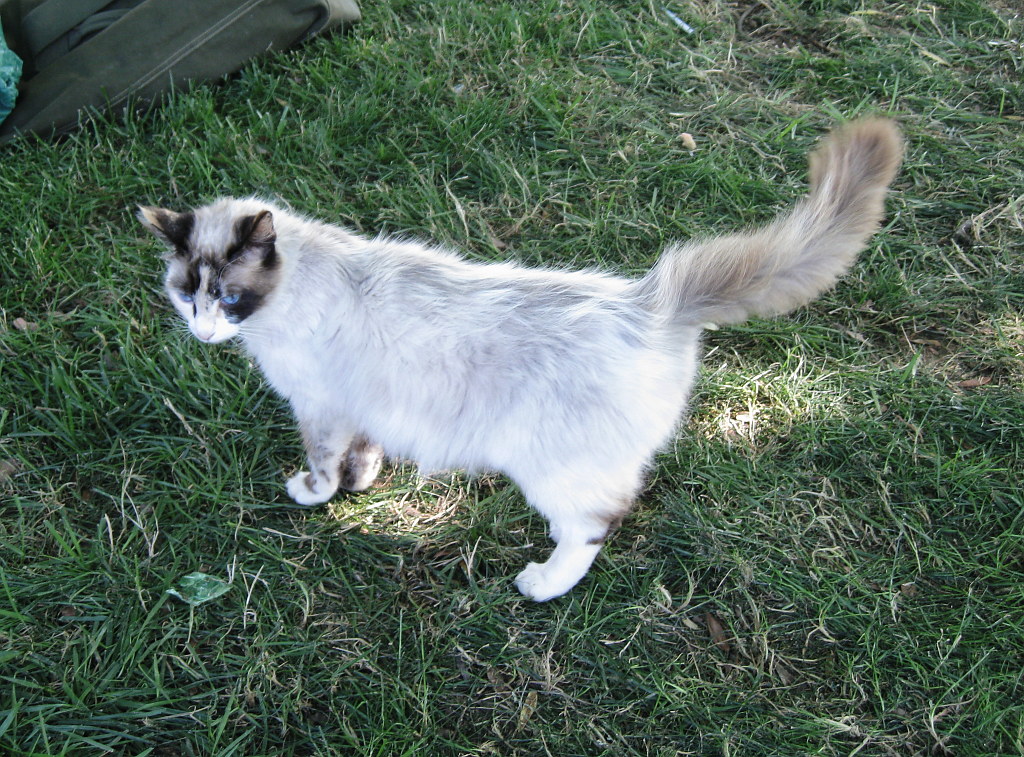
She was extremely curious, social with humans (and dogs, and other cats), and persistent -- eventually one of the younger cousins was told to go put her in the barn because she kept jumping on the picnic tables and trying to stick her nose in the chip-dip. But she got out of the barn easily. Hee. And she was also one of the most unique-looking cats I've ever seen: small (she was about a year old and probably weighed about six pounds) but with a feathery Maine Coon-ish tail, blue eyes, light-colored body, and "tortie point" coloration.
Diamond is now spayed but she did have a litter of kittens a few months ago. Matt is shown holding two of them: a little marmalade boy named OnyxTiger and a calico girl whose name I unfortunately cannot recall.

Like their mother these little ones were very sweet and inquisitive, though the girl kitten was quite a bit more adventurous. When I was holding her she sort of tried to climb up the back of my neck and probably would have ended up IN my backpack if the zipper had been open. Reminded me a lot of Cora in that regard!
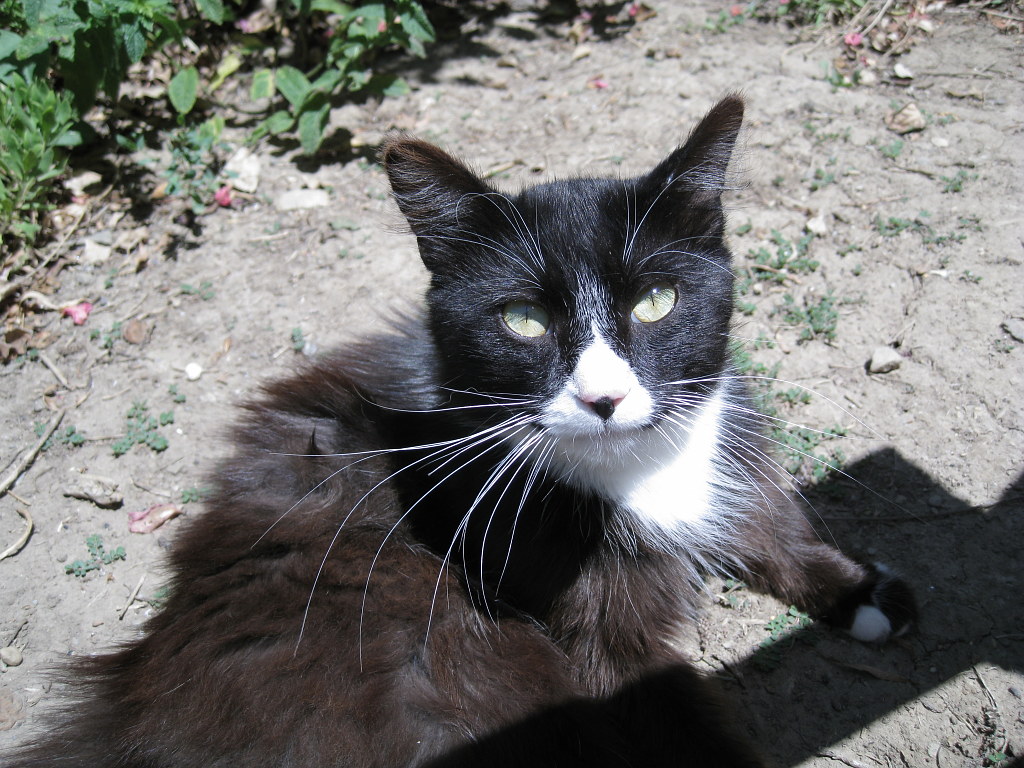
Diamond's brother Mooglu (was originally going to be "Mowgli" but the kids kept saying "Mooglu" and it stuck) was similarly curious about all the strange humans gallivanting around. He hung out and watched the festivities from the porch or front garden most of the time. He was about Diamond's size (must be a "small cat gene" in that population) and a very handsome tuxedo brownish-black-and-white.
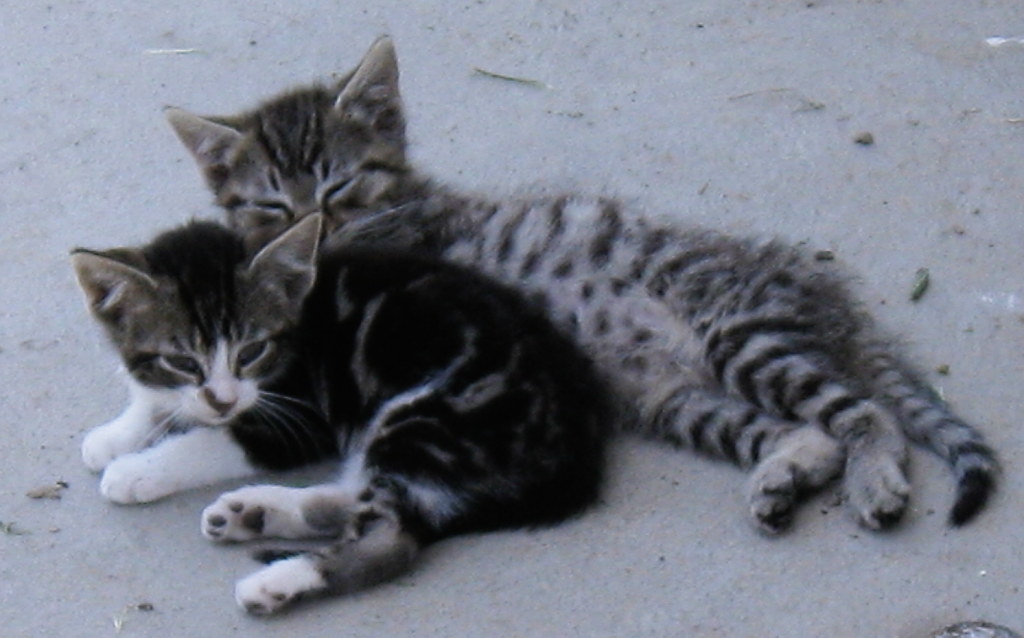
These two young kittens were lounging out by the barn most of the day. They don't have names yet.
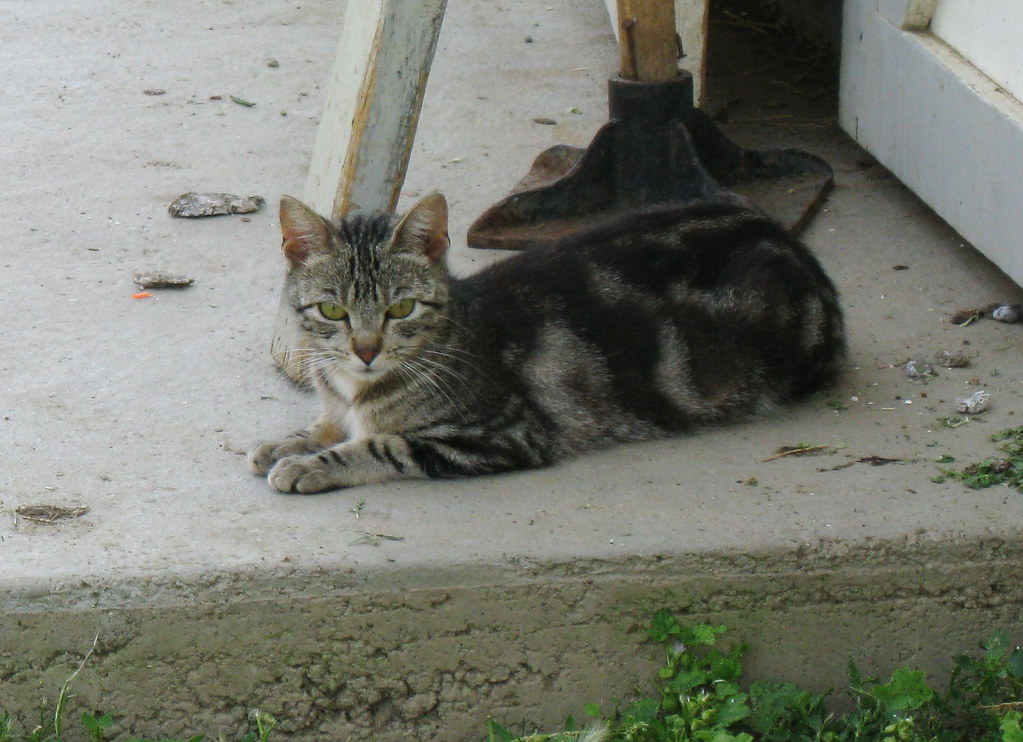
This pretty marble tabby girl is called Pocahontas.
And then there was this little grey fellow -- a very young kitten, probably no more than 3 or 4 weeks old.

When I first saw him something definitely seemed weird about the situation because it is not often you see a kitty that young without his mama. He was just sitting on one edge of the concrete platform thing at the barn entrance all by himself. I went over to let him sniff my finger (a cat greeting that is more polite, IMO, than just going up and petting them) and he did so. But when I got close to him I saw that his eyes were fused shut!
I thought at first maybe he was REALLY young and his eyes just were not open yet, however it turned out that he had some sort of eye infection that was causing his eyelids to stick. Kittens' eyes should be open by around 9 days and (tiny as he was) he was definitely older than that. I also learned that he was apparently the sole survivor of a litter that had been very sickly from the start, and that the mother kitty (who I did not see) had not been very attentive. Just as with humans, not all cats necessarily have the best parenting skills. And while Little Grey Kitten was apparently being sporadically nursed by another female cat, he was definitely not getting enough milk to thrive on. Kittens are supposed to have fat little round bellies and this little guy just felt like fur and air.
But! The day had somewhat of a happy ending for Little Grey Kitten, because another relative at the picnic (who I briefly spoke to -- she was definitely a Cat Person) got permission from the farm-folks to take him home with her, where she would be able to bottle-feed him, get him antibiotics for his eyes, etc. I really hope he pulls through, and I am SO glad there was someone else in attendance whose household cat-carrying capacity was not at its limit (as mine is with four felines-in-residence).
I would guess that most modern humans who did not grow up in farm-type settings and who've known cats primarily in the "companion" context might find the life of a barn cat to be quite unusual, perhaps even disconcerting. These are definitely not "kept" cats. They face some very harsh realities, such as the fact of being not just predators in the rural zones they inhabit, but prey for coyotes and the like. Aside from rabies vaccines, they probably rarely see the vet; sick barn cats either get better on their own or "disappear" as they succumb to illness. Most of them have a few fleas here and there, and this is not considered a big deal.
However, they have a lot more autonomy and freedom to come and go than the average house-cat. And their lifestyle certainly permits them to constantly engage in normal feline activities (hunting, territory-marking, etc.) without human interference or scolding. Some of them are spayed or neutered, of course, but not all, as (due to the aforementioned coyote predation issue) the farm-folks want to assure there are enough cats at any given time to properly deal with crop-threatening rodent pests.
Furthermore, these cats looked tremendously happy; trotting around the farm, eyes bright and sparkling, tails aloft like banners, greeting humans, dogs, and other cats alike with purrs and face-rubs. They also, aside from the aforementioned miscellaneous flea, looked to be extremely healthy: lean (but not too skinny) and glossy-furred.
Of course housecats can be, and often are, just as happy and healthy. Most will not wander far even if allowed outside, and hence I would certainly not consider them to categorically be "prisoners"; cats are territorial and tend to get very attached to places, after all. And there are ways to provide cats with plenty of human-acceptable outlets for necessary feline actions in human homes and suburban yards. My point here is hence not to suggest that either the housecat life or the barn cat life is fundamentally "better", but rather, to express considerable awe at the impressive adaptability of cats.
We humans call them "domestic" felines, however it seems clear to me that cats can do very well in any number of situations. It is almost as if they have a number of different "programs" they can potentially run depending on their early life circumstances. It rather amazes me to consider that the silent feral cat who only comes to the food bowl at night when humans aren't around, the super-socialized housecat riding around on her human's shoulder, and the friendly-but-scrappy mouser-extraordinaire barn cat are, genetically speaking, members of the same species.
Moreover, having observed cats in all these settings, I find myself amazed even further at the way each sort of life can be equally rich despite every path looking so radically different from every other. Of course I am not saying that it doesn't matter at all how we (humans) treat cats, so hopefully it does not come across that way. But I think there is a difference between treating someone ethically and respectfully, and trying to prescribe a particular sort of life for every member of a given species as the only possible acceptable one.
According to the farm-resident relatives, there are actually something like 40 cats (!!!) living on the property, a population consisting of about half kittens and half adult cats. I did not see all these cats personally, but I did not expect to, seeing as we were there during afternoon hours (a.k.a. naptime for kitties) and the place was huge (meaning there were lots of potential hiding and secluded sleeping spots).
The first cat I met, pictured below, is named Diamond. Matt's mom was actually holding her when Matt and I walked up to the picnic area.
She was extremely curious, social with humans (and dogs, and other cats), and persistent -- eventually one of the younger cousins was told to go put her in the barn because she kept jumping on the picnic tables and trying to stick her nose in the chip-dip. But she got out of the barn easily. Hee. And she was also one of the most unique-looking cats I've ever seen: small (she was about a year old and probably weighed about six pounds) but with a feathery Maine Coon-ish tail, blue eyes, light-colored body, and "tortie point" coloration.
Diamond is now spayed but she did have a litter of kittens a few months ago. Matt is shown holding two of them: a little marmalade boy named OnyxTiger and a calico girl whose name I unfortunately cannot recall.
Like their mother these little ones were very sweet and inquisitive, though the girl kitten was quite a bit more adventurous. When I was holding her she sort of tried to climb up the back of my neck and probably would have ended up IN my backpack if the zipper had been open. Reminded me a lot of Cora in that regard!
Diamond's brother Mooglu (was originally going to be "Mowgli" but the kids kept saying "Mooglu" and it stuck) was similarly curious about all the strange humans gallivanting around. He hung out and watched the festivities from the porch or front garden most of the time. He was about Diamond's size (must be a "small cat gene" in that population) and a very handsome tuxedo brownish-black-and-white.
These two young kittens were lounging out by the barn most of the day. They don't have names yet.
This pretty marble tabby girl is called Pocahontas.
And then there was this little grey fellow -- a very young kitten, probably no more than 3 or 4 weeks old.
When I first saw him something definitely seemed weird about the situation because it is not often you see a kitty that young without his mama. He was just sitting on one edge of the concrete platform thing at the barn entrance all by himself. I went over to let him sniff my finger (a cat greeting that is more polite, IMO, than just going up and petting them) and he did so. But when I got close to him I saw that his eyes were fused shut!
I thought at first maybe he was REALLY young and his eyes just were not open yet, however it turned out that he had some sort of eye infection that was causing his eyelids to stick. Kittens' eyes should be open by around 9 days and (tiny as he was) he was definitely older than that. I also learned that he was apparently the sole survivor of a litter that had been very sickly from the start, and that the mother kitty (who I did not see) had not been very attentive. Just as with humans, not all cats necessarily have the best parenting skills. And while Little Grey Kitten was apparently being sporadically nursed by another female cat, he was definitely not getting enough milk to thrive on. Kittens are supposed to have fat little round bellies and this little guy just felt like fur and air.
But! The day had somewhat of a happy ending for Little Grey Kitten, because another relative at the picnic (who I briefly spoke to -- she was definitely a Cat Person) got permission from the farm-folks to take him home with her, where she would be able to bottle-feed him, get him antibiotics for his eyes, etc. I really hope he pulls through, and I am SO glad there was someone else in attendance whose household cat-carrying capacity was not at its limit (as mine is with four felines-in-residence).
I would guess that most modern humans who did not grow up in farm-type settings and who've known cats primarily in the "companion" context might find the life of a barn cat to be quite unusual, perhaps even disconcerting. These are definitely not "kept" cats. They face some very harsh realities, such as the fact of being not just predators in the rural zones they inhabit, but prey for coyotes and the like. Aside from rabies vaccines, they probably rarely see the vet; sick barn cats either get better on their own or "disappear" as they succumb to illness. Most of them have a few fleas here and there, and this is not considered a big deal.
However, they have a lot more autonomy and freedom to come and go than the average house-cat. And their lifestyle certainly permits them to constantly engage in normal feline activities (hunting, territory-marking, etc.) without human interference or scolding. Some of them are spayed or neutered, of course, but not all, as (due to the aforementioned coyote predation issue) the farm-folks want to assure there are enough cats at any given time to properly deal with crop-threatening rodent pests.
Furthermore, these cats looked tremendously happy; trotting around the farm, eyes bright and sparkling, tails aloft like banners, greeting humans, dogs, and other cats alike with purrs and face-rubs. They also, aside from the aforementioned miscellaneous flea, looked to be extremely healthy: lean (but not too skinny) and glossy-furred.
Of course housecats can be, and often are, just as happy and healthy. Most will not wander far even if allowed outside, and hence I would certainly not consider them to categorically be "prisoners"; cats are territorial and tend to get very attached to places, after all. And there are ways to provide cats with plenty of human-acceptable outlets for necessary feline actions in human homes and suburban yards. My point here is hence not to suggest that either the housecat life or the barn cat life is fundamentally "better", but rather, to express considerable awe at the impressive adaptability of cats.
We humans call them "domestic" felines, however it seems clear to me that cats can do very well in any number of situations. It is almost as if they have a number of different "programs" they can potentially run depending on their early life circumstances. It rather amazes me to consider that the silent feral cat who only comes to the food bowl at night when humans aren't around, the super-socialized housecat riding around on her human's shoulder, and the friendly-but-scrappy mouser-extraordinaire barn cat are, genetically speaking, members of the same species.
Moreover, having observed cats in all these settings, I find myself amazed even further at the way each sort of life can be equally rich despite every path looking so radically different from every other. Of course I am not saying that it doesn't matter at all how we (humans) treat cats, so hopefully it does not come across that way. But I think there is a difference between treating someone ethically and respectfully, and trying to prescribe a particular sort of life for every member of a given species as the only possible acceptable one.
Wednesday, June 16, 2010
Carnivorous By Nature
Felis Cattus, is your taxonomic nomenclature,
an endothermic quadruped carnivorous by nature?
Your visual, olfactory and auditory senses
contribute to your hunting skills, and natural defenses.
I find myself intrigued by your subvocal oscillations,
a singular development of cat communications
that obviates your basic hedonistic predilection
for a rhythmic stroking of your fur, to demonstrate affection.
- From "Ode to Spot", a poem read by the android Data in the Star Trek: The Next Generation episode, 'Schisms'
A few years ago, while visiting Matt's parents (Matt being my Significant Other; his parents live locally to us) I witnessed a scene that probably plays out all the time in nature, but which I don't see all that often when I click links entitled "cute kitten video!!" In the back yard, a tiny (probably 7 weeks old at most) feral kitten was gleefully flinging an object around. Initially my reaction was typical: along the lines of "aww, how adorable!" But then I got a closer look at the object...and saw that it was a partly-eaten dead bird (most likely a house sparrow). Which I have to admit gave me a bit of a jolt. But that jolt was only momentary because I remembered, hey, this is a cat. Cuteness does not equal vegetarianism, after all!
So yeah. Personally I tend toward a vegetarian diet and prefer plant-based foods for myself whenever feasible. However this does not mean I would ever be tempted to impose my preferences and choices in this regard on my cats. Moreover, while I certainly disagree with factory farming practices and don't think I could stand hanging around in a slaughterhouse, I do accept that nature includes carnivores, herbivores, and omnivores, and somehow I doubt things would go well for life on Earth if all the carnivores suddenly disappeared!
But on to the main point of this post, which is to discuss a weird thing I've noticed looking around in the "pet" sections of grocery stores and the like. And that is the way products (especially food) for dogs and cats are marketed, formulated, and made available. I don't want to take the time right now to go around photographing display shelves and ingredients labels, so take this for what it's worth, but I suspect most people who've looked at these items will be familiar with what I am describing here.
Basically it looks to me like there's this perception of cats as being these dainty little creatures whose sensibilities might even be described as "delicate". Whereas dogs (with the exception of the "toy" breeds) are associated with a sort of rough-and-tumble "outdoorsiness" (or something along those lines). Dog food cans and bags tend to employ "strong"-looking or blocky lettering and dark or bold colors; cat food packaging is heavy on the pastels and the flowery script. Dogs and cats can of course be either male or female, but in many cases it seems like cat products look stereotypically "feminine" whereas dog products look stereotypically "masculine".
Now of course I am not claiming that the observations above are universally or 100% true for all foods and other products. For instance, foods marketed as being "natural" or "holistic" tend to use similar (frequently neutral or "artsy"-looking) packaging colors and designs for both cats and dogs. And there are certainly exceptions to the "all dogs are boys, all cats are girls" imagery; i.e., the archetypically masculine tomcat and the fluffy pink-beribboned poodle both show up repeatedly in popular culture. But I still think the overall trends otherwise I am describing here are at least prevalent enough to be worth mentioning.
All that said, I want to specifically focus on food here. Biologically speaking, cats are obligate carnivores (meaning they must consume the particular nutrients found in the flesh of other animals in order to survive). Dogs, while also technically carnivores, can eat a more omnivorous diet and tend to have less digestive trouble with grains than cats do. Yet the marketing and available selection of cat and dog foods and treats in many of the stores I've visited would suggest the exact opposite!
To illustrate what I mean, I was in one store recently (a local hardware store that is really more of a "general household goods" emporium, i.e., they carry lots of gardening equipment and rugs in addition to nuts, bolts, and tools) and in their "pet" aisle I noticed several things. One was that the selection of dog food was about twice as large as the selection of cat food. Another was that the dog food selection included at least one of the "natural" brands, noted as being high meat/low grain. The cat section included no such option; if I'd been restricted to buying food there, I'd have been completely out of luck as there was nothing Brodie (who gets severe stomach upset from corn and probably barley as well) could safely eat.
I have noticed the same trend in most grocery stores as far as treats are concerned. Treats of course are not a necessity, but as long as one isn't over-feeding one's cats or dogs, they can be a nice little mid-day surprise or supplement. But ye gads. Dogs get all this nice jerky stuff -- essentially pure meat -- while cats get these little "Fun Shaped" crunchy or chewy things that are, of course, predominantly corn. What. The. Heck.
So yeah. I am not sitting here fuming in outrage over all this -- there are, after all, multiple local pet supply stores where I can easily find reasonably species-appropriate cat food -- but this sort of thing does confuse and annoy me. It just seems like there's this bizarre cultural stereotype of cats being dainty, girlish...salad-eaters, or something, that is totally incongruous with their carnivorous reality*. And I don't think it does anyone, much less cats themselves, any service to misrepresent or disregard this reality.
* Not that there is anything wrong with being girlish, my point is more that there seems to be a conflation of cats with feminine with needing-less-meat, etc., which makes no sense at all, and wouldn't if applied to dogs or humans either!
Friday, June 11, 2010
Shadow Teaches Himself To Sit
...and I got it on video! See below:
Seriously, I have no idea why some people think cats are incapable of doing this kind of thing, or that they invariably "don't have the personality for it". Maybe that viewpoint is getting less common than it used to be, but still. This is easy stuff for Shadow.
I almost feel kind of weird doing stuff like this as I really don't want to...patronize him or anything, but the thing with him is that he seems to really enjoy this sort of "trick". It's a fun game for him, as he really enjoys communicating reciprocally (both with humans and with other cats) and he just seems so pleased with himself when he gets the treat!
(Also note Happy Tail-In-The-Air when I offer him another piece of chicken!)
Monday, April 26, 2010
On Larval Cats and Worthwhile Feral Lives
As I noted in their introductory pages, Coraline, Brodie, and Shadow all started out as feral. Matt's parents live locally to us, and there's a smallish but fairly persistent feral cat colony in their neighborhood, various members of which I started noticing some time ago, whenever we visited.
Anyway, Rosie (shown below, under a bench in Matt's parents' back yard) is another colony kitty. It is difficult to keep track of all the lineages amongst these cats, but I am pretty sure her mother was a grandchild of Coal (the trap-wise "matriarch" of the colony for the past several years, and the mother of my three youngsters), making her some sort of nth-cousin to Cora, Brodie, and Shadow.
Rosie's mother only ever had two litters that I know of before she died -- one consisted of two kittens (Toby, who Matt's parents adopted, and another I called Logan, who was fostered and adopted out by a neighbor), and the other consisted of three: Gryffindor, Sage, and Rosie. Gryff is a mischievous and playful tom who still cavorts around outside -- he's definitely high up there on the Neuter Waiting List. Sage was (past-tense, unfortunately -- she was hit and killed by a car out front when she was just under a year old) a sweet, stubborn, exceedingly inquisitive girl.

(Picture above shows Rosie, a brown tabby cat with blackish stripes and some greyish "ticked" fur crouched under a bench. It is night and her eyes are reflecting a lot! She has a somewhat rounded face, and appears wary and perhaps slightly defensive.)
Rosie, though? Rosie is something of a shy cat. She is much less bold than her littermates, who would actually come into the house sometimes to go after a dangly toy. Gryff actually got his name in part from being so brave that he would sometimes dart into the house, steal a toy, and run off with it! And Sage was nearly as bold as Gryff when it came to toys (she seemed like she was competing with her brother sometimes), and even let me pet her (with purring!) a few times. But Rosie was always the one hanging in the background, looking on with cautious interest, but not usually venturing forward.
Nevertheless, she is fairly used to Matt's parents and to me and Matt (seeing as we've been over there to do laundry a lot in the past year, due to not having washer plumbing yet in the new house). She doesn't immediately bolt if she sees humans (at least certain humans) -- and two weeks ago today (April 12, 2010), she chose to deliver her kittens right outside Matt's parents' back door.
It was unseasonably (for this part of California) cold and rainstormy that day, so as soon as Matt's mom saw what was going on, she made a nest (out of a cardboard box and a towel) and brought the kittens inside. Soon afterward, drawn by the cries of her babies, Rosie herself came right inside!
Now, the whole family is camping out in Matt's parents' larger bathroom -- and once the babies are old enough to not need near-constant feeding, Rosie can be spayed (and the kittens can be spayed or neutered safely as early as eight weeks, though some vets prefer to wait until they weigh four pounds.)
Now, for a bit of a tangent: I am a strong supporter of Trap-Neuter-Return (which you can read much more about on the Alley Cat Allies site -- one of my favorite cat-related resources). TNR (in conjunction with "trap-neuter-adopt" for young kittens and tame stray cats who have taken up with feral colonies) is clearly far more humane than the "round up and kill" method common to some areas, and also generally results in the cats going on to live much longer, healthier lives than they would have otherwise.
It is absolutely not true that feral cats by definition live a "miserable" existence -- I've seen and known enough of them to observe that so long as the humans in their midst accept their coexistence and aren't jerks or sadists, the cats are generally quite happy and content. I have watched many of them playing chase games, scrambling up trees, leaping after skittering leaves blown about by the wind, basking in sunbeams, and just generally seeming to enjoy their felinity. And yes there are risks outdoors, such as automobiles driven by careless humans (like the ones who killed Sage), but I do not think for a moment that the presence of these risks mean that the very existence of feral cats calls out for human pity.
In other words, there are good things humans can do for cats like Rosie -- getting her spayed, vaccinated against rabies, etc. -- but to suggest that her life is a tragedy just because she isn't a "pet" is ridiculous. Right now she is working hard (and doing a great job of) caring for her four beautiful children. Once she's done with that, she will get her trip to the vet and then she will be free to re-join her colony outdoors.

(Picture above shows Rosie, a brown tabby cat, lying on her side with her belly exposed. Four kittens -- about twelve days old when this photo was taken -- snuggle in a pile in front of her: a little marble/classic tabby is nursing, a dark grey tabby nestles near Rosie's arm, and a solid black kitty is curled up on top of a light grey tabby sibling.)
The kittens, as they're going to be spending their formative weeks indoors (Rosie has been free to come in and out, but mostly she stays in taking care of her babies), will not be feral -- feralness is a function of where and how kittens are raised, mostly, and how much early contact they have with humans*.
What this means, of course, is that we (meaning me, Matt, and his parents) are scouting around already, trying to find good homes for the kittens once they are old enough (11 weeks or thereabouts**) to leave Mom.
Matt's parents already have three "official" cats (Toby, Harmony, and semi-feral Suzie) so they can't really afford to take on four more, and I've set my own household feline limit at four (any more and we would likely have serious territory issues) so I can't take even one kitten home myself.***
So...I am really hoping we will find people who can maybe take two kittens at once (or someone ambitious enough to take on all four, even!), as littermates have a higher chance of getting along once they grow up than un-related cats (and they are absolutely delightful to see growing up together!).
But if someone can only take one kitten that is fine too, so long as they are committed to providing that kitten with a lifetime home (there are an unfortunate number of cats abandoned every year because some humans don't want them once they outgrow the "cute kitten" phase -- which I frankly can't even begin to wrap my brain around, seeing as cats are adults for most of their lives, and adult cats all seem to sort of "deepen" with age, in a manner that just makes me feel utterly privileged to be in their presence), and so long as they are generally respectful of cats.
In the meantime, though, I am definitely going to be enjoying watching the little kittens grow and develop. I have never actually seen kittens so young in person before -- seriously, that is where my post title came from, as they really do seem like cat larvae (in a cute way!) during the "eyes closed, ears folded" stage. So you can definitely expect more pictures, here and on my Flickr photostream!
For now, though, I leave you with one more image, this time of one particular kitten:

S/he (we don't know what sex any of the babies are yet) is all curled up against Rosie's belly, surrounded by siblings. Eyes are closed, and just the tiniest tip of tongue is poking out of his/her mouth!
* Of course there are some cats just born with very strong temperamental predilections toward either extreme human-wariness (meaning no matter how they're raised, they'll likely act feral) or its opposite (meaning they'll be very bold about approaching humans even if their first encounter is as older kitten or even adult ages).
** Cora and Brodie were younger than this -- closer to 7 weeks -- when I trapped and adopted them, and it would have been better if they'd been able to stay with Mom longer. However, seeing as their mother in particular was/is very feral, it would have likely been much, much harder to catch them the older they got. Shadow, meanwhile, got to stay with Mom for an extra 3 weeks while we worked out how to trap him -- he was very elusive -- so it ended up working out that no kitten was without at least one family member prior to the age of ten weeks.
*** I love cats and want to help care for as many as possible, but I know that caring for cats does not entail presuming every single kitty I encounter needs to live with me. That kind of attitude -- the "I must SAVE them all by KEEPING them all" thing -- is where "animal hoarding" comes in, and frankly that sort of mentality strikes me as both misguided and selfish, not compassionate.
One must be aware of the "cat-carrying capacity" of one's home (I figured mine to be four, and I'm sticking to that, based on the size of the house, number of rooms, and the fact that some of my resident Feline-Americans are way territorial), of one's own own available cat-care resources, and the personalities of the cat(s) involved when one is looking to adopt. And sometimes the best thing you can do is say "no, I can't take this cat, but I will certainly help look for someone else who can!" And participate in TNR efforts, however you are able. Yes, I'm opinionated about this. :P
Anyway, Rosie (shown below, under a bench in Matt's parents' back yard) is another colony kitty. It is difficult to keep track of all the lineages amongst these cats, but I am pretty sure her mother was a grandchild of Coal (the trap-wise "matriarch" of the colony for the past several years, and the mother of my three youngsters), making her some sort of nth-cousin to Cora, Brodie, and Shadow.
Rosie's mother only ever had two litters that I know of before she died -- one consisted of two kittens (Toby, who Matt's parents adopted, and another I called Logan, who was fostered and adopted out by a neighbor), and the other consisted of three: Gryffindor, Sage, and Rosie. Gryff is a mischievous and playful tom who still cavorts around outside -- he's definitely high up there on the Neuter Waiting List. Sage was (past-tense, unfortunately -- she was hit and killed by a car out front when she was just under a year old) a sweet, stubborn, exceedingly inquisitive girl.
(Picture above shows Rosie, a brown tabby cat with blackish stripes and some greyish "ticked" fur crouched under a bench. It is night and her eyes are reflecting a lot! She has a somewhat rounded face, and appears wary and perhaps slightly defensive.)
Rosie, though? Rosie is something of a shy cat. She is much less bold than her littermates, who would actually come into the house sometimes to go after a dangly toy. Gryff actually got his name in part from being so brave that he would sometimes dart into the house, steal a toy, and run off with it! And Sage was nearly as bold as Gryff when it came to toys (she seemed like she was competing with her brother sometimes), and even let me pet her (with purring!) a few times. But Rosie was always the one hanging in the background, looking on with cautious interest, but not usually venturing forward.
Nevertheless, she is fairly used to Matt's parents and to me and Matt (seeing as we've been over there to do laundry a lot in the past year, due to not having washer plumbing yet in the new house). She doesn't immediately bolt if she sees humans (at least certain humans) -- and two weeks ago today (April 12, 2010), she chose to deliver her kittens right outside Matt's parents' back door.
It was unseasonably (for this part of California) cold and rainstormy that day, so as soon as Matt's mom saw what was going on, she made a nest (out of a cardboard box and a towel) and brought the kittens inside. Soon afterward, drawn by the cries of her babies, Rosie herself came right inside!
Now, the whole family is camping out in Matt's parents' larger bathroom -- and once the babies are old enough to not need near-constant feeding, Rosie can be spayed (and the kittens can be spayed or neutered safely as early as eight weeks, though some vets prefer to wait until they weigh four pounds.)
Now, for a bit of a tangent: I am a strong supporter of Trap-Neuter-Return (which you can read much more about on the Alley Cat Allies site -- one of my favorite cat-related resources). TNR (in conjunction with "trap-neuter-adopt" for young kittens and tame stray cats who have taken up with feral colonies) is clearly far more humane than the "round up and kill" method common to some areas, and also generally results in the cats going on to live much longer, healthier lives than they would have otherwise.
It is absolutely not true that feral cats by definition live a "miserable" existence -- I've seen and known enough of them to observe that so long as the humans in their midst accept their coexistence and aren't jerks or sadists, the cats are generally quite happy and content. I have watched many of them playing chase games, scrambling up trees, leaping after skittering leaves blown about by the wind, basking in sunbeams, and just generally seeming to enjoy their felinity. And yes there are risks outdoors, such as automobiles driven by careless humans (like the ones who killed Sage), but I do not think for a moment that the presence of these risks mean that the very existence of feral cats calls out for human pity.
In other words, there are good things humans can do for cats like Rosie -- getting her spayed, vaccinated against rabies, etc. -- but to suggest that her life is a tragedy just because she isn't a "pet" is ridiculous. Right now she is working hard (and doing a great job of) caring for her four beautiful children. Once she's done with that, she will get her trip to the vet and then she will be free to re-join her colony outdoors.
(Picture above shows Rosie, a brown tabby cat, lying on her side with her belly exposed. Four kittens -- about twelve days old when this photo was taken -- snuggle in a pile in front of her: a little marble/classic tabby is nursing, a dark grey tabby nestles near Rosie's arm, and a solid black kitty is curled up on top of a light grey tabby sibling.)
The kittens, as they're going to be spending their formative weeks indoors (Rosie has been free to come in and out, but mostly she stays in taking care of her babies), will not be feral -- feralness is a function of where and how kittens are raised, mostly, and how much early contact they have with humans*.
What this means, of course, is that we (meaning me, Matt, and his parents) are scouting around already, trying to find good homes for the kittens once they are old enough (11 weeks or thereabouts**) to leave Mom.
Matt's parents already have three "official" cats (Toby, Harmony, and semi-feral Suzie) so they can't really afford to take on four more, and I've set my own household feline limit at four (any more and we would likely have serious territory issues) so I can't take even one kitten home myself.***
So...I am really hoping we will find people who can maybe take two kittens at once (or someone ambitious enough to take on all four, even!), as littermates have a higher chance of getting along once they grow up than un-related cats (and they are absolutely delightful to see growing up together!).
But if someone can only take one kitten that is fine too, so long as they are committed to providing that kitten with a lifetime home (there are an unfortunate number of cats abandoned every year because some humans don't want them once they outgrow the "cute kitten" phase -- which I frankly can't even begin to wrap my brain around, seeing as cats are adults for most of their lives, and adult cats all seem to sort of "deepen" with age, in a manner that just makes me feel utterly privileged to be in their presence), and so long as they are generally respectful of cats.
In the meantime, though, I am definitely going to be enjoying watching the little kittens grow and develop. I have never actually seen kittens so young in person before -- seriously, that is where my post title came from, as they really do seem like cat larvae (in a cute way!) during the "eyes closed, ears folded" stage. So you can definitely expect more pictures, here and on my Flickr photostream!
For now, though, I leave you with one more image, this time of one particular kitten:
S/he (we don't know what sex any of the babies are yet) is all curled up against Rosie's belly, surrounded by siblings. Eyes are closed, and just the tiniest tip of tongue is poking out of his/her mouth!
* Of course there are some cats just born with very strong temperamental predilections toward either extreme human-wariness (meaning no matter how they're raised, they'll likely act feral) or its opposite (meaning they'll be very bold about approaching humans even if their first encounter is as older kitten or even adult ages).
** Cora and Brodie were younger than this -- closer to 7 weeks -- when I trapped and adopted them, and it would have been better if they'd been able to stay with Mom longer. However, seeing as their mother in particular was/is very feral, it would have likely been much, much harder to catch them the older they got. Shadow, meanwhile, got to stay with Mom for an extra 3 weeks while we worked out how to trap him -- he was very elusive -- so it ended up working out that no kitten was without at least one family member prior to the age of ten weeks.
*** I love cats and want to help care for as many as possible, but I know that caring for cats does not entail presuming every single kitty I encounter needs to live with me. That kind of attitude -- the "I must SAVE them all by KEEPING them all" thing -- is where "animal hoarding" comes in, and frankly that sort of mentality strikes me as both misguided and selfish, not compassionate.
One must be aware of the "cat-carrying capacity" of one's home (I figured mine to be four, and I'm sticking to that, based on the size of the house, number of rooms, and the fact that some of my resident Feline-Americans are way territorial), of one's own own available cat-care resources, and the personalities of the cat(s) involved when one is looking to adopt. And sometimes the best thing you can do is say "no, I can't take this cat, but I will certainly help look for someone else who can!" And participate in TNR efforts, however you are able. Yes, I'm opinionated about this. :P
Monday, April 19, 2010
Nikki, The Guarding Cat
I've found that a lot of the time with Nikki, I have to be very careful of applying any "generalized" cat-theory to her, and to be hyper-vigilant about making sure I stop doing something no matter how many books tell me "oh, cats like it!"
Nikki, you see, defies a lot of "cat-dogma", and until quite recently I found the particular combination of things she reacted "unusually" to rather odd and surprising.

Case in point: the catnip thing. Nikki is a catnip "responder", meaning it's clear she is at least somewhat affected by the stuff. However, she doesn't seem to particularly like the effects of nepetalactone, and in fact will go out of her way to avoid being "taken in" by the Catnip State.
After she'd settled in somewhat, I offered catnip to her on multiple occasions, hoping she'd find it to be a source of fun -- but instead she seemed to get angry at it, sniffing it and then either whacking the scented object away with a hiss, or running away from it in the opposite direction.
And up until now I've never seen a cat react this way to catnip, ever. All the other cats I've known either ignore it (the non-responders) or love it. But not Nikki. She has her own way of responding, and she's made it clear that she doesn't want to feel however the catnip makes her feel. So I don't offer it to her anymore (though she is free to go seek it out if she feels like it).
Another case in point: "feline facial pheromones". These are supposed to be the "calming" chemicals secreted by cats in their cheek, chin, and forehead areas -- the depositing of which accounts for the feline habit of head-rubbing on familiar objects when they're feeling relaxed.
The first time I saw Nikki's reaction to these pheromones was when I was doing the whole "scent mixing" thing I'd read was important for making introductions between unfamiliar cats. I'd taken a glove and petted the younger cats on their faces with it. Then I went into Nikki's room and let her sniff the glove. She proceeded to remove the glove from my hand with a single paw-swipe, accompanied by a hiss.
At the time I figured she was probably just not happy about smelling (then) unfamiliar cats. But then, a while later, after she'd been given the run of the house along with the others, I got the idea of trying some Feliway spray in an effort to give Nikki some "safe" areas for napping, etc., where she could go and feel comfortable and secure.
I'd read that cats will supposedly interpret these synthetic facial pheromones as identical to their own, and from my human perspective, I saw using the spray as a sort of "prosthetic" means for me to go around making certain objects smell homey and non-threatening (seeing as I don't have cat-glands in my own cheeks and chin!).
But, in what was beginning to look like yet another element in a pattern, Nikki did not seem to appreciate the Feliway. At all. Her reaction to it was very similar to how she reacted to catnip -- the "get this stuff AWAY from me!" response. And then, rather than wanting to go sit in the areas I'd Feliway-ed, she avoided those areas for weeks -- probably until the synthetic pheromones dissipated.
So, for a while those "odd" reactions to things cats are reputed to "like" really puzzled me.
I was also puzzled at Nikki's apparent "moodiness". Yes, I know cats --particularly Siamese cats -- have sort of a species reputation for this, but most of the time it's been pretty evident to me that they aren't reacting randomly to things, and I tend to get annoyed at humans who talk about cats like they're all completely enigmatic and inexplicable. And I wasn't presuming that Nikki was having "random" reactions either, but I was definitely getting perplexed by the sheer frequency and intensity of her emphatic announcements.
Sometimes she seemed to just be screaming at me (using every cubic centimetre of her formidable Siamese lung capacity) for "no apparent reason" (even though SHE clearly had a reason). Other times, she just seemed to be irritated at everything and everyone. She'd go stomping around the house, making these little "harrumph" noises and swatting at the other cats if they got in the way of her circuit.
Some of this I attributed, probably correctly, to the fact that she was still adjusting to having moved (after eight years in the same home, with the same humans), and to the presence of three other cats. But that didn't account for all of it. And I knew it wasn't a medical issue, because she'd been pronounced impressively healthy for her age at her last vet visit in January. And she always has food, fresh water, and clean litter. So I was at a loss to explain what the heck was going on. And I was feeling guilty and frustrated at myself for not knowing what she was telling me.
But then, one evening last week, something changed. Nikki found a way to communicate with me that was...pretty unmistakable (and no, it did not involve urine).
I am still not sure how she did it, or even exactly what she did to get her message across. Maybe someday I will be able to describe the mechanism (as I'm sure it was something perfectly mundane as far as cats are concerned), but I can't yet, so I will just skip to the result. And the result was that my brain completely paradigm-shifted and I realized that everything about her behavior that had seemed "weird" or "frustrating" to me made total sense when I looked at her in the vocation of a security guard.
In other words, the patrolling, the seeming annoyance at the other cats "interfering" with her work, the extreme dislike of anything that altered her perceptions or seemed to "trick" her...it all suddenly fell into place.
So, I did what anyone whose cat has just told them the feline equivalent of "you know, you've been awfully dense about all this!" would do: I said "Thank you".
Then I am sure I visibly relaxed, because she visibly relaxed, and ever since then, there's been a whole lot more relaxedness around here, and a lot less harrumphing.

And as odd as this may sound to some, I actually do feel safer knowing Nikki is on patrol.
Nikki, you see, defies a lot of "cat-dogma", and until quite recently I found the particular combination of things she reacted "unusually" to rather odd and surprising.
Case in point: the catnip thing. Nikki is a catnip "responder", meaning it's clear she is at least somewhat affected by the stuff. However, she doesn't seem to particularly like the effects of nepetalactone, and in fact will go out of her way to avoid being "taken in" by the Catnip State.
After she'd settled in somewhat, I offered catnip to her on multiple occasions, hoping she'd find it to be a source of fun -- but instead she seemed to get angry at it, sniffing it and then either whacking the scented object away with a hiss, or running away from it in the opposite direction.
And up until now I've never seen a cat react this way to catnip, ever. All the other cats I've known either ignore it (the non-responders) or love it. But not Nikki. She has her own way of responding, and she's made it clear that she doesn't want to feel however the catnip makes her feel. So I don't offer it to her anymore (though she is free to go seek it out if she feels like it).
Another case in point: "feline facial pheromones". These are supposed to be the "calming" chemicals secreted by cats in their cheek, chin, and forehead areas -- the depositing of which accounts for the feline habit of head-rubbing on familiar objects when they're feeling relaxed.
The first time I saw Nikki's reaction to these pheromones was when I was doing the whole "scent mixing" thing I'd read was important for making introductions between unfamiliar cats. I'd taken a glove and petted the younger cats on their faces with it. Then I went into Nikki's room and let her sniff the glove. She proceeded to remove the glove from my hand with a single paw-swipe, accompanied by a hiss.
At the time I figured she was probably just not happy about smelling (then) unfamiliar cats. But then, a while later, after she'd been given the run of the house along with the others, I got the idea of trying some Feliway spray in an effort to give Nikki some "safe" areas for napping, etc., where she could go and feel comfortable and secure.
I'd read that cats will supposedly interpret these synthetic facial pheromones as identical to their own, and from my human perspective, I saw using the spray as a sort of "prosthetic" means for me to go around making certain objects smell homey and non-threatening (seeing as I don't have cat-glands in my own cheeks and chin!).
But, in what was beginning to look like yet another element in a pattern, Nikki did not seem to appreciate the Feliway. At all. Her reaction to it was very similar to how she reacted to catnip -- the "get this stuff AWAY from me!" response. And then, rather than wanting to go sit in the areas I'd Feliway-ed, she avoided those areas for weeks -- probably until the synthetic pheromones dissipated.
So, for a while those "odd" reactions to things cats are reputed to "like" really puzzled me.
I was also puzzled at Nikki's apparent "moodiness". Yes, I know cats --particularly Siamese cats -- have sort of a species reputation for this, but most of the time it's been pretty evident to me that they aren't reacting randomly to things, and I tend to get annoyed at humans who talk about cats like they're all completely enigmatic and inexplicable. And I wasn't presuming that Nikki was having "random" reactions either, but I was definitely getting perplexed by the sheer frequency and intensity of her emphatic announcements.
Sometimes she seemed to just be screaming at me (using every cubic centimetre of her formidable Siamese lung capacity) for "no apparent reason" (even though SHE clearly had a reason). Other times, she just seemed to be irritated at everything and everyone. She'd go stomping around the house, making these little "harrumph" noises and swatting at the other cats if they got in the way of her circuit.
Some of this I attributed, probably correctly, to the fact that she was still adjusting to having moved (after eight years in the same home, with the same humans), and to the presence of three other cats. But that didn't account for all of it. And I knew it wasn't a medical issue, because she'd been pronounced impressively healthy for her age at her last vet visit in January. And she always has food, fresh water, and clean litter. So I was at a loss to explain what the heck was going on. And I was feeling guilty and frustrated at myself for not knowing what she was telling me.
But then, one evening last week, something changed. Nikki found a way to communicate with me that was...pretty unmistakable (and no, it did not involve urine).
I am still not sure how she did it, or even exactly what she did to get her message across. Maybe someday I will be able to describe the mechanism (as I'm sure it was something perfectly mundane as far as cats are concerned), but I can't yet, so I will just skip to the result. And the result was that my brain completely paradigm-shifted and I realized that everything about her behavior that had seemed "weird" or "frustrating" to me made total sense when I looked at her in the vocation of a security guard.
In other words, the patrolling, the seeming annoyance at the other cats "interfering" with her work, the extreme dislike of anything that altered her perceptions or seemed to "trick" her...it all suddenly fell into place.
So, I did what anyone whose cat has just told them the feline equivalent of "you know, you've been awfully dense about all this!" would do: I said "Thank you".
Then I am sure I visibly relaxed, because she visibly relaxed, and ever since then, there's been a whole lot more relaxedness around here, and a lot less harrumphing.
And as odd as this may sound to some, I actually do feel safer knowing Nikki is on patrol.
Monday, April 12, 2010
A Note On Words And Their Uses As They Pertain To Cats
(1) When I use phrases like "my cats" in my writing, I do not mean to suggest that they are objects I "own".
Yes, I am responsible for them in many respects, but as they are living, sentient creatures, they are not really "ownable", at least as far as I'm concerned.
Hence, wording like "my cat" or "I have four cats" should be read here as similar to when people say "my sister" or "I have four cousins".
Also, I don't like the word "owner". I prefer to consider myself "my cats' human" in the same sense that said felines are "my cats".
(2) My personal definition of the word "person" most definitely includes members of the feline species. "Person", in my mind, is not necessarily synonymous with "human", but rather a term that when used connotes (for me at least) a certain measure of respect, and which acknowledges the sentience of the individual in question.
Of course I don't believe that cats perceive the world and interpret information exactly the same way humans do. But I also don't believe that humans have the monopoly on how to do self-awareness. Cats are different from us but that doesn't make them nonpersons.
Hopefully that makes sense. I know some people don't care about making such distinctions, but I do, so I figured I should explain.
Subscribe to:
Posts (Atom)
