Feline reproduction evolved in harsh desert environments where, despite being predators themselves, small cats tended to become the prey of larger animals. Being able to produce many offspring starting at a very young parental age was necessary in order for the survival of the species. Needless to say, the modern human-populated environs many cats today call home are a far cry from those their ancestors lived in. Which is one reason there are so many feral cats.
So, as I've written before, in the absence of any evidence that cats are banding together to start their own family-planning clinics. it falls to us -- the humans who share communities with them -- to help them out in this department. Mind you, I wish there was some way to do it that did not involve surgery, but the way things are now, the consequences for cats of not being spayed or neutered are frankly tragic. I won't go into any graphic descriptions here, as I'm sure most readers already know what I am talking about, but suffice to say that I would be totally fine with calling a moratorium on "breeding" cats until all the existing ones get homes.
But I digress. The title of this post refers to a situation that I've seen happen -- or almost happen -- more than once in the local colony. Right now there's a beautiful, TINY tabby cat named Bella (Matt named her, and no, he was not making a 'Twilight' reference!) who currently looks like she's managed to swallow a whole cantaloupe. Unfortunately I have no pictures of her yet but I will try and get one. According to Matt's mom, Bella has been hanging around the house a lot lately (very common when female cats are 'nesting' -- even feral ones will tend to become much braver around humans if they see putting up with us as a sensible tradeoff for the safety of their babies).
I don't know how old she is, but probably under a year -- I'd guess seven months or thereabouts. She's one of the little females that managed to evade the last round of trapping, and who then seemed to disappear for a while, only to show up quite thoroughly gravid. Still, her overall body size (aside from her belly) looks like that of about a typical four month old kitten, probably because this is not even her first litter. She's had at least one prior to this, though Matt's mom found the resultant kittens after they were born and they appeared to have either been stillborn or just too small to have managed to live a day.
But in any event, while I know some cats are just genetically small, I suspect that Bella's size is largely due to growth attenuation caused by early pregnancy and consequent nutrient deprivation. I have no idea if this impending batch of kittens will be born viable but either way, I plan on making sure it is her last litter...that way she might at least get to finish growing up herself. All I can think of when I see her is how there but for the grace of chance goes Cora -- who herself first went into heat at a mere 4 months of age!
Showing posts with label genes. Show all posts
Showing posts with label genes. Show all posts
Monday, May 21, 2012


Tuesday, November 22, 2011
TNR News: Some Good, Some Sad
Since my last writing on this matter we've managed to get 3 more colony kitties successfully neutered and returned to their outdoor home. Which is awesome, of course -- it's definitely at the point where whenever I visit the colony, I'm liable to see unaltered cats way outnumbered by their TNRed cohorts.
So, that's the good news.
There is a bit of sad news to report as well, though: we actually brought in a total of 4 cats following the last round of trapping. While three came through the surgery fine, one of them (Tami, a little tabby girl who couldn't have been more than six months old) apparently had either an undiagnosed heart condition or sensitivity to the anesthesia because the clinic reported that her heart just randomly stopped on the operating table.
I hate reporting bad news like that, but I don't think Tami's memory would be well served by pretending this sort of thing never happens. It's rare, but it does happen, and whenever one gets involved in any type of cat rescue, one runs the risk of getting up close and personal with the occasional freak tragedy. I don't blame myself, I'm just really sorry that Tami never got to finish growing up and living a life spent running, playing, and climbing trees with her colony-mates.
What this sort of thing really drives home for me is the extreme need for more support for TNR clinics. It's great that the local Humane Society has a low-cost spay/neuter program at all, but over the long term I'd really like to see a bit more pre-op health screening become standard. If Tami did have a heart condition she might still be around if someone had been able to diagnose and treat it, and if she had a problem with one type of anesthesia, perhaps a different one might have been used.
Obviously it doesn't help anything to sit here dwelling on what could have been, but I'm not the sort of person who can just go "oh well, these things happen!' in response to this sort of thing. So I'm at least trying to look at what I can learn from the situation to help avoid it in the future. For one thing, I want to make sure that next time we bring in any cats that we at least REMIND the clinic of what happened to Tami. If nothing else that might prompt them to take a bit more care during surgery prep and watch more closely for signs of something being wrong, given that I know some heart conditions are familial and lots of cats in that colony are "cousins" of some degree.
…and on that note I will end this entry (and I promise the next one will be less sad!).
So, that's the good news.
There is a bit of sad news to report as well, though: we actually brought in a total of 4 cats following the last round of trapping. While three came through the surgery fine, one of them (Tami, a little tabby girl who couldn't have been more than six months old) apparently had either an undiagnosed heart condition or sensitivity to the anesthesia because the clinic reported that her heart just randomly stopped on the operating table.
I hate reporting bad news like that, but I don't think Tami's memory would be well served by pretending this sort of thing never happens. It's rare, but it does happen, and whenever one gets involved in any type of cat rescue, one runs the risk of getting up close and personal with the occasional freak tragedy. I don't blame myself, I'm just really sorry that Tami never got to finish growing up and living a life spent running, playing, and climbing trees with her colony-mates.
What this sort of thing really drives home for me is the extreme need for more support for TNR clinics. It's great that the local Humane Society has a low-cost spay/neuter program at all, but over the long term I'd really like to see a bit more pre-op health screening become standard. If Tami did have a heart condition she might still be around if someone had been able to diagnose and treat it, and if she had a problem with one type of anesthesia, perhaps a different one might have been used.
Obviously it doesn't help anything to sit here dwelling on what could have been, but I'm not the sort of person who can just go "oh well, these things happen!' in response to this sort of thing. So I'm at least trying to look at what I can learn from the situation to help avoid it in the future. For one thing, I want to make sure that next time we bring in any cats that we at least REMIND the clinic of what happened to Tami. If nothing else that might prompt them to take a bit more care during surgery prep and watch more closely for signs of something being wrong, given that I know some heart conditions are familial and lots of cats in that colony are "cousins" of some degree.
…and on that note I will end this entry (and I promise the next one will be less sad!).
Sunday, May 29, 2011
Newbies
It was weird...for a while after we (meaning me, Matt, and his parents) got three pairs of cats Trap-Neuter-Returned, it seemed like every cat we saw was already eartipped (meaning they were someone who'd already had their trip to the clinic). Thus, we've been holding off making appointments pending the stragglers coming out of wherever they've been hiding.
That said, it looks like we're going to be starting up the trapping again real soon. There are at least three unspayed females still at large, and from what I can tell, two of them recently had litters. Current calculations estimate a minimum of seven new kittens in the neighborhood.
Here is one of the newbies I managed to catch on camera the other day:

This little guy/girl (haven't been able to get close enough to determine which yet) is one of a litter of four. Two solid grey, two brown and black tabbies.
Here is a closeup of Grey Kitten #1 munching on a quail leg. No, s/he didn't catch the quail -- I very boringly got it at the supermarket. (Getting feral kittens to the point where they will even come near enough to the traps to venture inside can be a task in itself, so I figured I'd bring them a bit of quail as a friendship offering. They were, needless to say, enthused.)

The next picture actually has three cats in it, though the one in back (Grey Kitten #2) is sort of hard to see. Grey Kitten #1 is still munching away at the quail leg in the foreground, while adolescent kittygirl Dominique watches with great interest (she already finished her quail leg, and was probably wondering if the little guys were going to drop any leftovers!).

...and finally we have some actual clear pictures of Radar, who is my current number-one suspected baby-daddy to the little grey newbies (the resemblance is quite apparent).
Genealogically speaking, Radar is the son of Coal, elder brother of Cora, Brodie, and Shadow, and littermate of Suzie. Unfortunately we've not yet managed to catch him for neutering, and he's managed to become one of the current reigning toms. Whilst quite dashing and popular with the ladies, Radar is generally too shy around humans to even come out during daylight hours. I'm guessing the only reason he was out and about when this picture was taken was because, with kittens recently weaned, one or more of the local momcats has come back into heat. :/

Above, Radar is mildly startled to find a camera pointed at him. I thought he would run away, but he didn't this time.

...but as this last picture shows, he probably didn't run because, well, Buddy (another local boycat) had been dragging around a catnip-filled sock. From the looks of it, Radar found some residue from this on the concrete, because he spent several minutes rolling around and drooling and looking altogether, well, catnipped. (Which has me wondering if maybe putting catnip in/near the TNR traps might increase our catch rate! Anyone know whether this has been tried?)
That said, it looks like we're going to be starting up the trapping again real soon. There are at least three unspayed females still at large, and from what I can tell, two of them recently had litters. Current calculations estimate a minimum of seven new kittens in the neighborhood.
Here is one of the newbies I managed to catch on camera the other day:
This little guy/girl (haven't been able to get close enough to determine which yet) is one of a litter of four. Two solid grey, two brown and black tabbies.
Here is a closeup of Grey Kitten #1 munching on a quail leg. No, s/he didn't catch the quail -- I very boringly got it at the supermarket. (Getting feral kittens to the point where they will even come near enough to the traps to venture inside can be a task in itself, so I figured I'd bring them a bit of quail as a friendship offering. They were, needless to say, enthused.)
The next picture actually has three cats in it, though the one in back (Grey Kitten #2) is sort of hard to see. Grey Kitten #1 is still munching away at the quail leg in the foreground, while adolescent kittygirl Dominique watches with great interest (she already finished her quail leg, and was probably wondering if the little guys were going to drop any leftovers!).
...and finally we have some actual clear pictures of Radar, who is my current number-one suspected baby-daddy to the little grey newbies (the resemblance is quite apparent).
Genealogically speaking, Radar is the son of Coal, elder brother of Cora, Brodie, and Shadow, and littermate of Suzie. Unfortunately we've not yet managed to catch him for neutering, and he's managed to become one of the current reigning toms. Whilst quite dashing and popular with the ladies, Radar is generally too shy around humans to even come out during daylight hours. I'm guessing the only reason he was out and about when this picture was taken was because, with kittens recently weaned, one or more of the local momcats has come back into heat. :/
Above, Radar is mildly startled to find a camera pointed at him. I thought he would run away, but he didn't this time.
...but as this last picture shows, he probably didn't run because, well, Buddy (another local boycat) had been dragging around a catnip-filled sock. From the looks of it, Radar found some residue from this on the concrete, because he spent several minutes rolling around and drooling and looking altogether, well, catnipped. (Which has me wondering if maybe putting catnip in/near the TNR traps might increase our catch rate! Anyone know whether this has been tried?)
Sunday, May 15, 2011
Plumbing Issues
(TMI warning applies to this entire post, by the way.)
The photo just below is not a picture of a cat. Rather, it is a picture of my front yard taken last Tuesday.

Normally my yard doesn't look like this. And, just in case anyone was wondering, no, it has not been invaded by giant gophers.
The large mound of dirt, the cones, and the caution tape are all there due to Major Plumbing Activity. You see, we've got this great whopping sweetgum tree in the front yard that's nearly as old as the house, which was built in 1954. The tree provides lovely shade and turns a splendid array of hues in the autumn season (yes, we do have some trees in California that actually change colours!). Its roots, however, can pose quite a bit of an issue for sewer pipes, especially old segmented clay and cast iron pipes.
Anyway, to make a long story slightly less long, recently Tree won a significant victory in the longstanding Tree Versus Pipes battle, and the result was, shall we say, unpalatable. Essentially we had raw sewage backing up into the yard whenever anything went down a drain anywhere in the house. Initially it was just a little backup, and the flowers by the porch certainly seemed happy about the extra water and fertilizer, but over the past few weeks it started getting to the point where you couldn't step out the front door without stepping in The Partially Disintegrated Toilet Paper Wad That Time Forgot.
Which, you know, I figured was setting up to be an environmental hazard in addition to being monumentally disgusting.

Needless to say, plumbers were called.
Thankfully they arrived promptly and by Thursday afternoon everything was fixed up and filled back in. The yard looks remarkably unscathed, and we aren't stepping out the front door into any unpleasant surprises anymore. I will be very happy to spend the next hundred years (or whatever the lifespan of the new plastic pipes is) NOT thinking about my sewer lines, let alone stepping in the effluvia thereof.
Which brings me back to cats. The photo below is of a cat.
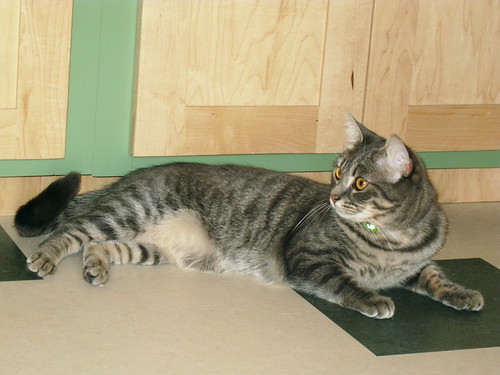
Specifically, it is a photo of Coraline, taken last weekend. She was feeling okay at that point -- in fact, she'd just finished a vigorous session of "leaping after the feather toy" -- but apparently sometime between then and Tuesday evening something (not tree roots, though!) clogged up her plumbing, leaving her unable to poop effectively.
And as gross as the mere concept of poop is, it's pretty important to be able to produce it if one happens to be alive (and wishes to stay that way). Just as there can be no light without darkness, there can be no eating without pooping. (Which is one reason my little niece's simulated kitten-care video games, wherein you get to feed the cats but never deal with a litter box, baffle me endlessly. But that's another topic entirely.)
As far as how I came to realize Cora wasn't producing...well, when you live with multiple cats and scoop their litter boxes on a daily basis, you kind of end up getting to the point of recognizing everyone's, er, deposits. And Cora's have always been rather distinctive inasmuch as no matter what she eats...let's just say if there were a prize for "superior feline stool formation", under normal circumstances she would be a grand champion. Not so much last week, though, as pretty much all the recognizable solid matter I scooped had clearly (based on known dimensional attributes and scent signature parameters) emerged from Nikki or the boys.
Mind you, I don't think Cora ever got completely obstructed. I did find a few of what are colloquially referred to around here as "poopflakes" in the box, and I will let you use your imagination to figure out the etymology of that term. Moreover, she was able to keep food down despite an obviously diminished appetite, whereas total colonblockery tends to result in projectile pukesplosion shortly after meals.
Most alarming, though, (aside from the pooplack, of course) was how her whole demeanor was just off. Normally, Cora is extremely active (in the same sense that the sun is extremely hot), but on Tuesday evening all her movements seemed very slow and tentative. She also only made half-hearted attempts to jump and climb the way she usually does, and showed no interest whatsoever in her favorite toys.
So, I called the vet's office with my concerns. They agreed that something didn't sound right, so first thing Thursday morning Matt and I bundled her up in the carrier and took her off to the clinic. We ended up getting assigned to a different doctor than last time (again) due to scheduling constraints, but that turned out fine as this doctor was pretty awesome (at least as awesome as the one we'd previously seen and liked a lot).
Moving along, though, the bottom line (heh) is that Cora did indeed, per the vet's examination, have a traffic jam in her lower intestinal zone. Thankfully a single Super Colon Cleanse (read: enema) was able to dislodge the backup, and all this entailed was a mild sedative (as opposed to general anaesthesia, which would have been needed if they'd had to "go in manually") and monitoring at the clinic until around 5:30 PM.
The vet undoubtedly dealt with the most buttfountainous aftereffects of the enema, for which I am thoroughly grateful. Nevertheless, things were still fairly...messy when we initially got Cora home. The sedative had mostly worn off by around 4 PM (when the vet called me, proclaiming that my cat had "pooped beautifully") so I can completely understand why Cora was returned to us with her entire back end, tail, and legs soggy and smelly.
Trying to give a fully-conscious Coraline anything resembling an effective bath is probably marginally more difficult than trying to perform a one-handed backwards cartwheel through a swarm of bees. And I would rather deal with a bit of yuck than have my cat sedated a second time solely for cleaning purposes.
Nevertheless, I didn't want her getting infections (or tracking Ass Flavored Smoothie all over the house) so Matt and I did the best we could to soap and rinse her lower half while she proceeded to claw her way up my chest and attempt to surgically attach herself to my face.
That went about as well as you can imagine it did.
Luckily I only ended up with a few holes in my neck, and none of them bled that much.
Really, though, my primary emotion Thursday evening was one of pure relief. Poor Cora. I can't imagine how much it must have been hurting her to be that blocked up. I was so happy when she got home, and she seemed to be as well, though I had to decline her friendly tail-swipey-leg-weaving greetings at first!
That said, ye gads, I honestly hope I never have to see anything like that coming out of a cat ever again. Granted most of the scariness was due to the fact that I'd been feeding her robust doses of hairball gel and petroleum jelly for a day and a half prior to her vet trip, but it was nonetheless disconcerting to have the contents of the litter scoop jiggle like some sort of earthquake-evaluation medium.
But anyway. Three days following her ordeal, Cora appears to be none the worse for wear (and Shadow, who has a severe Vet Phobia, has ceased hissing at her hind end). I put her in "quarantine" in the spare bedroom for only one night following her Great Rectal Waterslide Adventure. She was very quiet that evening, but by mid-morning Friday I figured she was fine to rejoin the household proper, given that she was shoving her paws under the door and trying to tear off pieces of the wood by that point.
The cause of her epic pooplog backup is thus far unknown, but the current primary suspects are (a) hairball material stuck in transit, and (b) her apparently "highly efficient" colon.
In other words, apparently Cora's tendency toward poops-so-perfect-they-almost-look-fake is actually a sign that her body is really good at extracting things (including water) from whatever is passing through. This isn't a disease, mind you, just a physiological predilection of sorts.
Cats evolved to be extremely efficient in this regard and as Cora is already like a more intense version of a regular cat to begin with, I guess it's not surprising this goes all the way down to the intestinal level. But it's something that needs to be managed, as cats Cora's age (less than two years old) only rarely get this badly blocked up. I have been instructed to (a) add 1/8 tsp twice daily of polyethylene glycol (a laxative, commonly sold under the brand "Miralax") to her food, (b) stop feeding her any dry food (aside from the occasional crunchie-treat), and (c) start brushing her every day (at least while we're in the midst of Super Shedding Season).
Adding more fiber to her diet may be something to think about as well, but the vet cautioned against going overboard here given that additional "bulk" could make things worse.
So yeah. Last week was pretty epic, and not in a cool fun way. I will certainly never again take any form of waste-pipery for granted, whether said pipery be part of my household sewer line or my cat's intestines.
Tuesday, April 12, 2011
Shifting Feral Colony Dynamics
I've definitely observed a shift in colony dynamics over the past two weeks or so. The last few times Matt and I have stopped over at his parents', I've gone on little expeditions around the neighborhood and tried to take a bit of a "cat inventory". Most of that area is houses, but there are also two parks within easy walking distance and a number of large-ish fieldy areas -- it is apparent why so many cats choose to live there, given the amount and type of space available.
Anyway, the "shift" I'm noting seems to have to do with which cats are likely to be found where -- in addition to which cats are likely to be found at all.
I saw one cat come right into the yard whom I've never seen before -- a strapping young tabby tom who proceeded to prance around, spritzing shrubs and whatnot, and altogether looking quite pleased with himself. No clue where he came from, but I'm definitely glad we managed to get four of the females spayed prior to his arrival!
I also spotted something like five or six black cats, spread across several yards and lots. There are a LOT of black cats in that colony (which I've read is common in random-bred populations; over time you start seeing coats default to brown tabby and black, because those patterns confer the best camouflage, or something like that). I can tell them apart pretty readily once I've seen them a few times, by way of differing face/body shapes and movement patterns, but I am nonetheless becoming really appreciative of ear-tipping, given the fact that some of these kitties really only ever grace us with rapid-fire cameo appearances every now and then.
Speaking of which...at one point (when we were standing in his mom's living room) Matt motioned out the door at one particular black cat and said, "That one looks like Shadow". I glanced out myself and lo and behold, Coal was slinking out from under a car!
I was REALLY relieved to see her because frankly I'd actually gotten to the point of presuming she was probably dead. She's the mother of my three youngsters, Suzie, Radar, and, well, probably a whole lot of others who've come and gone over the past few years (Coal herself is six or seven years old). She's very distinctive-looking, though, especially given that she's extremely large for a female cat. Not fat-large -- if not pregnant she tends toward the wiry/rangy side -- but just big, long, squarish bone structure. And Shadow is the spitting image of his mom in a lot of ways, especially in the face.
So yeah. Coal is one tough lady. And she's smart. She's had to be both to survive as long as she has. I would dearly love to trap her and get her spayed but something tells me I'm going to have to build another drop trap in order to do that, because she's way too cautious to get anywhere near the cage-type traps that we've been putting out. But in any case, it is good at least to know she's alive, albeit looking rather ragged.
I've also twice now seen a cat that I think is supposed to be black...but who seems to be missing all his/her fur on one side! S/he is very skinny but ate like a horse during the last feeding session I observed so I'm guessing there's something skin-related going on rather than a worse, systemic thing, but it was still pretty alarming to see. My tentative guess is that this poor kitty has flea allergy dermatitis, given that s/he looks a heck of a lot like this, but it's hard to tell for sure.
Either way, if s/he ends up in the trap that will enable closer inspection as well as administration of some sort of topical flea treatment. In the meantime, though, I am seriously wondering if there's something safe we might be able to sprinkle on the food that could help reduce the parasite load for the ferals. Any suggestions would certainly be appreciated.
But back to my original point about shifting colony dynamics. I really shouldn't be surprised to see this sort of thing at all. I tend to think of spay/neuter purely in the sense of it being Kitty Birth Control, but it also impacts hormones. Which means that it will also likely impact the social organization of the colony, what with far fewer cats engaged in courtship and mating and all that accompanies those activities.
The newbie tabby male I described above has probably just moved in to fill what he sees as an opening. I didn't realize before the extent to which Blue was "guarding" the yard over the past few months (in addition to guarding his adopted babies). With him gone, and with JB/Tuxie neutered, there's been a decided drop in testosterone as of late. And I never noticed this until now, but in general it seems like the majority of long-term colony members are female, both spayed and unspayed. There's a much higher "turnover rate" with the boys, and quite a few have just seemed to disappear as mysteriously as they've appeared.
Anyway, the "shift" I'm noting seems to have to do with which cats are likely to be found where -- in addition to which cats are likely to be found at all.
I saw one cat come right into the yard whom I've never seen before -- a strapping young tabby tom who proceeded to prance around, spritzing shrubs and whatnot, and altogether looking quite pleased with himself. No clue where he came from, but I'm definitely glad we managed to get four of the females spayed prior to his arrival!
I also spotted something like five or six black cats, spread across several yards and lots. There are a LOT of black cats in that colony (which I've read is common in random-bred populations; over time you start seeing coats default to brown tabby and black, because those patterns confer the best camouflage, or something like that). I can tell them apart pretty readily once I've seen them a few times, by way of differing face/body shapes and movement patterns, but I am nonetheless becoming really appreciative of ear-tipping, given the fact that some of these kitties really only ever grace us with rapid-fire cameo appearances every now and then.
Speaking of which...at one point (when we were standing in his mom's living room) Matt motioned out the door at one particular black cat and said, "That one looks like Shadow". I glanced out myself and lo and behold, Coal was slinking out from under a car!
I was REALLY relieved to see her because frankly I'd actually gotten to the point of presuming she was probably dead. She's the mother of my three youngsters, Suzie, Radar, and, well, probably a whole lot of others who've come and gone over the past few years (Coal herself is six or seven years old). She's very distinctive-looking, though, especially given that she's extremely large for a female cat. Not fat-large -- if not pregnant she tends toward the wiry/rangy side -- but just big, long, squarish bone structure. And Shadow is the spitting image of his mom in a lot of ways, especially in the face.
So yeah. Coal is one tough lady. And she's smart. She's had to be both to survive as long as she has. I would dearly love to trap her and get her spayed but something tells me I'm going to have to build another drop trap in order to do that, because she's way too cautious to get anywhere near the cage-type traps that we've been putting out. But in any case, it is good at least to know she's alive, albeit looking rather ragged.
I've also twice now seen a cat that I think is supposed to be black...but who seems to be missing all his/her fur on one side! S/he is very skinny but ate like a horse during the last feeding session I observed so I'm guessing there's something skin-related going on rather than a worse, systemic thing, but it was still pretty alarming to see. My tentative guess is that this poor kitty has flea allergy dermatitis, given that s/he looks a heck of a lot like this, but it's hard to tell for sure.
Either way, if s/he ends up in the trap that will enable closer inspection as well as administration of some sort of topical flea treatment. In the meantime, though, I am seriously wondering if there's something safe we might be able to sprinkle on the food that could help reduce the parasite load for the ferals. Any suggestions would certainly be appreciated.
But back to my original point about shifting colony dynamics. I really shouldn't be surprised to see this sort of thing at all. I tend to think of spay/neuter purely in the sense of it being Kitty Birth Control, but it also impacts hormones. Which means that it will also likely impact the social organization of the colony, what with far fewer cats engaged in courtship and mating and all that accompanies those activities.
The newbie tabby male I described above has probably just moved in to fill what he sees as an opening. I didn't realize before the extent to which Blue was "guarding" the yard over the past few months (in addition to guarding his adopted babies). With him gone, and with JB/Tuxie neutered, there's been a decided drop in testosterone as of late. And I never noticed this until now, but in general it seems like the majority of long-term colony members are female, both spayed and unspayed. There's a much higher "turnover rate" with the boys, and quite a few have just seemed to disappear as mysteriously as they've appeared.
Monday, March 7, 2011
Gooseberry Green
Apparently there's an actual name for Brodie's eye color: gooseberry green. I learned this while reading about Egyptian Mau cats. My guys are mutts, not Maus, but seeing as the distinguishing features of all known cat "breeds" came from random-bred populations originally it's totally unsurprising to see modern random-bred kitties expressing traits commonly associated with particular types of cats.
It's difficult to get good photos of cats' eyes, but the one below (of Brodie, if that wasn't obvious!) is pretty accurate color-wise:

Cats' eyes commonly change color as they grow. My youngsters all had greyish eyes when first adopted, and like most kittens probably had blue eyes at birth. Now they've all got different hues going on in the ocular region: Cora's eyes are a deep amber, Shadow's are bright yellow with greenish bits toward the center, and Brodie's are, well, gooseberry (or, as I've previously described them, "clear limeade green").
Brodie also does actually look vaguely Mau-ish in other respects too...these Flickr Mau-cats remind me of him a fair bit. He's more striped than spotted but he's definitely got the long body and the wedge-with-rounded-points head shape.
Anyway, definitely a frivolous observation but cat traits and genetics are just something that fascinates me, so I thought I'd post about it.
It's difficult to get good photos of cats' eyes, but the one below (of Brodie, if that wasn't obvious!) is pretty accurate color-wise:
Cats' eyes commonly change color as they grow. My youngsters all had greyish eyes when first adopted, and like most kittens probably had blue eyes at birth. Now they've all got different hues going on in the ocular region: Cora's eyes are a deep amber, Shadow's are bright yellow with greenish bits toward the center, and Brodie's are, well, gooseberry (or, as I've previously described them, "clear limeade green").
Brodie also does actually look vaguely Mau-ish in other respects too...these Flickr Mau-cats remind me of him a fair bit. He's more striped than spotted but he's definitely got the long body and the wedge-with-rounded-points head shape.
Anyway, definitely a frivolous observation but cat traits and genetics are just something that fascinates me, so I thought I'd post about it.
Subscribe to:
Posts (Atom)