I've definitely observed a shift in colony dynamics over the past two weeks or so. The last few times Matt and I have stopped over at his parents', I've gone on little expeditions around the neighborhood and tried to take a bit of a "cat inventory". Most of that area is houses, but there are also two parks within easy walking distance and a number of large-ish fieldy areas -- it is apparent why so many cats choose to live there, given the amount and type of space available.
Anyway, the "shift" I'm noting seems to have to do with which cats are likely to be found where -- in addition to which cats are likely to be found
at all.
I saw one cat come right into the yard whom I've
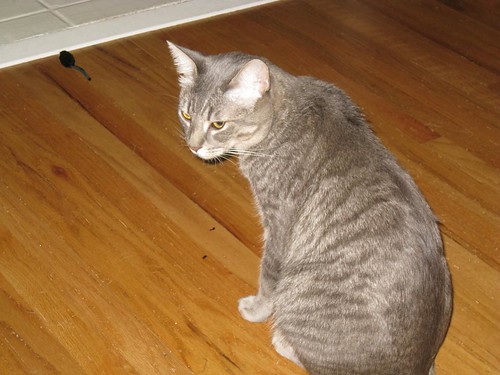
never seen before -- a strapping young tabby tom who proceeded to prance around, spritzing shrubs and whatnot, and altogether looking
quite pleased with himself. No clue where he came from, but I'm definitely glad we managed to get four of the females spayed prior to his arrival!
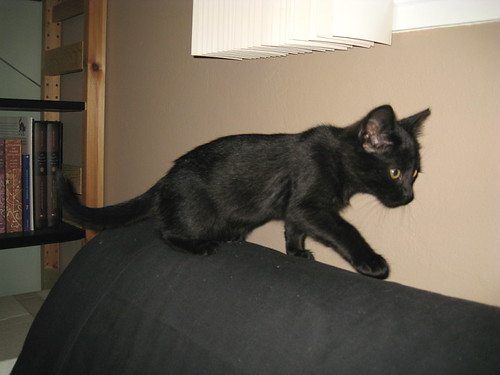
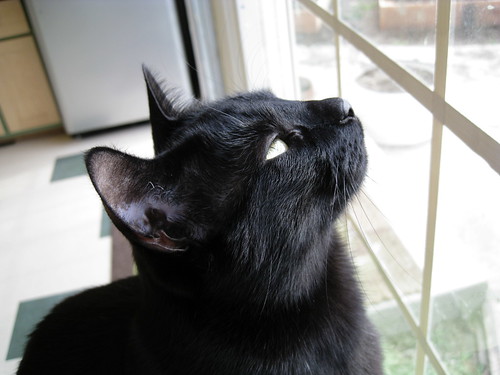
I also spotted something like five or six black cats, spread across several yards and lots. There are a LOT of black cats in that colony (which I've read is common in random-bred populations; over time you start seeing coats default to brown tabby and black, because those patterns confer the best camouflage, or something like that). I can tell them apart pretty readily once I've seen them a few times, by way of differing face/body shapes and movement patterns, but I am nonetheless becoming really appreciative of ear-tipping, given the fact that some of these kitties really only ever grace us with rapid-fire cameo appearances every now and then.
Speaking of which...at one point (when we were standing in his mom's living room) Matt motioned out the door at one particular black cat and said, "That one looks like Shadow". I glanced out myself and lo and behold, Coal was slinking out from under a car!
I was REALLY relieved to see her because frankly I'd actually gotten to the point of presuming she was probably dead. She's the mother of my three youngsters, Suzie, Radar, and, well, probably a whole lot of others who've come and gone over the past few years (Coal herself is six or seven years old). She's very distinctive-looking, though, especially given that she's extremely large for a female cat. Not fat-large -- if not pregnant she tends toward the wiry/rangy side -- but just big, long, squarish bone structure. And Shadow is the spitting image of his mom in a lot of ways, especially in the face.
So yeah. Coal is one tough lady. And she's
smart. She's had to be both to survive as long as she has. I would dearly love to trap
her and get her spayed but something tells me I'm going to have to build another drop trap in order to do that, because she's
way too cautious to get anywhere near the cage-type traps that we've been putting out. But in any case, it is good at least to know she's alive, albeit looking rather ragged.
I've also twice now seen a cat that I
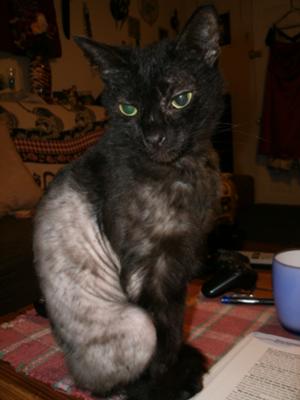
think is supposed to be black...but who seems to be missing all his/her fur on one side! S/he is very skinny but ate like a horse during the last feeding session I observed so I'm guessing there's something skin-related going on rather than a worse, systemic thing, but it was still pretty alarming to see. My tentative guess is that this poor kitty has
flea allergy dermatitis, given that s/he looks a heck of a lot like
this, but it's hard to tell for sure.
Either way, if s/he ends up in the trap that will enable closer inspection as well as administration of some sort of topical flea treatment. In the meantime, though, I am seriously wondering if there's something safe we might be able to sprinkle on the food that could help reduce the parasite load for the ferals. Any suggestions would certainly be appreciated.
But back to my original point about shifting colony dynamics. I really shouldn't be surprised to see this sort of thing at all. I tend to think of spay/neuter purely in the sense of it being Kitty Birth Control, but it also impacts hormones. Which means that it will also likely impact the social organization of the colony, what with far fewer cats engaged in courtship and mating and all that accompanies those activities.
The newbie tabby male I described above has probably just moved in to fill what he sees as an opening. I didn't realize before the extent to which Blue was "guarding" the yard over the past few months (in addition to guarding his adopted babies). With him gone, and with JB/Tuxie neutered, there's been a decided drop in testosterone as of late. And I never noticed this until now, but in general it seems like the majority of long-term colony members are female, both spayed and unspayed. There's a much higher "turnover rate" with the boys, and quite a few have just seemed to disappear as mysteriously as they've appeared.