Well, we are now about four weeks into the raw feeding trial here. Again I am pleased to report that Cora, Brodie, and Shadow are still doing extremely well on their new diet (which is still, and likely to remain, in a state of flux, for variety's sake if nothing else). Nobody has grown wings or become telepathic or anything -- I am certainly not one of those who believes raw food is some sort of Miracle Serum, but everyone seems plenty active, playful, etc.
On the gastrointestinal front, I continue to be astounded at how little the trio's poops stink these days, and how even Brodie's, er, deposits have been so consistent in their consistency. Even on the grain-free regular cat food (which was far more friendly to his system than some of the early grain-based foods I tried) he often seemed to have intestinal gas. As in, I could hear his guts gurgling from halfway across the room -- which can't have been comfortable for him. That's possibly the thing I am most pleased/excited about in this whole endeavor...Brodie just seems to FEEL better to a degree he never could on anything else we tried. Yay!
We've had a mere one incident of puking in the past month. I don't know who it was, as it was one of those "woken up by the Hork Alarm, but cats are all arranged at opposite corners of the living room by the time I manage to get out there" affairs.
I am not super concerned about this, though -- anyone who lives with cats for any length of time tends to learn firsthand that the feline approach to reverse peristalsis borders on the recreational. Moreover, all the cats had eaten some grass (from the yard, during one of their supervised outdoor jaunts) the previous day and of course there's always the Hairball Factor to consider.
Truth be told, only one incident of Gastronomical Splatter Art in the course of a month is kind of amazing when you live with four cats! So whether it was grass, hairballs, or perhaps a tad too much liver (it's very rich and I've since been strictly portioning it out so nobody gets more than a dime-sized piece per meal), it doesn't seem to have been a sign of anything sinister.
So, I expect I'll be keeping this up. It's actually far more logistically easy than I ever imagined -- I mean seriously, plopping one-third of a whole thawed quail down in someone's dish isn't appreciably more complicated than setting out half a can of wet food.
That said, the kitties are still also getting some commercial cat food, though probably less than 20% of their diet is currently comprised of this. I know some raw feeders encourage a complete switch as soon as possible but as I am taking an evidentiary approach rather than an ideological one, I figure I should probably not rush things or even necessarily assume before I have more data that All Raw, All The Time is the Absolute Best Ideal Cat Diet.
I am convinced at this point that there are aspects of raw feeding that are truly awesome and ought to be studied/explored/acknowledged, and my cats seem to be doing great so far, but I see no reason to make a religion out of it.
But I digress. The trio take their supplemental taurine no problem when it's mixed into a spoonful of meat-byproduct-pate', and while their "crunchies" (dry food) have pretty much been reduced to "treat" status, they each end up getting some of those most days as well.
I find that the crunchies are very handy for "enrichment"-type games...like putting a few of them into a tall cup on the floor and seeing if they can figure out how to knock it over (yep, they can). Or putting them (the crunchies, not the cats!) into weird apparatusses (apparati?) like the one in my Informal Cat Cognition Experiment.
The youngsters also LOVE the "chase the crunchie across the floor" game, and Shadow has become incredibly proficient at catching his treats in mid-air (yet another thing he taught himself to do...I really must post a video of it sometime!)
I still haven't tried raw with Nikki and I am kind of afraid to. She is such a "Princess and the Pea" about food and pretty much everything (this isn't an insult...she just has extremely keen senses, even for a cat, and her sense of taste is particularly acute) that I suspect even a micron of raw chicken mixed into her Fancy Feast would set off her alarms. I would still like to try at some point but give how picky she is I am reluctant to risk potentially putting her off the only well-hydrated thing she will (at least when she's not going through one of her "I Hate Everything" weeks) accept.
Oh yeah. And the bone thing. Wow. I have never SEEN such enthusiasm at mealtime. Shadow especially LOVES his chicken and quail wings and legs and ribs, etc. LOVES them. Like to the point where he will stand up on his hind legs, paws on the kitchen counter (he is REALLY tall now!), shrieking at me as I portion out the carcass of whatever it is I'm preparing.
And then when he gets his Meaty Bone Of The Day he sits there gnawing on it and growling and making noises that literally sound like "OMNOMONONONMMNOM!"
Cora does this occasionally as well which just amuses me to no end because she's so little and sweet-looking...she is truly the epitome of badass adorable.
Brodie, meanwhile, tends to stand off in a corner (or, lately, under the dining room table -- he seems to prefer eating with a "roof" over his head) politely and methodically chomping away, then licking up the bits and quite daintily cleaning his paws when finished.
I've actually been having to put Shadow in a different room once he's finished his own meal, as he can be a bit on the pushy side and Brodie (the resident gentle Gamma boy) is more of a pushover. He doesn't challenge Shadow if said brother tries to steal his chicken wing...he's more liable to be all "Okay, bro, no problem...take it...backing up now, I'll just be over here..."). This is turning out to be a wholly manageable situation, though, and with the raw stuff I prefer to watch them eating anyway so monitoring isn't a big deal.
Wednesday, August 25, 2010


Monday, August 16, 2010
The Terrifying Hat

Apologies for the poor quality image -- I had just wanted to take a quick picture of the hat (on my head) so I used the bathroom mirror, and then the image came out weirdly bright red so I ended up turning the saturation way down so I didn't look like I had some sort of terrible sunburn.
But all that is beside the point...the point being that my sister Katie gave me this neat kitty hat yesterday! She says she got it from a street vendor who sold various hand-made items. I think it is very cute personally...but the younger cats here do NOT agree!
I put it on last night and as soon as Shadow saw me, he put his ears back and ran out of the room. Cora and Brodie did the same thing when they saw it. So I took it off and let them sniff it, and they didn't seem afraid of it then.
However, when I picked it up again and they were able to see the face, they ran off again! Eeep. I guess it must look like some sort of GIANT CAT OF DOOM with EYES THAT NEVER STOP STARING to them.
So for now I am just not wearing it in their presence...I don't want to freak them out! I will probably let them examine it some more with it NOT on my head and see if maybe eventually they will realize it's neither "real" nor a threat.
Nikki, meanwhile, didn't seem remotely fazed by GIANT CAT OF DOOM HAT. She's older than the others so for all I know she's seen this sort of thing before.
Sunday, August 15, 2010
Happy Birthday to the Formerly Feral Trio!
Well technically we do not know the EXACT date on which they were born, but going by the vet's estimate of their age on their first visit last year, I determined that August 15 was close enough to serve as the "official" date. So I just wanted to post here in celebration of Coraline, Brodie, and Shadow reaching one year old!
Here are some photos from their first year:
Tiny Coraline and Brodie, during their first week post-adoption. They were still completely feral at this point (not to mention covered with fleas and infested with coccidia parasite). Both weighed just about 2 pounds.

Tiny Shadow during his first week here. He was trapped 3 weeks after his siblings, when they were all around 10 weeks old. I had been all prepared for a VERY wild kitten that would take ages to get used to (some) humans, if he ever did, but Shadow ended up surprising everyone by settling down and deciding I was okay (and Matt wasn't bad either) within a mater of days!

Tiny Shadow climbing the scratching post (a home-made one that was eventually incorporated into the Kitchen Cat Platform Thing). Nowadays the post isn't much of a "climb" for him, seeing as he is now taller than it when he stands up on his hind legs!

Tiny Coraline playing in my shoes!

Tiny Brodie sneaking across the bed (the kittens were JUST beginning to settle down...at that point they would sleep and play on the bed when there were no humans about, but they would dive under the bed whenever I or Matt walked into the room).

Tiny Brodie having just woken up from a nap (Cora can be seen partially in the background, still resting her eyes). I think they were maybe 12 weeks old here. In order to get these pictures I had to move veeeerrrry sloooooowly so the kittens did not get startled. (In general that is a polite thing to do around cats in general when the cats don't know you well, not just feral cats. Also it is important not to stare directly into their eyes because many cats find that threatening.)

The trio napping on my bed, at around 4 months old. (Cora had just been spayed -- that little outfit she is wearing was actually a sock modified with holes, so that she would have something protecting her incision.):

The trio playing in sunbeams on the bed, at around 5 months old:

The trio in the kitchen, dazzled by sunbeams again:

Cora in the sunbeams:

As they grow from kittenhood into catolescence, you can fully expect young kitties to start taking over the sofa, but it will be so adorable you won't care. (Nikki stays at a safe distance on the arm of the couch):

Honestly, could YOU move these guys?!:

Takeovers of beds also increase in magnitude and intensity as the youngsters near 6-8 months of age:

...and by the time they're a year old, you may expect to find folding the laundry simply isn't what it used to be!

Here are some photos from their first year:
Tiny Coraline and Brodie, during their first week post-adoption. They were still completely feral at this point (not to mention covered with fleas and infested with coccidia parasite). Both weighed just about 2 pounds.
Tiny Shadow during his first week here. He was trapped 3 weeks after his siblings, when they were all around 10 weeks old. I had been all prepared for a VERY wild kitten that would take ages to get used to (some) humans, if he ever did, but Shadow ended up surprising everyone by settling down and deciding I was okay (and Matt wasn't bad either) within a mater of days!
Tiny Shadow climbing the scratching post (a home-made one that was eventually incorporated into the Kitchen Cat Platform Thing). Nowadays the post isn't much of a "climb" for him, seeing as he is now taller than it when he stands up on his hind legs!
Tiny Coraline playing in my shoes!
Tiny Brodie sneaking across the bed (the kittens were JUST beginning to settle down...at that point they would sleep and play on the bed when there were no humans about, but they would dive under the bed whenever I or Matt walked into the room).
Tiny Brodie having just woken up from a nap (Cora can be seen partially in the background, still resting her eyes). I think they were maybe 12 weeks old here. In order to get these pictures I had to move veeeerrrry sloooooowly so the kittens did not get startled. (In general that is a polite thing to do around cats in general when the cats don't know you well, not just feral cats. Also it is important not to stare directly into their eyes because many cats find that threatening.)
The trio napping on my bed, at around 4 months old. (Cora had just been spayed -- that little outfit she is wearing was actually a sock modified with holes, so that she would have something protecting her incision.):
The trio playing in sunbeams on the bed, at around 5 months old:
The trio in the kitchen, dazzled by sunbeams again:
Cora in the sunbeams:
As they grow from kittenhood into catolescence, you can fully expect young kitties to start taking over the sofa, but it will be so adorable you won't care. (Nikki stays at a safe distance on the arm of the couch):
Honestly, could YOU move these guys?!:
Takeovers of beds also increase in magnitude and intensity as the youngsters near 6-8 months of age:
...and by the time they're a year old, you may expect to find folding the laundry simply isn't what it used to be!
Wednesday, August 11, 2010
Raw and Whole Prey Feeding: A Trial Run
...is something I've actually gotten up the nerve to try recently. There will probably be several lengthy posts about this, but for now here is a picture of Cora polishing off a quail:

I should also note that I am not doing 100% raw for the moment...I am still learning about and evaluating what research there is regarding this sort of thing. But the younger cats have been getting around 50-60% of their daily diet in the form of raw meat, bones, organs, etc., for nearly two weeks now. (Nikki won't touch the stuff but that's no surprise -- for the moment I am just glad she is back to liking grain-free wet food.)
Briefly I will also say that:
- Nobody has gotten sick
- Poop output and stink seems to have been reduced by at least half
- Coats are getting softer and shinier
- Brodie seems to have a lot more energy (which makes me wonder if he is just really, really bad, even for a cat, at getting any benefit whatsoever from carbohydrates, which even grain-free commercial cat foods generally have some of)
Hence, so far I would say things look very promising!
(And yes, I am supplementing with extra taurine -- technically cats "should" be able to get all the taurine they need from raw prey or prey-model food containing enough heart and dark muscle meat and such, but I don't want to take ANY chances with that particular amino acid.
One study in which two groups of cats were fed, respectively, a commercial diet and a diet of whole ground rabbit, resulted in one cat in the raw group suddenly dying of cardiomyopathy due to severe taurine deficiency. When examined, other cats in that group were also found to have signs of deficiency, so their diet was supplemented with taurine for the remainder of the study. So while I would guess tentatively that the process of grinding the rabbit was responsible for the loss of taurine, again, not taking any chances here.)
I also tried (in addition to the chicken, turkey, quail, and beef that the trio have been quite happy with so far) getting some frozen feeder mice at one of those pet stores that caters to reptiles. Yes, I know, kind of gross (and the mice were so cute despite being dead!), but in a way I sort of feel like feeding whole prey is a way for me to really come to terms with what a carnivore is. Store-bought kibble may come in cute little shapes reminiscent of children's cereal, but it still (if it's of any quality) contains dead animal bits and something in me finds it a bit unnerving to be so disconnected from the "source" of said animals. If that makes any sense at all to anyone.
In any case, so far only Brodie seems willing to actually eat the mice. Cora and Shadow played with them a bit, but didn't seem to recognize them as food. (Which I am sure Brodie is just fine with...he got what they didn't eat!).
Sunday, August 1, 2010
With Sideways Mind: On Listening To Cats
Scene: computer room, my house, around 7:30 PM this evening
Shadow (from the floor behind my chair): "YAAAAAAOW! YAAAAOW! MYOOOOOUUUU! MRRREW!"
Anne: "What?"
Shadow: "YAAAAAOW! REEEE! MIEW! MMMMM!"
Anne: "What, little guy?"
Shadow: "Nrrrrrrr. Miew. YAAAO!"
Anne (gets up from chair): "Okay, fine, Lassie, show me what you want."
Shadow: *gets up, trots into the hallway*
Anne: *follows, waits to see which direction Shadow seems to be going in*
Shadow: *heads toward kitchen*
Anne: *follows*
Shadow: *plunks self down on linoleum, looks at Anne, looks out window*
Anne: "You want me to sit down?"
Shadow: *motions in the affirmative*
***
So, I sit down, right on the linoleum (which is actually linoleum and not vinyl). Shadow proceeds to snuggle up against my leg. I hear the purr motor start going.
Seated there, I notice that there's quite a lovely breeze coming through the back screen door. The air smells fresh and carries little notes of back-yard with it: tomato leaves, pepper, dry grass. Then I look out the large window overlooking the patio.
Through the trellised semi-roof over the concrete surface next to the garden I see a huge flock of birds making their way across the sky. They're too far away for me to tell what type of bird they are; all I can see is that they're dark-colored, too small to be crows, too large to be sparrows.
Shadow and I both sit there for a while. I don't keep track of exactly how long. The birds pass in waves: one group, then another, then another. The breeze continues to blow. Shadow climbs into my lap, still purring.
Eventually, of course, I have to get up, so I do. But not before thanking Shadow.
***
Cats communicate. They may not speak (in English or any other human language) but they certainly have plenty to say. I do not claim to understand cats in general, or any specific cat, perfectly, and I find it unnerving (and often a sign of bad ethics) when any human makes such a claim.
However, in living with cats and noting the patterns of how they interact with me, with other cats, with objects in their environment, etc., I have definitely come to realize certain things about listening. Not listening with ears, per se. -- more like (and readers of Michael Ende will know what I mean here) Momo-listening.
What cats have to say can be very subtle. Shadow meows loudly and often but that is only a miniscule part of what he says. Yes, he often wants a snack, and sometimes it's clear he wants me to get one of those wand-type toys he loves and wiggle the string so he can chase the feather-tailed mouse or whatever happen to be attached. But other times he just plain surprises me.
***
The incident related above is foremost in my mind as I write this, yet it is far from isolated. I have been astounded more times than I can count at the complexity and delicacy of what my cats tell me, how their actions illustrate what they're noticing and paying attention to in the world around them.
There is just not much in the human culture with which I am most familiar (or its common vocabularies) that prepares someone for this kind of thing.
For listening to cats involves a lot of what I would call "the cognitive equivalent of peripheral vision".
It involves a lot of not as well: as in, not immediately assuming the cat just wants food, or even play, or generalized "attention". It involves not placing fixed, arbitrary limits on your idea of what cats are capable of thinking, experiencing, and doing.
This is, in part, because cats are so good at being cats, they don't actively require our approval or permission to continue doing so throughout their lives. In other words, their catness is not dependent on being judged proper or sufficent by humans; catness simply is, and cats are surely cats even when no-one is looking.
This means that a human might "keep" a cat, feed her, change her litter, pat her head and call her a good cat on occasion -- presuming the whole while that their human view of their coexistence encompasses the whole of the cat's existence and experience. When in fact nothing could be further from the truth. The truth is that only cats have subjective knowledge of what being a cat feels like, and the truth is also that cattish priorities very often differ from typical human ones.
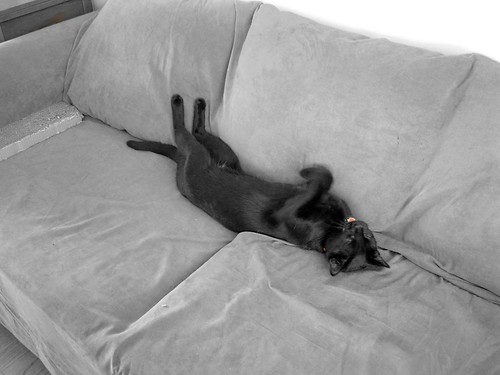
As for me, while certainly I am not a cat, I am very interested in what they have to say. I want very much for them to feel like they can show me where to sit to let a nice breeze wash over one, and where one might get to witness a dazzling display of avian migration. I want them to know that I see their priorities and interests as valid and genuine. I do not know the degree to which this will ultimately be possible, but I am sure as heck willing to keep trying my darndest to listen.
Shadow (from the floor behind my chair): "YAAAAAAOW! YAAAAOW! MYOOOOOUUUU! MRRREW!"
Anne: "What?"
Shadow: "YAAAAAOW! REEEE! MIEW! MMMMM!"
Anne: "What, little guy?"
Shadow: "Nrrrrrrr. Miew. YAAAO!"
Anne (gets up from chair): "Okay, fine, Lassie, show me what you want."
Shadow: *gets up, trots into the hallway*
Anne: *follows, waits to see which direction Shadow seems to be going in*
Shadow: *heads toward kitchen*
Anne: *follows*
Shadow: *plunks self down on linoleum, looks at Anne, looks out window*
Anne: "You want me to sit down?"
Shadow: *motions in the affirmative*
***
So, I sit down, right on the linoleum (which is actually linoleum and not vinyl). Shadow proceeds to snuggle up against my leg. I hear the purr motor start going.
Seated there, I notice that there's quite a lovely breeze coming through the back screen door. The air smells fresh and carries little notes of back-yard with it: tomato leaves, pepper, dry grass. Then I look out the large window overlooking the patio.
Through the trellised semi-roof over the concrete surface next to the garden I see a huge flock of birds making their way across the sky. They're too far away for me to tell what type of bird they are; all I can see is that they're dark-colored, too small to be crows, too large to be sparrows.
Shadow and I both sit there for a while. I don't keep track of exactly how long. The birds pass in waves: one group, then another, then another. The breeze continues to blow. Shadow climbs into my lap, still purring.
Eventually, of course, I have to get up, so I do. But not before thanking Shadow.
***
Cats communicate. They may not speak (in English or any other human language) but they certainly have plenty to say. I do not claim to understand cats in general, or any specific cat, perfectly, and I find it unnerving (and often a sign of bad ethics) when any human makes such a claim.
However, in living with cats and noting the patterns of how they interact with me, with other cats, with objects in their environment, etc., I have definitely come to realize certain things about listening. Not listening with ears, per se. -- more like (and readers of Michael Ende will know what I mean here) Momo-listening.
What cats have to say can be very subtle. Shadow meows loudly and often but that is only a miniscule part of what he says. Yes, he often wants a snack, and sometimes it's clear he wants me to get one of those wand-type toys he loves and wiggle the string so he can chase the feather-tailed mouse or whatever happen to be attached. But other times he just plain surprises me.
***
The incident related above is foremost in my mind as I write this, yet it is far from isolated. I have been astounded more times than I can count at the complexity and delicacy of what my cats tell me, how their actions illustrate what they're noticing and paying attention to in the world around them.
There is just not much in the human culture with which I am most familiar (or its common vocabularies) that prepares someone for this kind of thing.
For listening to cats involves a lot of what I would call "the cognitive equivalent of peripheral vision".
It involves a lot of not as well: as in, not immediately assuming the cat just wants food, or even play, or generalized "attention". It involves not placing fixed, arbitrary limits on your idea of what cats are capable of thinking, experiencing, and doing.
This is, in part, because cats are so good at being cats, they don't actively require our approval or permission to continue doing so throughout their lives. In other words, their catness is not dependent on being judged proper or sufficent by humans; catness simply is, and cats are surely cats even when no-one is looking.
This means that a human might "keep" a cat, feed her, change her litter, pat her head and call her a good cat on occasion -- presuming the whole while that their human view of their coexistence encompasses the whole of the cat's existence and experience. When in fact nothing could be further from the truth. The truth is that only cats have subjective knowledge of what being a cat feels like, and the truth is also that cattish priorities very often differ from typical human ones.
As for me, while certainly I am not a cat, I am very interested in what they have to say. I want very much for them to feel like they can show me where to sit to let a nice breeze wash over one, and where one might get to witness a dazzling display of avian migration. I want them to know that I see their priorities and interests as valid and genuine. I do not know the degree to which this will ultimately be possible, but I am sure as heck willing to keep trying my darndest to listen.
Update: Nikki is eating!
Hooray! While she still seems to be "off" wet food, Nikki has eaten about her usual amount of dry food (including some of the EVO she was rejecting last week and some of the Blue Buffalo Wilderness which she'd never had before at all) yesterday evening and throughout today. She is back up to her normal (high) energy level, and was even running around on the neighbors' roof this morning!

(Image shows Nikki, patrolling the rooftops)
I do hope she eventually accepts some sort of wet food but for now I am just glad she is eating something with a reasonable amount of basic nutrients -- she certainly would not be able to live indefinitely on whipped cream and cheese!
In any case, I am compiling a list of things to try in case this ever happens again. So far that list consists of:
1.) Whipped cream (the Reddi-Whip spray stuff). NOT in large quanities, just a little lick off the finger. This type of whipped cream contains a bit of sugar as well so it might help resolve a glucose crash and inspire her to eat more before she starts getting heartburn.
2.) Shredded cheese (she is partial to the Mexican 4-Cheese blend). Again, only to be given in very small amounts. Provides a small amount of protein at least.
3.) Wellness brand Turkey & Salmon Jerky treats (as many of these as she wants -- they don't have the full litany of nutrients needed for a complete diet but at least they're meat)
4.) Purina Cat Chow Indoor Formula dry food. I don't like feeding her this as a primary diet (as it's basically meat-flavored cereal, NOT the best thing for an obligate carnivore) but it seems to be a "comfort food" for Nikki, sort of her version of saltines and ginger ale. And it is at least a source of taurine and other vital nutrients.
I would be quite curious to hear from anyone else out there who lives with a very picky cat -- what s/he eats when s/he will hardly eat anything, etc.!
Saturday, July 31, 2010
Picky Cat Is Picky, But She Still Needs To Eat!
Well, it appears I spoke too soon regarding Nikki's acceptance of the new-ish EVO dry food (the weight-management stuff). She WAS eating it just fine until earlier this week, but she's been turning her nose up at it for the past few days. She is also still rejecting the Fancy Feast, and hasn't liked any of the other wet foods I've offered recently. I still haven't tried the Whole Foods brand she seemed to like a few weeks back so hopefully I can get some of that soon, though I have a feeling she's just "off" wet food completely right now.
Anyway, the past few days have involved a fair bit of worry on my part, because I know cats who go on hunger strike for whatever reason are at risk of hepatic lipidosis if they go more than 24-48 hours without food. Nikki isn't fat (she weighs about 8 pounds) so she's less likely to develop liver problems than a larger cat would, but obviously it's still not good for her to not be eating.
She had a full workup at the vet's a few months back (they did a comprehensive "senior wellness" checkup, which is standard for cats over seven years old) and all her results were very good (vets often comment that Nikki, who will be nine in October of this year, seems "unusually healthy for her age") so it's doubtful she has any chronic or serious illnesses. And while certainly I would call the vet if she wasn't eating anything, or if she couldn't seem to keep anything down, or if she was having elimination issues, none of those things are true at this time, so I don't figure it's worth stressing her further with a trip to the clinic just yet.
For now I am watching her closely to note any changes in her behavior that might indicate either illness or that she's feeling better. I do suspect she's had a bit of a stomach ache this week, as she's spent more time than usual in the "hoverloaf" position (sort of an elevated kittyloaf, which cats will sometimes sit in when they feel fine, but which is also commonly engaged in by cats who don't feel well as it lets them partially lie down without their abdomen touching the ground)and has gagged even when offered some things she usually likes (such as the chicken-and-fish flavored hairball remedy gel I give all the kitties occasionally).
My tentative theory is that (due, possibly, to a recent ingredient alteration/less tasty batch of byproducts in her Fancy Feast) she went a bit too long without eating, which irritated her stomach, which led to barfing the next time she tried to eat, which led to further aversion to her usual food, which led to low blood sugar, which led to even less of an inclination to eat.
Last night I tried giving her a little bit of honey to address the possible blood sugar issue -- I put a tiny bit on her lips and paws and while she didn't seem particularly enthusiastic about this, she didn't gag and licked it all off. She seemed a bit sprightlier after that so I suspect she probably was getting a bit crashy (something I've experienced myself -- as a kid I would often refuse food to the point of hypoglycemia, and my parents would have to coax me for hours into nibbling on a piece of cheese, etc.).
This morning I offered her:
- Fancy Feast salmon again (she didn't gag, but ignored it)
- Wellness Core Chicken and Turkey wet food (she ignored this too)
- EVO dry food (sniffed it warily, picked up one piece in her mouth but spat it out)
- Purina Indoor Formula dry food (her "old" food, which my parents left when they brought her over in January -- she ate some of this, albeit without enthusiasm)
- Whipped light cream (she ran up to me meowing when I got the container out to put some in my coffee, and happily licked some off my finger)
- Shredded cheese (she ate this enthusiastically)
- Plain yogurt (I tried to trick her into eating this by putting some cheese in it but she just ate the cheese and ignored the yogurt, though she did lick off what I put on her paws -- I figured the "good bacteria" might help her stomach)
Given that litany of responses, I've concluded that she DOES have an appetite -- which is a relief. Not having any appetite at all is pretty bad for a cat, but being extremely picky is, well, par for the course for Nikki. She seems to have an extremely sensitive sense of taste and smell even for a cat, and goes "off" things very easily, so I expect this won't be the last time I'm dealing with a mass trial-and-error session. Of course she is completely worth the effort -- it's not even something I would consider NOT doing...she NEEDS to eat, and it's not like she's rejecting stuff on purpose. It's not a power struggle -- her sensory system is just set up in a way that means, sometimes, there's only a very limited selection of foods that won't trigger a nausea response. And she can't help that, so there's no sense in my getting upset or frustrated with her.
So, for the moment she's going to be getting occasional bits of cheese and whipped light cream, along with as much dry food as she wants (which isn't a lot right now, but at least it's something). I've been mixing the EVO with the Purina Indoor and while she's mostly eating "around" the EVO, she's at least not being so turned off by the smell that she doesn't eat the other stuff. I may try getting some more Innova Cat & Kitten (dry) food again since she seemed to like that a lot and it's far healthier than the Purina -- I've already had to feed her the Purina separately from the other cats so Brodie won't get into it, and that hasn't been a major hassle, so perhaps I should just accept that and not be so concerned about finding a food I can give to everyone here all at once.
Thursday, July 29, 2010
A Small, Informal Cat Causality Cognition Experiment
(Cross-posted to Existence Is Wonderful)
My post referencing the 2009 cat-cognition study noted that:
(a) Most of the popular articles regarding that study made what looked to me like unwarranted interpretive leaps (sadly not much of a surprise there these days), and
(b) While the study itself read as more "neutrally investigative" and data-focused than the popular articles, it did not seem as if the experimental setup necessarily accounted for feline sensory modalities, and hence may not have permitted a true test of the cats' cognitive capacities in the area of physical causality.
So, in light of item (b) above, and in light of the fact that I had all the necessary components on hand to create a setup similar to that used in the aforementioned study, I decided to see if my own feline housemates might be interested in trying their hand (or rather, paw) at some string-pulling.
Of course I am not aiming to present my own "results" as Real Scientific Data; they were, after all, quite informally obtained from a tiny sample set. At the absolute most, observations presented herein might represent a sort of "proof of concept", i.e., how setups could be improved in future experiments to increase the likelihood of meaningful results. Overall, though, I mainly did this for fun -- for me, and for the cats!
BACKGROUND
Four cats were offered the opportunity to participate in this activity:
(1) Brodie
DOB: 15 August, 2009 (approx)
SEX: Male (neutered)
ANCESTRY: Domestic shorthair
(2) Coraline
DOB: 15 August, 2009 (approx)
SEX: Female (spayed)
ANCESTRY: Domestic shorthair
(3) Shadow
DOB: 15 August, 2009 (approx)
SEX: Male (neutered)
ANCESTRY: Domestic shorthair
(4) Nikki
DOB: 28 October, 2001
SEX: Female (spayed)
ANCESTRY: Siamese (Chocolate Point)
The three younger cats (Coraline, Brodie, and Shadow) were littermates, born into a feral colony. I adopted them when they were between 7 and 10 weeks of age. The elder cat (Nikki) is unrelated to the others, was born into a cattery, and lived with my parents until early 2010.
All four cats had lived with me for at least six months prior to the experiment, and since the experiment took place in my' home, they did not have to acclimate to an unfamiliar environment beforehand.
PREDICTIONS
Predictions going into the experiment were as follows:
(1) At least one cat (of the four) would demonstrate both motivation and ability to complete at least one task case successfully.
(2) Performance (in motivated cats) would improve when the treats were made more visually obvious, i.e., via use of color and size contrast.
(3) Performance might improve if a less flexible medium (i.e., plastic zip ties rather than string) was used, as this would provide faster feedback to the cats regarding their efforts and would be less likely to induce distraction (cats often find strings, and their movements, extremely interesting in their own right).
SETUP
The setup used in this exercise was based on the description provided by the study1:
Some articles referencing the study also included a photograph of the apparatus used, which I attempted to replicate as closely as possible given available materials.
Main Structure
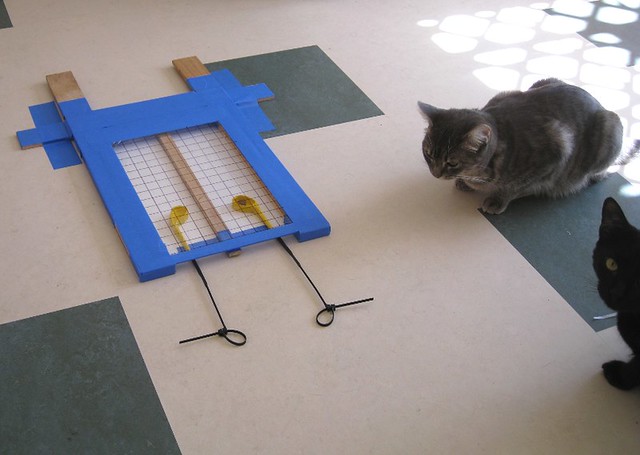
To make the main structure of the apparatus, I used several pieces of scrap, held together with blue painter's tape in a rectangular "frame" shape. To the bottom side of the frame I attached a sheet of thick white watercolor paper.
To the top side of the frame I attached a piece of Plexiglas with a grid pattern drawn on it -- however, upon closer reading of the study apparatus description (after I'd already completed my experiment), I noted that the original study had used a plain wire mesh on the top of the frame.

(Image showing main structure of test apparatus I built)
This meant that, contrary to my original (incorrect) impression, the cats more than likely would have indeed been able to smell the treats, as wire mesh blocked their physical access to the treats via the top of the box, but not the transmission of odors. If I were to try the experiment again at home I would use a piece of window screen or similar material for the lid of the box, rather than Plexiglas.
Another difference (albeit a deliberate one in this instance) between my setup and the referenced study's setup was the fact that in some trials I employed a central wooden divider that extended the interior length of the box (parallel to its left and right sides).
The purpose of this divider was to prevent the strings or zip tie mechanisms (more on that in a moment) from interfering with each other physically at all during "parallel string" trials, as I saw the potential for distraction if one string ended up touching the other while the cat was pulling on it, etc. However, in practice this divider turned out to be unnecessary, as when I removed it the cats' performance did not change and the strings/zip ties did not get tangled at all.
Treat Delivery Media
I experimented with two primary variables in terms of the treat-delivery media:
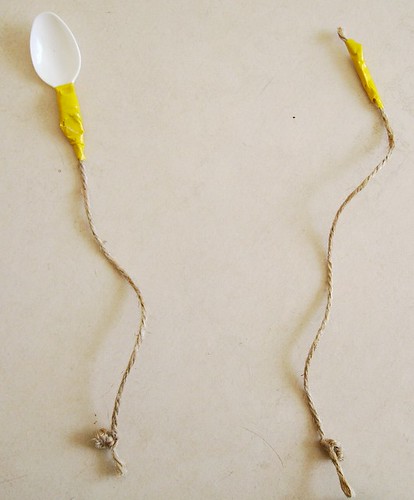
(1) Flexibility: In some trials I used actual strings (lengths of very flexible sisal twine), with or without a "treat container" at one end (see below):
In others I used plastic zip ties modified to include a small "cup" on one end to hold treats.
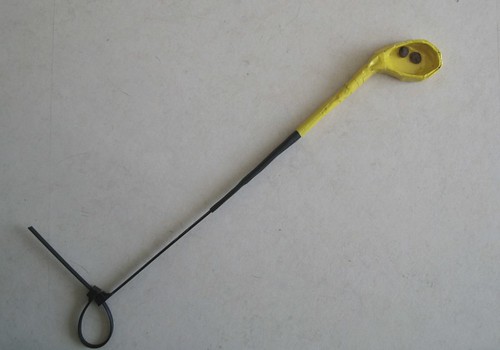
(Image shows one of the zip tie/treat cup mechanisms employed)
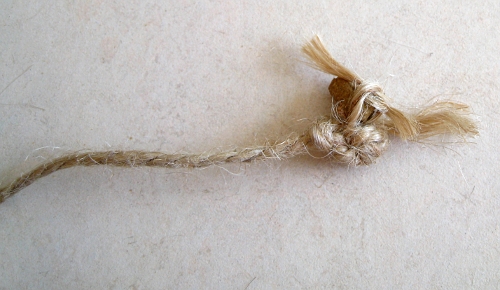
(2) Contrast: In the first few trials I used unmodified sisal twine lengths and simply tied a piece of dry cat food or chicken jerky to the end of the treat-carrying piece (see image below, note the lack of visual contrast):
In the second few trials I used yellow "cups" filled with a small amount of dry cat food attached to the ends of plastic zip ties.
In the third round of trials I went back to using the sisal twine, but attached the end of a white plastic spoon as a treat container.
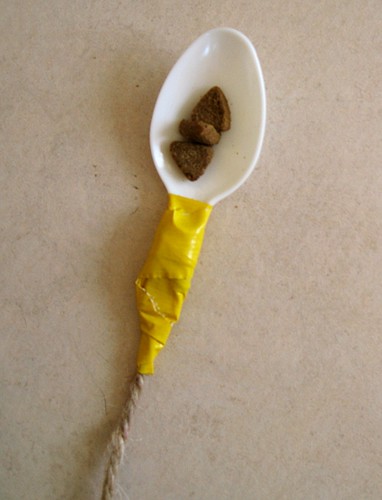
The goal here was to see what, if any, impact visual contrast had on the cats' ability to correctly identify the treat-carrying piece (thus distinguishing it from the "dummy" piece). One major criticism I had of the original study was that (inasmuch as I could tell from the description and photos available) it did not seem as if the treats were sufficiently visible to the cats.
Since, as I noted in my prior post, cats have fairly poor close-range visual acuity for fine details, I surmised that the treat holder needed to be significantly larger/wider than the end of the string (or zip tie) in order for them to be able to distinguish it properly. I also figured that it would be helpful for the treats themselves to stand out color-wise against the background of their container or cup.
TRAINING
I did not employ a formal "training phase" as the study described doing. However, I did present the treat-delivering string and zip tie pieces to the cats for inspection (prior to inserting them into the puzzle box). During this activity some of the string/zip tie pieces contained treats and some did not.
I also left the apparatus on the floor for several hours prior to starting any task trials, so that the cats would be able to investigate it at their leisure and not be distracted by the sheer novelty of the equipment when the task trials began.
RESULTS & DISCUSSION
Participation Variation
Of the four individual cats presented with the test equipment, two (Coraline and Brodie) completed various task cases successfully. Shadow was very interested in watching his siblings but declined to participate himself, and Nikki seemed totally uninterested in the activity.
Having lived with these particular cats for some time now I am not surprised by this outcome, given their respective personalities and predilections; Coraline and Brodie (Coraline especially) have always been the most mechanically inclined of the group, whereas Shadow is more inclined to solicit favors from humans (i.e., he'd rather meow at me to GIVE him a treat than try and get one himself).
Nikki, meanwhile, just tends to operate on an agenda all her own, and while at some point I can see her getting interested in a string puzzle of some sort, she wasn't interested on the day(s) on which I ran trials.
I should note that I do not draw any conclusions (negative or positive) about the non-participant cats' understanding of physical cause and effect based on their non-participation in this particular exercise. Since neither of the non-participants even attempted to complete the task, all I figure is warranted in terms of conclusion is that the materials and situation failed to inspire their interest, which of course says absolutely nothing about their capacity to cogitate about string and its uses.
Social Factors
By "social factors" here I refer to the presence/absence of multiple cats near the apparatus setup during task trials. Initially I tried testing one cat at a time, however, for the younger cats this proved impossible. No single cat would participate or do anything with the apparatus at all when separated (via a closed door in the house) from his or her siblings. Instead, the lone cat would wander around looking for his/her siblings, while the sibling cats would scratch at the door.
Once I let all the cats wander about freely, though, the three younger ones were plenty interested in the apparatus and two of them participated consistently over the course of three days. To me this suggests social factors might be more important to cats (especially related cats who get along well) than many would necessarily suspect. Having all the cats accessing the setup simultaneously did make certain aspects of the experiment more difficult to organize but it was certainly a better situation than zero participation, as I had when I attempted to test a single lone cat at a time.
As for Nikki's non-interest in the setup, social factors may have played a role her as well -- she tolerates the others but does not seem to like being very near them. I may try taking the apparatus out to the patio at some point and seeing if she might show more interest there -- she seems to be a lot more inhibited indoors, will only play with toys in the yard, etc.
Basic Observations
Again, as this was an informal/fun exercise and not an Official Scientific Experiment, I did not keep a precise count of how many times a given cat solved a task -- since I was the sole person setting up and running everything, it was not possible to carefully track every variable. However, I did note whenever a cat was able to solve a particular task case 2 or more times, and I considered that to be my basis for "success".
As expected, none of the cats completed a task in which a treat was tied to the end of a string. They all seemed vaguely interested in the strings as strings, but did not appear to even realize that one of them had a treat attached. I expect that this effect was compounded to a degree not necessarily present in the referenced study due to my use of plexiglas rather than wire mesh (which they'd have been able to smell the treats through) as a box lid. Unfortunately I did not get any video footage of this phase.
During the zip tie trials, Brodie and Coraline both consistently solved the parallel case. Their success was independent of "position habit", meaning that I was able to switch what side the treats were on and/or move the apparatus to a different room in the house and they still knew what zip tie to pull on to get the treats.
Brodie solving parallel zip tie task (room #1, treats on left side):
Brodie solving parallel zip tie task (room #2, treats on right side):
Cora demonstrates her zip tie prowess here:
(This one is actually an "amusing out-take" candidate -- I had not yet properly secured the apparatus to the floor before this trial, and Cora got her claw stuck in the treat container after she pulled it out, so we had a bit of a treat explosion! Her brothers, of course, were pleased by this turn of events.)
I did not end up doing a "crossed" case with the zip ties, because I discovered that the ties were too thick to fit under the 1 cm gap at the front of the box when stacked on top of one another. Refinement of this task would definitely account for this issue.
In the "string and spoon" phase (in which the treats were placed into the end of a white plastic spoon attached to one of the pieces of sisal twine), again, both Coraline and Brodie were successful at the parallel strings task. Unfortunately (due to disorganization and logistical wrangling difficulties on my part) I did not get a video of Brodie doing this but I got two of Coraline:
In the "crossed strings" case, Coraline had no trouble with this at all. I don't think she went for the "wrong" string even once. Brodie did not do as well here, however, he has always been very interested in string as a toy, and it seemed like when the strings were crossed it was a lot more fun to play with them than try to figure out which one had a treat attached to it.
The video below shows Cora easily solving the crossed-strings case:
(To me it certainly LOOKS like she knows darn well what the function of the string is, but I am not sure how to quantify this observation!)
CONCLUSION
In conclusion I note that my predictions (1) and (2) turned out to be accurate inasmuch as I could tell. Two out of four cats-in-residence completed at least two types of task each, which to me suggests that their performance was unlikely to have been the result of "random luck". However, of course in a formal study many more data points would be taken and results might differ.
As for the contrast issue, while again more data would be a good thing to have here, it really did seem based on what I observed that if the cats could clearly see the treats, those motivated to obtain them had no trouble doing so.
As for whether the zip tie mechanism improved performance (due to it being easier to physically manipulate than the string), it did look like this was probably the case, at least for the parallel task. Again, physical constraints of the apparatus prevented me from trying a true "crossed zip tie" case.
Finally, I find myself really wishing there were some way to quantify or better express what looks to me like "purposefulness" in Cora's performance on the crossed strings task. Perhaps, though, the difficulty of quantifying such impressions is why well-designed experiments employ numerous trials through which many data points are obtained, so that one is not relying upon subjective impressions, but rather, probability.
And all that said, I do have to say that trying this experiment (fumbling as my attempt was...) definitely turned out to be highly enjoyable, both for me and for the participating (and spectator) cats. I've since been strongly inspired to come up with ways of feeding them more creative than just dumping food in a bowl, as they seem to greatly enjoy "outsmarting" their food, which I suppose is quite appropriate for a small carnivorous predator species!
1-Whitt, E., Douglas, M., Osthaus, B., & Hocking, I. (2009). Domestic cats (Felis catus) do not show causal understanding in a string-pulling task Animal Cognition, 12 (5), 739-743 DOI: 10.1007/s10071-009-0228-x
My post referencing the 2009 cat-cognition study noted that:
(a) Most of the popular articles regarding that study made what looked to me like unwarranted interpretive leaps (sadly not much of a surprise there these days), and
(b) While the study itself read as more "neutrally investigative" and data-focused than the popular articles, it did not seem as if the experimental setup necessarily accounted for feline sensory modalities, and hence may not have permitted a true test of the cats' cognitive capacities in the area of physical causality.
So, in light of item (b) above, and in light of the fact that I had all the necessary components on hand to create a setup similar to that used in the aforementioned study, I decided to see if my own feline housemates might be interested in trying their hand (or rather, paw) at some string-pulling.
Of course I am not aiming to present my own "results" as Real Scientific Data; they were, after all, quite informally obtained from a tiny sample set. At the absolute most, observations presented herein might represent a sort of "proof of concept", i.e., how setups could be improved in future experiments to increase the likelihood of meaningful results. Overall, though, I mainly did this for fun -- for me, and for the cats!
BACKGROUND
Four cats were offered the opportunity to participate in this activity:
(1) Brodie
DOB: 15 August, 2009 (approx)
SEX: Male (neutered)
ANCESTRY: Domestic shorthair
(2) Coraline
DOB: 15 August, 2009 (approx)
SEX: Female (spayed)
ANCESTRY: Domestic shorthair
(3) Shadow
DOB: 15 August, 2009 (approx)
SEX: Male (neutered)
ANCESTRY: Domestic shorthair
(4) Nikki
DOB: 28 October, 2001
SEX: Female (spayed)
ANCESTRY: Siamese (Chocolate Point)
The three younger cats (Coraline, Brodie, and Shadow) were littermates, born into a feral colony. I adopted them when they were between 7 and 10 weeks of age. The elder cat (Nikki) is unrelated to the others, was born into a cattery, and lived with my parents until early 2010.
All four cats had lived with me for at least six months prior to the experiment, and since the experiment took place in my' home, they did not have to acclimate to an unfamiliar environment beforehand.
PREDICTIONS
Predictions going into the experiment were as follows:
(1) At least one cat (of the four) would demonstrate both motivation and ability to complete at least one task case successfully.
(2) Performance (in motivated cats) would improve when the treats were made more visually obvious, i.e., via use of color and size contrast.
(3) Performance might improve if a less flexible medium (i.e., plastic zip ties rather than string) was used, as this would provide faster feedback to the cats regarding their efforts and would be less likely to induce distraction (cats often find strings, and their movements, extremely interesting in their own right).
SETUP
The setup used in this exercise was based on the description provided by the study1:
The apparatus consisted of a box of base size 49 × 40 cm with clear Perspex walls on three sides and a wire mesh lid. The top of the box hinged off the base to allow access to the inside. The base was made of chipboard with a white plastic surface, and protruded from the box at the front by 9 cm, providing a smooth surface and good contrast for the strings. A 1-cm gap at the base of the front wall allowed the strings to pass from the front accessible end into the inaccessible part of the box. A clear Perspex bridge (base size 11 cm × 6 cm) was used in trials where there are two crossed strings to prevent the strings getting tangled. Every part of the set-up was visible to the cats at any time. The strings were blue rope (∅ 5 mm), with a length of 25 cm (long) and 10 cm (short). Cat treats were attached to the strings to act as rewards for succeeding in the task. The reward for each trial was approximately 10 g of mashed tuna or pilchards, or a small cat biscuit.
Some articles referencing the study also included a photograph of the apparatus used, which I attempted to replicate as closely as possible given available materials.
Main Structure
To make the main structure of the apparatus, I used several pieces of scrap, held together with blue painter's tape in a rectangular "frame" shape. To the bottom side of the frame I attached a sheet of thick white watercolor paper.
To the top side of the frame I attached a piece of Plexiglas with a grid pattern drawn on it -- however, upon closer reading of the study apparatus description (after I'd already completed my experiment), I noted that the original study had used a plain wire mesh on the top of the frame.
(Image showing main structure of test apparatus I built)
This meant that, contrary to my original (incorrect) impression, the cats more than likely would have indeed been able to smell the treats, as wire mesh blocked their physical access to the treats via the top of the box, but not the transmission of odors. If I were to try the experiment again at home I would use a piece of window screen or similar material for the lid of the box, rather than Plexiglas.
Another difference (albeit a deliberate one in this instance) between my setup and the referenced study's setup was the fact that in some trials I employed a central wooden divider that extended the interior length of the box (parallel to its left and right sides).
The purpose of this divider was to prevent the strings or zip tie mechanisms (more on that in a moment) from interfering with each other physically at all during "parallel string" trials, as I saw the potential for distraction if one string ended up touching the other while the cat was pulling on it, etc. However, in practice this divider turned out to be unnecessary, as when I removed it the cats' performance did not change and the strings/zip ties did not get tangled at all.
Treat Delivery Media
I experimented with two primary variables in terms of the treat-delivery media:
(1) Flexibility: In some trials I used actual strings (lengths of very flexible sisal twine), with or without a "treat container" at one end (see below):
In others I used plastic zip ties modified to include a small "cup" on one end to hold treats.
(Image shows one of the zip tie/treat cup mechanisms employed)
(2) Contrast: In the first few trials I used unmodified sisal twine lengths and simply tied a piece of dry cat food or chicken jerky to the end of the treat-carrying piece (see image below, note the lack of visual contrast):
In the second few trials I used yellow "cups" filled with a small amount of dry cat food attached to the ends of plastic zip ties.
In the third round of trials I went back to using the sisal twine, but attached the end of a white plastic spoon as a treat container.
The goal here was to see what, if any, impact visual contrast had on the cats' ability to correctly identify the treat-carrying piece (thus distinguishing it from the "dummy" piece). One major criticism I had of the original study was that (inasmuch as I could tell from the description and photos available) it did not seem as if the treats were sufficiently visible to the cats.
Since, as I noted in my prior post, cats have fairly poor close-range visual acuity for fine details, I surmised that the treat holder needed to be significantly larger/wider than the end of the string (or zip tie) in order for them to be able to distinguish it properly. I also figured that it would be helpful for the treats themselves to stand out color-wise against the background of their container or cup.
TRAINING
I did not employ a formal "training phase" as the study described doing. However, I did present the treat-delivering string and zip tie pieces to the cats for inspection (prior to inserting them into the puzzle box). During this activity some of the string/zip tie pieces contained treats and some did not.
I also left the apparatus on the floor for several hours prior to starting any task trials, so that the cats would be able to investigate it at their leisure and not be distracted by the sheer novelty of the equipment when the task trials began.
RESULTS & DISCUSSION
Participation Variation
Of the four individual cats presented with the test equipment, two (Coraline and Brodie) completed various task cases successfully. Shadow was very interested in watching his siblings but declined to participate himself, and Nikki seemed totally uninterested in the activity.
Having lived with these particular cats for some time now I am not surprised by this outcome, given their respective personalities and predilections; Coraline and Brodie (Coraline especially) have always been the most mechanically inclined of the group, whereas Shadow is more inclined to solicit favors from humans (i.e., he'd rather meow at me to GIVE him a treat than try and get one himself).
Nikki, meanwhile, just tends to operate on an agenda all her own, and while at some point I can see her getting interested in a string puzzle of some sort, she wasn't interested on the day(s) on which I ran trials.
I should note that I do not draw any conclusions (negative or positive) about the non-participant cats' understanding of physical cause and effect based on their non-participation in this particular exercise. Since neither of the non-participants even attempted to complete the task, all I figure is warranted in terms of conclusion is that the materials and situation failed to inspire their interest, which of course says absolutely nothing about their capacity to cogitate about string and its uses.
Social Factors
By "social factors" here I refer to the presence/absence of multiple cats near the apparatus setup during task trials. Initially I tried testing one cat at a time, however, for the younger cats this proved impossible. No single cat would participate or do anything with the apparatus at all when separated (via a closed door in the house) from his or her siblings. Instead, the lone cat would wander around looking for his/her siblings, while the sibling cats would scratch at the door.
Once I let all the cats wander about freely, though, the three younger ones were plenty interested in the apparatus and two of them participated consistently over the course of three days. To me this suggests social factors might be more important to cats (especially related cats who get along well) than many would necessarily suspect. Having all the cats accessing the setup simultaneously did make certain aspects of the experiment more difficult to organize but it was certainly a better situation than zero participation, as I had when I attempted to test a single lone cat at a time.
As for Nikki's non-interest in the setup, social factors may have played a role her as well -- she tolerates the others but does not seem to like being very near them. I may try taking the apparatus out to the patio at some point and seeing if she might show more interest there -- she seems to be a lot more inhibited indoors, will only play with toys in the yard, etc.
Basic Observations
Again, as this was an informal/fun exercise and not an Official Scientific Experiment, I did not keep a precise count of how many times a given cat solved a task -- since I was the sole person setting up and running everything, it was not possible to carefully track every variable. However, I did note whenever a cat was able to solve a particular task case 2 or more times, and I considered that to be my basis for "success".
As expected, none of the cats completed a task in which a treat was tied to the end of a string. They all seemed vaguely interested in the strings as strings, but did not appear to even realize that one of them had a treat attached. I expect that this effect was compounded to a degree not necessarily present in the referenced study due to my use of plexiglas rather than wire mesh (which they'd have been able to smell the treats through) as a box lid. Unfortunately I did not get any video footage of this phase.
During the zip tie trials, Brodie and Coraline both consistently solved the parallel case. Their success was independent of "position habit", meaning that I was able to switch what side the treats were on and/or move the apparatus to a different room in the house and they still knew what zip tie to pull on to get the treats.
Brodie solving parallel zip tie task (room #1, treats on left side):
Brodie solving parallel zip tie task (room #2, treats on right side):
Cora demonstrates her zip tie prowess here:
(This one is actually an "amusing out-take" candidate -- I had not yet properly secured the apparatus to the floor before this trial, and Cora got her claw stuck in the treat container after she pulled it out, so we had a bit of a treat explosion! Her brothers, of course, were pleased by this turn of events.)
I did not end up doing a "crossed" case with the zip ties, because I discovered that the ties were too thick to fit under the 1 cm gap at the front of the box when stacked on top of one another. Refinement of this task would definitely account for this issue.
In the "string and spoon" phase (in which the treats were placed into the end of a white plastic spoon attached to one of the pieces of sisal twine), again, both Coraline and Brodie were successful at the parallel strings task. Unfortunately (due to disorganization and logistical wrangling difficulties on my part) I did not get a video of Brodie doing this but I got two of Coraline:
In the "crossed strings" case, Coraline had no trouble with this at all. I don't think she went for the "wrong" string even once. Brodie did not do as well here, however, he has always been very interested in string as a toy, and it seemed like when the strings were crossed it was a lot more fun to play with them than try to figure out which one had a treat attached to it.
The video below shows Cora easily solving the crossed-strings case:
(To me it certainly LOOKS like she knows darn well what the function of the string is, but I am not sure how to quantify this observation!)
CONCLUSION
In conclusion I note that my predictions (1) and (2) turned out to be accurate inasmuch as I could tell. Two out of four cats-in-residence completed at least two types of task each, which to me suggests that their performance was unlikely to have been the result of "random luck". However, of course in a formal study many more data points would be taken and results might differ.
As for the contrast issue, while again more data would be a good thing to have here, it really did seem based on what I observed that if the cats could clearly see the treats, those motivated to obtain them had no trouble doing so.
As for whether the zip tie mechanism improved performance (due to it being easier to physically manipulate than the string), it did look like this was probably the case, at least for the parallel task. Again, physical constraints of the apparatus prevented me from trying a true "crossed zip tie" case.
Finally, I find myself really wishing there were some way to quantify or better express what looks to me like "purposefulness" in Cora's performance on the crossed strings task. Perhaps, though, the difficulty of quantifying such impressions is why well-designed experiments employ numerous trials through which many data points are obtained, so that one is not relying upon subjective impressions, but rather, probability.
And all that said, I do have to say that trying this experiment (fumbling as my attempt was...) definitely turned out to be highly enjoyable, both for me and for the participating (and spectator) cats. I've since been strongly inspired to come up with ways of feeding them more creative than just dumping food in a bowl, as they seem to greatly enjoy "outsmarting" their food, which I suppose is quite appropriate for a small carnivorous predator species!
1-Whitt, E., Douglas, M., Osthaus, B., & Hocking, I. (2009). Domestic cats (Felis catus) do not show causal understanding in a string-pulling task Animal Cognition, 12 (5), 739-743 DOI: 10.1007/s10071-009-0228-x
Subscribe to:
Posts (Atom)

