Showing posts with label health. Show all posts

Wednesday, July 25, 2012

Nikki's Kidneys, Redux


I talked to the vet this morning in order to get a better sense of what is actually going on with Nikki's kidney values. It was a very instructive conversation, actually, and I'm glad she (this vet) is willing to actually go over technical details with me.

As for the nature of those details...apparently there IS actually some concern about her creatinine, even though it's technically within the normal range (2.1). The reason for this is the fact that her urinary specific gravity is lower than it should be.

The important lesson I'm taking from this is the fact that lab values can be kind of misleading if you just look at absolutes. Often you have to check and see how certain values relate to certain other values. Brodie's creatinine is actually higher than Nikki's (2.3) but since his urine was much more highly concentrated, this isn't indicative of a problem. The ability to concentrate urine is, it seems, a really significant function of feline biology and even an apparently small loss of this ability shouldn't be ignored.

...but all that said, the vet stopped short of actually officially diagnosing Nikki with chronic renal failure (CRF), though it certainly sounds to me like that's what we're looking at long-term. Which doesn't freak me out nearly as much as one would think it might, probably because I've known some cats-of-friends with the condition who've nonetheless gone on to live to ripe old ages. It's not a death sentence, nor is it the sort of thing that means the cat is going to be living for years in constant pain.

Moreover, there's no way to know how fast it will progress...the vet said she used to see a 23-year-old cat who had numbers very similar to Nikki's (and who'd had those same results for something like six years in a row). Of course I'm going to watch Nikki more carefully now for signs of discomfort and pay more attention to things like making sure she stays well-hydrated, but I don't see any reason to treat her with pity or what-have-you. She'd hate that, and it just doesn't seem logical besides.

As far as treatment goes...the vet did end up recommending I try offering Nikki some prescription food. There are different "levels" of RX for kidney trouble, apparently, and not all of them are extremely low in protein. She's going to leave me a can of Purina kidney diet this afternoon when I go and pick up the Panacur (giardia medication) for the younger kitties. Nikki is the pickiest eater I've ever met, so even if she's not at the stage yet where she absolutely needs a prescription diet I figure it's worth seeing how she reacts to it. And I was relieved to learn that there are other options if she refuses the RX food, e.g., mixing in a phosphorous-binding powder with her regular food.

She's not yet at the medication-needing stage, mind you, but when and if she gets to that point they will probably try an ACE inhibitor first. Either way, I'm just...really glad that veterinary care even exists, and that nobody is trying to pressure me to just "put her down". Nikki is a tough kitty and while she's never been much of a happy-go-lucky sort (except in case of copious sunbeams) I am absolutely certain that she has a whole slew of very important reasons for living all her own.

Tuesday, July 24, 2012

Beaver Fever, Dead Rats, and A Kidney Or Two

Note: the faint of stomach may not want to proceed with reading this post, which makes copious mention of fecal parasites and includes a cameo appearance by a dead rat.


So, one of my cats (either Shadow or Brodie, as I can tell their poop from the girls', but not from each other's) just tested positive for giardia, otherwise known as "beaver fever" (I remember being warned not to drink from streams in the woods as a kid because of this very same entity). The vet sent the results today and I'm supposed to talk to her tomorrow about treatment options, which will likely include medicating all the cats here just to be on the safe side.

Mind you, nobody has any symptoms at present -- the positive test was due to the appearance of a very tiny number of cysts in the fecal sample -- but now I'm actually beginning to wonder if giardia could be the root cause of Brodie's twitchy stomach. Mainly it manifests these days in the form of "gets the runs and exudes gas that could knock out a rhino if any amount of corn is consumed", so it could just be a wholly separate thing, but who knows.

(Cats can harbor the parasite for years and my guys will be 3 next month. Giardia also apparently can be tricky to diagnose as it is not consistently shed in the poo; all the kitties here have had poo tests in the past and all were negative, but that doesn't necessarily mean there wasn't something there.)

...but all that said, while kind of gross, I'm not figuring this to be worth panicking over. Again, nobody is currently symptomatic, and it's not like giardia is super rare in cats. If Brodie didn't pick it up as a kitten I'm guessing Shadow managed to roll in something out in the back yard. He likes to flop on the ground and cover himself in dirt and we do sometimes get neighbour cats visiting the garden who could be leaving, er, "presents".

OH and Shadow did actually catch a RAT recently during one of his (supervised) evening yard-frolics. Thankfully he didn't eat it -- I mean, I'm all for raw feeding, but NOT when the "food" might have been poisoned. It was kind of weird, as he didn't even "play" with it -- he just ran straight at it, did the neck-bitey thing, and then proceeded to bring it to me and drop it in front of the kitchen door. I guess he figured he'd done his job (and he did look SO pleased with himself!). Given the life cycle of giardia and the fact that I'm pretty sure it's not actually transmitted from rodents to cats this probably wasn't the root of the beaver-fever, but I was definitely VERY glad Shadow was up to date on both shots and flea/tick/worm-prevention meds when he displayed his hunting prowess.

Needless to say, though, I really want to get this treatment over with. I'll happily treat all the kitties if that's what it'll take, though I'm a bit concerned over what I've read thus far about giardia sometimes being really hard to effectively get rid of in kitties.

...and on another subject entirely, I'm also going to be discussing the matter of Nikki's kidneys with the vet. She's not officially in chronic renal failure at this point, though given her age (nearly 11) and breed (Siamese) it actually wouldn't be excessively surprising if she ended up with that diagnosis in a few years. I've done enough reading to know that this wouldn't be the end of the world, and since her numbers mostly look really good (her BUN/creatinine are perfect) I am not figuring much is due to be done in the short term other than step up efforts to keep her hydrated.

The vet's concern is due to a slightly low urinary specific gravity (which can indicate a diminished ability to concentrate urine) and a slightly elevated amylase reading. I'll of course take her recommendations into consideration, whatever they may be, but I am really hoping she doesn't try to insist on a low-protein diet right now. I know that used to be the go-to solution for feline kidney issues, but really it doesn't make sense to restrict protein in an obligate carnivore unless there is clear evidence that this will actually prolong health and life. And I'm pretty sure that unless a cat's kidneys are in extremely bad shape, protein restriction generally does more harm than good. (Though if anyone can point me at some good literature -- as in, NOT articles on some sort of "alternative new age happy health" site -- indicating either way, that'd be awesome).


Monday, July 16, 2012

The Litter Box Is Not A Poop Storage Device. It Is Merely A Waystation.

The litter box is not a storage container for poop (or anything else that comes out of a cat).

The litter box is, rather, a place for cats to deposit their, er, business. After which said business should be removed in a timely manner. NOT allowed to accumulate until it becomes disgusting.

The fact of the matter is that a properly maintained litter box will not smell any more than a regularly flushed human toilet will. Which means it's best to scoop at least twice a day, and that if you have multiple cats, you should have multiple litter boxes.

I admit I've become a bit of a zealot about this, but only because I know how many cats are given up to shelters and subsequently killed due to "litter box issues". When in reality, I'm sure that many of those "issues" were probably either medical problems (undiagnosed UTIs, etc.) or matters of protest due to improper box maintenance.

That said, I realize sometimes people have problems cleaning the box due to illness, disability, etc. And if the box isn't getting cleaned in that sort of a situation, it's due to the cat's human not receiving adequate support. Which of course is a problem in and of itself. This post is NOT meant to denigrate anyone who cannot scoop litter themselves -- again, if you can't scoop, you should absolutely be getting assistance from someone who can -- but rather, to note a few things that might help whoever is supposed to be cleaning the box do it more often.

And it just occurred to me tonight that perhaps part of the reason litterboxen often get neglected far longer than is right or healthy is because too many people think of the box as a kind of....poop reservoir, or something, where basically you only clean it out when it fills up completely.

I've also met a number of people who believe that catboxes "just smell" and that this is normal/acceptable/okay. Even when their cats are suffering from ear ulcers due to having to enter a covered box reeking of ammonia fumes I've seen people baffled that I think something is wrong. And so I figured something like this post was in order.

In the interest of full disclosure, I should acknowledge that I am myself a reformed catbox-neglecter. When I was younger, I would basically wait until my parents nagged me to clean the box -- the consequence of which was that my poor cat Tim ended up with a box so nasty he eventually got fed up and decided to use my acid-washed-denim-look-neon-paint-splattered beanbag chair instead (seriously, I was all about to sit down and play Zelda one day when I was around thirteen, and very nearly sat in the middle of a tidy pile of feline feces!).

After that I got a little better about scooping, but it wasn't until I was an adult, with 4 cats of my own, that I figured out the actual meaning of litterbox cleanliness. And I am so glad I did figure it out because, well, my house doesn't stink, and my cats are so happy with their bathroom facilities that they use them regularly and perfectly. And I would never dream of going back to my preteen method of "wait until something bad happens, then clean the box". It's much, much more pleasant for everyone when the box is treated as a temporary waystation for waste as opposed to an accumulatorium (if that's even a real word) for same.

Monday, June 11, 2012

Cora and Shadow Get A Blood Test


Heh, the title of this post, now that I look at it, makes me think of the titles of the Berenstein Bears books I used to like as a kid (this being before the annoyingly fundamentalist offspring of the original authors took over the series, but I digress).


Ahem. Getting back to the all-important realm of cats, I am posting this both because I find medical-statistical values extremely interesting, and because (while I am NOT a vet and this should in NO way construe the proffering of medical advice) I figure I can't be the only one inclined to be searching around for comparison blood-test values for raw-fed cats. Which Cora and Shadow and Brodie have been for the better part of 2 years now. 


So since Cora and Shadow went to the vet this past Saturday (Nikki and Brodie will go in for their shots and checkups next; it's just easier for Matt and I to wrangle two cats at a time as opposed to all four!) and the vet was kind enough to email me their blood test results, I thought I'd go ahead and post the data here (copied and pasted from the PDFs I received; I wasn't able to get the little "low-normal-high" bar things to render but you can tell well enough from the values what was what. Results appear below; note that reference ranges are in parentheses ( ).


------------------------------------------------------
Pet Name: Shadow
Species: Feline
Breed: Domestic Short Hair 
Age: 2Y
Sex: CM


Wellness Chemistries


Total Protein: 7.6 (5.2-8.8 g/dL)
Albumin: 4.2 (2.5-3.9 g/dL)
Globulin: 3.4 (2.3-5.3 g/dL)
A/G Ratio: 1.2 (0.35-1.5)
ALT (SGPT): 39 (10-100 IU/L)
Alk Phosphatase: 14 (6-102 IU/L)
BUN: 29 (14-36 mg/dL)
Creatinine: 2.5 (0.6-2.4 mg/dL)
BUN/Creatinine Ratio: 12 (4-33)
Glucose: 112 (64-170 mg/dL)
Potassium: 3.9 (3.4-5.6 mEq/L)


CBC


WBC: 8.4 (3.5-16.0 103/μL)

RBC: 9.5 (5.92-9.93 106/μL)
HGB: 14.8 (9.3-15.9 g/dL)
HCT: 49 (29-48 %)
MCV: 51 (37-61 fL)
MCH: 15.6 (11-21 pg)
MCHC: 31 (30-38 g/dL)
Platelet Count: 214 (200-500 103/μL)
Platelet Est: Adequate


               Differential         Absolute
Neutrophils:   4368          52%    2500-8500 /μL
Lymphocytes:   3192          38%    1200-8000 /μL
Monocytes:     168           2%     0-600 /μL
Eosinophils:   672           8%     0-1000 /μL
Basophils:     0             0%     0-150 /μL


Heartworm Antibody: Negative
Ova & Parasite: None Seen
Giardia (ELISA): Negative


------------------------------------------
Pet Name: Coraline
Species: Feline
Breed: Domestic Short Hair 
Age: 2Y
Sex: SF


Wellness Chemistries


Total Protein: 7.2 (5.2-8.8 g/dL)
Albumin: 3.9 (2.5-3.9 g/dL)
Globulin: 3.3 (2.3-5.3 g/dL)
A/G Ratio: 1.2 (0.35-1.5)
ALT (SGPT): 35 (10-100 IU/L)
Alk Phosphatase: 11 (6-102 IU/L)
BUN: 30 (14-36 mg/dL)
Creatinine: 2.4 (0.6-2.4 mg/dL)
BUN/Creatinine Ratio: 13 (4-33)
Glucose: 111 (64-170 mg/dL)
Potassium: 4.5 (3.4-5.6 mEq/L)


CBC


WBC: 9.0 (3.5-16.0 103/μL)
RBC: 9.2 (5.92-9.93 106/μL)
HGB: 14.8 (9.3-15.9 g/dL)
HCT: 49 (29-48%)
MCV: 53 (37-61 fL)
MCH: 16.2 (11-21 pg)
MCHC: 30 (30-38 g/dL)
Platelet Count 127 (200-500 103/μL)
Platelet Est: Adequate


            Differential      Absolute 
Neutrophils: 4230         47% 2500-8500 /μL
Lymphocytes: 3870         43% 1200-8000 /μL
Monocytes:   180           2% 0-600 /μL
Eosinophils: 720           8% 0-1000 /μL
Basophils:   0             0% 0-150 /μL


Heartworm Antibody: Negative
Ova & Parasite: None Seen
Giardia (ELISA): Negative

------------------------------------------------------------------------

...so, overall, everything looked great! Both kitties were within reference ranges for almost everything, and the only values where they were "on the edge" were things that, due to their diet, would be expected to appear slightly high (creatinine, albumin). Protein-related values on a raw diet can be higher because raw-fed cats aren't generally consuming as many (if any) carbohydrates. Thus, it's important to factor in what's on a cat's regular menu when looking at his or her blood results, as the reference ranges have basically all been obtained from cats on a steady diet of commercial cat food, as that's what most people feed these days.

HCT (hematocrit) was also borderliney, but the vet said this probably wasn't a concern other than possibly indicating mild dehydration, which I wouldn't be surprised to see given it's been warm lately and my guys aren't big drinkers. They're accustomed to getting the vast majority of fluids IN their food, and since cats often don't feel thirst strongly, my guess is that they've not increased their liquid intake in light of the weather, meaning I should supplement their meat with some extra water during the summer months especially. 

[Which I tried doing tonight and it was a total success...apparently if the water is meat-flavored they lap it right up (I know, amazing!).]

Oh and regarding Cora's platelets: initially I was confused as to why the number was on the low side, and why the vet had no concerns at all about this. But apparently the important part of the platelet value is actually the little comment that says "Platelet est:  Adequate". Because they get the initial value using a machine, only the machine can't necessarily get the most accurate number, because platelets clump together and the machine is just taking an average from a limited volume of sample. So what the test lab people do then is smear some of the blood on a slide and then determine based on how that looks whether the platelet count is okay. And it was apparently fine for both cats. 

Finally, I was also of course happy to see there was no evidence of parasites in their poop (they did a fecal analysis too). Shadow had tapeworms as a kitten and I could barely look at sesame seeds for months afterward (believe me, if you've ever dealt with tapeworms, you'll understand why!). 


Saturday, May 26, 2012

Kittenbirth!


So, Matt and I were on the way to find lunch and run some typical Saturday errands earlier today when his mom called, asking if we could possibly stop by and help her and Matt's dad troubleshoot a leaky washing machine. Thus, once we'd eaten we headed over to the parental homestead, and as luck would have it, we arrived pretty much just in time to see Bella show up at the feeding station. Unfortunately I didn't have my good camera with me -- just the one in my cell phone -- so the small picture below is the only one I was able to get of her:


When I took the photo I didn't know that the kittens were THAT close to emerging, but it was clear that something was going on. Despite the fact that she was still engaging in normal cattish activities like eating and playing, Bella was definitely walking with a bit of a "waddling" gait, and her back end was covered in a clear, slick substance that I soon realized must be amniotic fluid (meaning her water had broken). She wandered around the patio for about half an hour, then proceeded to make a beeline for a cardboard box Matt's mom had placed some old cushions and bathroom rugs in near the back of the house. And for a while she just sat in the box, breathing heavily and slow-blinking her eyes.

Meanwhile, something very interesting was going on with the other cats in the vicinity. There were maybe 4 or 5 of them, and before going to lie down in her box, Bella actually went over and approached each of them in turn, gave them a very intense look, waited for them to respond, and then walked away. Most of her feline cohorts simply gave her a brief sniff, blink, or nod, the one exception being Toby (the resident Queen Bee Boss Cat of the yard), who hissed and then trotted off looking annoyed.

I really wish I'd been able to film these interactions because I'd never seen anything quite like them before. Again, I can't even begin to offer an exact cat-to-English translation, but it was clear that something was being communicated. And then once Bella had taken her place in the box, I saw no less than three other female cats (who were all spayed, mind you) arrange themselves in a semicircle around her at a distance of maybe 10-15 feet from where she lay. As for me, I sat on a bench on the patio. I would have gone into the house but Bella didn't seem bothered by my presence -- in fact, she seemed to prefer it when I was there. At one point I did briefly get up to use the house bathroom, only to be informed by Matt's mom that when I'd entered the house, Bella had sat up, looked in my direction, and meowed!

But anyway...I'll get to the actual kitten-birthing I saw. It was simultaneously more awkward-looking and less gross than I'd expected it would be. Bella didn't explode with fluids or poop everywhere when the kitten started emerging, which was kind of a relief (I've read WAY too many horrifying birth stories apparently). What she did do, though, once the head began poking out was get up out of the box and walk over to the little rug under the food bowl. I think at that point she needed to stand up and move around more than the box allowed so that gravity could assist the kitten in popping out. And pop out the kitten did! Seriously, it was like Bella just did this one massive forward-sideways PUSH thing once she was standing up and suddenly there was a whole kitten AND a placenta dangling from her nethers.

At that point Bella seemed to sort of "shift into high gear". She was a little freaked out by what had just happened, and (this is the part I would describe as "awkward") spent about 20 seconds running in place in a tight circle with the kitten hanging down doing head-spins on the concrete (all the while going EEE! EEEEEE!). Needless to say, I got a bit worried at this point and hoped Bella wasn't too wigged out to cut the umbilical cord. But thankfully she figured it out and within another few seconds had the kitten in her mouth by the scruff. Which she then proceeded to carry off to the bushes. I had been hoping she'd go back to the box to have the rest, but my guess is at that point her instinct to seek deeper cover kicked in.

...so, to make a long story slightly shorter, as of right now I don't know whether she is even finished birthing yet. I will have to check with Matt's mom. Right now, though, I am just glad that Bella seemed to be getting through the process without complications despite her small size. Ideally Matt's mom will be able to coax her into the house where she will be welcome to nest in the bathroom for as long as she likes -- this will help immensely with both keeping Bella safe until she is strong enough to be spayed and with making sure the kittens can start acclimating to humans as soon as possible. As much as I know a feral cat can have a plenty worthwhile life without much, if any, human contact, being able to adopt out kittens is a very important part of good colony management as it helps maintain a stable-to-decreasing population (which means better living conditions for all the cats concerned). And in this case Matt even has a co-worker who may be able to adopt one of the kittens, provided they survive (which is still touch-and-go and will be until it's established that they're all actually born, and alive, and nursing, etc.). I'm planning on trying to make a case for her adopting two!


Monday, May 21, 2012

When kittens have kittens

Feline reproduction evolved in harsh desert environments where, despite being predators themselves, small cats tended to become the prey of larger animals. Being able to produce many offspring starting at a very young parental age was necessary in order for the survival of the species. Needless to say, the modern human-populated environs many cats today call home are a far cry from those their ancestors lived in. Which is one reason there are so many feral cats.

So, as I've written before, in the absence of any evidence that cats are banding together to start their own family-planning clinics. it falls to us -- the humans who share communities with them -- to help them out in this department. Mind you, I wish there was some way to do it that did not involve surgery, but the way things are now, the consequences for cats of not being spayed or neutered are frankly tragic. I won't go into any graphic descriptions here, as I'm sure most readers already know what I am talking about, but suffice to say that I would be totally fine with calling a moratorium on "breeding" cats until all the existing  ones get homes.

But I digress. The title of this post refers to a situation that I've seen happen -- or almost happen -- more than once in the local colony. Right now there's a beautiful, TINY tabby cat named Bella (Matt named her, and no, he was not making a 'Twilight' reference!) who currently looks like she's managed to swallow a whole cantaloupe. Unfortunately I have no pictures of her yet but I will try and get one. According to Matt's mom, Bella has been hanging around the house a lot lately (very common when female cats are 'nesting' -- even feral ones will tend to become much braver around humans if they see putting up with us as a sensible tradeoff for the safety of their babies).

I don't know how old she is, but probably under a year -- I'd guess seven months or thereabouts.  She's one of the little females that managed to evade the last round of trapping, and who then seemed to disappear for a while, only to show up quite thoroughly gravid. Still, her overall body size (aside from her belly) looks like that of about a typical four month old kitten, probably because this is not even her first litter. She's had at least one prior to this, though Matt's mom found the resultant kittens after they were born and they appeared to have either been stillborn or just too small to have managed to live a day.

But in any event, while I know some cats are just genetically small, I suspect that Bella's size is largely due to growth attenuation caused by early pregnancy and consequent nutrient deprivation. I have no idea if this impending batch of kittens will be born viable but either way, I plan on making sure it is her last litter...that way she might at least get to finish growing up herself. All I can think of when I see her is how there but for the grace of chance goes Cora -- who herself first went into heat at a mere 4 months of age!

Tuesday, November 22, 2011

TNR News: Some Good, Some Sad

Since my last writing on this matter we've managed to get 3 more colony kitties successfully neutered and returned to their outdoor home. Which is awesome, of course -- it's definitely at the point where whenever I visit the colony, I'm liable to see unaltered cats way outnumbered by their TNRed cohorts.

So, that's the good news.

There is a bit of sad news to report as well, though: we actually brought in a total of 4 cats following the last round of trapping. While three came through the surgery fine, one of them (Tami, a little tabby girl who couldn't have been more than six months old) apparently had either an undiagnosed heart condition or sensitivity to the anesthesia because the clinic reported that her heart just randomly stopped on the operating table.

I hate reporting bad news like that, but I don't think Tami's memory would be well served by pretending this sort of thing never happens. It's rare, but it does happen, and whenever one gets involved in any type of cat rescue, one runs the risk of getting up close and personal with the occasional freak tragedy. I don't blame myself, I'm just really sorry that Tami never got to finish growing up and living a life spent running, playing, and climbing trees with her colony-mates.

What this sort of thing really drives home for me is the extreme need for more support for TNR clinics. It's great that the local Humane Society has a low-cost spay/neuter program at all, but over the long term I'd really like to see a bit more pre-op health screening become standard. If Tami did have a heart condition she might still be around if someone had been able to diagnose and treat it, and if she had a problem with one type of anesthesia, perhaps a different one might have been used.

Obviously it doesn't help anything to sit here dwelling on what could have been, but I'm not the sort of person who can just go "oh well, these things happen!' in response to this sort of thing. So I'm at least trying to look at what I can learn from the situation to help avoid it in the future. For one thing, I want to make sure that next time we bring in any cats that we at least REMIND the clinic of what happened to Tami. If nothing else that might prompt them to take a bit more care during surgery prep and watch more closely for signs of something being wrong, given that I know some heart conditions are familial and lots of cats in that colony are "cousins" of some degree.

…and on that note I will end this entry (and I promise the next one will be less sad!).

Thursday, September 1, 2011

Termites. And a Field Trip For Cats.

Matt (the SO) and I recently began some electrical improvements in our garage -- basically the wiring in there was really old and crappy and scary (definitely NOT to code in places) and the lighting was poor, and there was nowhere to plug in a washer or dryer, and Matt needs more and beefier outlets for all the machine-shop stuff he would like to eventually install. It's been a project long in the making (or at least in the wanting), so it's nice to be finally getting to it.

As for how it impacts the cats here -- well, that's an interesting and somewhat convoluted matter. See, while the electrical part of things is going quite well (Matt even did the responsible thing and went and got permits from the city! And we are doing fun awesome things like bending conduit and attaching it to the walls! OMG!), we found a few subterranean termites attempting to set up shop in the wall framing.


(ACTUAL GARAGE PICTURE. WOOD DAMAGE IS REAL. NOMMING TERMITE IS A DRAMATIZATION.)

The damage we discovered was mainly just tunnels left by long-since-fumigated buglets, but still. We saw at least five or six live ones and that was enough to prompt calling the exterminators. I mean I know the termites are just trying to survive and all, but I am unwilling to let them eat my house toward that end. Left unchecked, termites can literally do this, and if it's all happening sight unseen (as it typically is), conditions can become quite dangerous for anyone entering the structure. Which means that the critters have to go, and that apparently (per last week's inspection) entails the exterminators drilling holes around the perimeter of the garage and injecting insecticide into the dirt underneath the slab there.

Anyway, the cat-relevant part of this ordeal is the fact that, despite the fact that the house is NOT being tented (this is just very localized application of liquid insecticide), the exterminators require the structure (meaning the whole house, as ours is an attached garage) to be vacated by all resident mammals. Thus, while Nigel the goldfish gets to stay happily swimming in his aquarium in the computer room, Matt and I and the kitties need to be elsewhere for approximately four hours on Termite Death Day.

We've scheduled the thing for one of my non-work days (currently my schedule only has me out of the house three days a week) so someone will be there to let the exterminators in. Matt will be at work, and I have plenty of places I could go locally that would get me out of the house...but the cats are going to be another matter entirely.

I can't just take them all out into the yard with me as the termite guys need to do some stuff outside as well and the yard isn't huge (meaning there's no way to get the requisite distance from the extermination work area). I REALLY don't want to board them, as they would all hate it, and plus it just seems like overkill given it's only for 3-4 hours. I had a friend offer to let my kitties hang out in his guest room but he lives a few towns over and my non-driving self wouldn't have any way to get there (let alone with four cats) during the day.

Thus far, the best option that has presented itself is for Matt's parents to pick me and the kitties up on Termite Morning and bring us to their (local, in-town) house for the day. This still makes me nervous for about a zillion reasons (most of them named "Nikki", who is going to -- and I don't use this term lightly -- flip her shit when she sees/smells that OTHER, UNFAMILIAR CATS LIVE THERE) but at least it wouldn't involve any of the kitties having to deal with totally unfamiliar humans. I will probably just see if I can put my guys' carriers in the parents' spare bedroom or something and hope they will sleep for a while. It won't be fun for them but it should at least be safe and minimally horrible.

All that said, I guess I am pleased that this situation has at least prompted me into action on something I should have taken care of a long time ago -- that is, last night I went ahead and ordered two more cat carriers. For a long time we only had one, because the kittens were so little they would all fit. Then the kittens stopped being so little (read: grew up into massive muscled strapping Beasts of Awesome) and so I got a second carrier in order to make for more efficient vet trips. Really, though, if you have four cats you should have four carriers -- I mean, in case of an emergency evacuation or something you REALLY want to be able to pack them up properly for maximum safety and whatnot. So now I will have four carriers, and that should not only make transporting them off on their field trip easier, but give me additional peace of mind in the emergency-preparedness realm.

Finally, I also have to admit that I am a teensy bit curious about seeing how the kitties react to "going visiting", especially given that most of the cats currently traipsing through Matt's parents' house are Cora's, Brodie's, and Shadow's cousins and probable half-siblings. I mean I don't expect them to remember specific individuals given that they were only 7-10 weeks old when they were last over there, but I am wondering if anything will at least smell familiar, and if so, what they will do. So as much as I am not looking forward to the logistical ordeal of this whole thing, and as much as I feel bad for having to put the cats through it in the first place, it isn't liable to be boring, that's for sure!

Wednesday, July 27, 2011

A Chance For Jack

We (meaning me, my partner Matt, and his parents) have had something of a fumbling start getting the local feral cat colony into a "managed" state, but things are getting better. Sometimes I look out into the feeding area and see no less than eight or so cats -- all sleek, clear-eyed, glossy-coated, and ear-tipped (indicating their TNRed status).

We've still got a ways to go, however, and I know of at least three unspayed females -- all of whom had litters in April or May of this year. I've thus far seen two solid grey babies, three black ones, and two tiny tabbies. There may have been more but either they didn't survive or are still being hidden by their mothers. It is also hard to tell which kittens belong to which mama -- this is common in feral colonies, though, as female cats (especially sisters or mother-daughter groups) will trade babysitting duties.

Unfortunately, despite the cooperative mothering that can occur in groups of outdoor cats, sometimes kittens still get abandoned. We suspect that to be the case with the kitten below:


This little guy's name is Jack, and in this photo (taken this past weekend) he is resting on the sofa with Matt's mom. We think he's maybe 8 - 10 weeks old, but he could be older -- he is very underweight. When I held him it felt like his backbone was about to poke through his skin.

Matt's mom (with help from 10-year-old niece Julie) managed to catch him pretty easily in the back yard without even employing a trap; this is not a good sign, as a feral kitten that can't move fast enough to run away generally isn't a very healthy kitten. We'd been seeing him around for a while but he never seemed to be "with" the other kittens -- rather, he sort of hung around on the periphery, and has always (since we started noticing him) been much smaller than the rest.

Of course Jack will be taken in for neutering eventually, but right now the priority is getting him well. One reason for his alarming skinniness became apparent to me when I happened to peek under his tail: Jack's got tapeworms. Big time. Or rather, he had tapeworms -- hopefully the medication has worked by now. Various worms are capable of infecting cats, and roundworms are more common than tapeworms, but tapeworms have a pretty distinctive, um, style, and thanks to Shadow's tapeworm adventure when he was five months old I got a very effective lesson in recognizing them.

Cats get tapeworms either from fleas (which are a necessary element of the worm's life cycle) or infected rodents. I am fairly certain Shadow got his from a flea, but whatever the vector, I am quite vigilant these days about not letting anyone's monthly topical parasite treatment lapse. I learned the hard way that just because a cat stays indoors all or most of the time doesn't mean they can't get cooties. Fleas can hitch-hike in on your clothes, for instance, especially if you spend any amount of time around groups of cats, and given my feral-colony dealings I try to be mindful of this.

But back to tapeworms. The first sign of Shadow's wormage was the little pile of what I initially believed to be sesame seeds in between my sofa cushions. Which was odd to begin with, considering I couldn't recall having eaten anything with sesame seeds on it at any point in the preceding months. Later that day my uneasy feeling was validated when I noticed that Shadow had a number of what looked like grains of rice stuck to the fur under his tail.

I fleetingly hoped that he'd just, you know, sat in a bowl of rice or something -- but then I saw that the "rice" was moving.

Ew.

Thankfully, two doses of praziquantel took care of the beasties that had set up shop in my (then) little black cat. Everyone else got dosed too, of course, just to be on the safe side, and the only side effect I observed was (in Cora's case) "excessive salivation", which resolved on its own within a few minutes.

Praziquantel is available under several brand names but the stuff I got was simply labeled "tape worm tabs". I've seen it at pet stores but it's generally ridiculously expensive there; I ended up buying it online and only spent a quarter of what I would have locally.

You can't just use regular wormer (e.g., the piperazine stuff easily found in grocery stores) because that will usually only get rid of roundworms. Tapeworms are essentially like those monsters in video games that can regenerate themselves indefinitely until you get to the source, and the praziquantel does something chemically to permit the head to be digested and passed uneventfully out of the body.

In any event, the point of all this is that if you live or work with cats, I highly recommend having tapeworm meds in your stock of Kitty First Aid supplies. Because I had two whole bottles left over from Shadow's wormisode, Jack was able to get treated without delay. Yay! Now hopefully he will start gaining some weight. He's still got a stuffy nose (hence the slightly open mouth in the photo above) and might need a vet trip for some antibiotics, but he is definitely looking more alert these days.

I will be sure to get another picture when I next visit, and of course if anyone local reading this blog has been looking for a kitten, please feel free to inquire! One area I would like to improve upon in terms of colony management is that of removing adoptable kittens and finding them permanent homes. Outdoor, unsocialized cats can of course lead perfectly happy lives (so long as they've got ample access to food, shelter, etc.) but it really makes it MUCH easier to care for those that cannot be adopted when colony populations are kept on the small side.

Sunday, May 15, 2011

Plumbing Issues


(TMI warning applies to this entire post, by the way.)

The photo just below is not a picture of a cat. Rather, it is a picture of my front yard taken last Tuesday.


Normally my yard doesn't look like this. And, just in case anyone was wondering, no, it has not been invaded by giant gophers.

The large mound of dirt, the cones, and the caution tape are all there due to Major Plumbing Activity. You see, we've got this great whopping sweetgum tree in the front yard that's nearly as old as the house, which was built in 1954. The tree provides lovely shade and turns a splendid array of hues in the autumn season (yes, we do have some trees in California that actually change colours!). Its roots, however, can pose quite a bit of an issue for sewer pipes, especially old segmented clay and cast iron pipes.

Anyway, to make a long story slightly less long, recently Tree won a significant victory in the longstanding Tree Versus Pipes battle, and the result was, shall we say, unpalatable. Essentially we had raw sewage backing up into the yard whenever anything went down a drain anywhere in the house. Initially it was just a little backup, and the flowers by the porch certainly seemed happy about the extra water and fertilizer, but over the past few weeks it started getting to the point where you couldn't step out the front door without stepping in The Partially Disintegrated Toilet Paper Wad That Time Forgot.

Which, you know, I figured was setting up to be an environmental hazard in addition to being monumentally disgusting.


Needless to say, plumbers were called.

Thankfully they arrived promptly and by Thursday afternoon everything was fixed up and filled back in. The yard looks remarkably unscathed, and we aren't stepping out the front door into any unpleasant surprises anymore. I will be very happy to spend the next hundred years (or whatever the lifespan of the new plastic pipes is) NOT thinking about my sewer lines, let alone stepping in the effluvia thereof.

Which brings me back to cats. The photo below is of a cat.


Specifically, it is a photo of Coraline, taken last weekend. She was feeling okay at that point -- in fact, she'd just finished a vigorous session of "leaping after the feather toy" -- but apparently sometime between then and Tuesday evening something (not tree roots, though!) clogged up her plumbing, leaving her unable to poop effectively.

And as gross as the mere concept of poop is, it's pretty important to be able to produce it if one happens to be alive (and wishes to stay that way). Just as there can be no light without darkness, there can be no eating without pooping. (Which is one reason my little niece's simulated kitten-care video games, wherein you get to feed the cats but never deal with a litter box, baffle me endlessly. But that's another topic entirely.)

As far as how I came to realize Cora wasn't producing...well, when you live with multiple cats and scoop their litter boxes on a daily basis, you kind of end up getting to the point of recognizing everyone's, er, deposits. And Cora's have always been rather distinctive inasmuch as no matter what she eats...let's just say if there were a prize for "superior feline stool formation", under normal circumstances she would be a grand champion. Not so much last week, though, as pretty much all the recognizable solid matter I scooped had clearly (based on known dimensional attributes and scent signature parameters) emerged from Nikki or the boys.

Mind you, I don't think Cora ever got completely obstructed. I did find a few of what are colloquially referred to around here as "poopflakes" in the box, and I will let you use your imagination to figure out the etymology of that term. Moreover, she was able to keep food down despite an obviously diminished appetite, whereas total colonblockery tends to result in projectile pukesplosion shortly after meals.

Most alarming, though, (aside from the pooplack, of course) was how her whole demeanor was just off. Normally, Cora is extremely active (in the same sense that the sun is extremely hot), but on Tuesday evening all her movements seemed very slow and tentative. She also only made half-hearted attempts to jump and climb the way she usually does, and showed no interest whatsoever in her favorite toys.

So, I called the vet's office with my concerns. They agreed that something didn't sound right, so first thing Thursday morning Matt and I bundled her up in the carrier and took her off to the clinic. We ended up getting assigned to a different doctor than last time (again) due to scheduling constraints, but that turned out fine as this doctor was pretty awesome (at least as awesome as the one we'd previously seen and liked a lot).

Moving along, though, the bottom line (heh) is that Cora did indeed, per the vet's examination, have a traffic jam in her lower intestinal zone. Thankfully a single Super Colon Cleanse (read: enema) was able to dislodge the backup, and all this entailed was a mild sedative (as opposed to general anaesthesia, which would have been needed if they'd had to "go in manually") and monitoring at the clinic until around 5:30 PM.

The vet undoubtedly dealt with the most buttfountainous aftereffects of the enema, for which I am thoroughly grateful. Nevertheless, things were still fairly...messy when we initially got Cora home. The sedative had mostly worn off by around 4 PM (when the vet called me, proclaiming that my cat had "pooped beautifully") so I can completely understand why Cora was returned to us with her entire back end, tail, and legs soggy and smelly.

Trying to give a fully-conscious Coraline anything resembling an effective bath is probably marginally more difficult than trying to perform a one-handed backwards cartwheel through a swarm of bees. And I would rather deal with a bit of yuck than have my cat sedated a second time solely for cleaning purposes.

Nevertheless, I didn't want her getting infections (or tracking Ass Flavored Smoothie all over the house) so Matt and I did the best we could to soap and rinse her lower half while she proceeded to claw her way up my chest and attempt to surgically attach herself to my face.

That went about as well as you can imagine it did.

Luckily I only ended up with a few holes in my neck, and none of them bled that much.

Really, though, my primary emotion Thursday evening was one of pure relief. Poor Cora. I can't imagine how much it must have been hurting her to be that blocked up. I was so happy when she got home, and she seemed to be as well, though I had to decline her friendly tail-swipey-leg-weaving greetings at first!

That said, ye gads, I honestly hope I never have to see anything like that coming out of a cat ever again. Granted most of the scariness was due to the fact that I'd been feeding her robust doses of hairball gel and petroleum jelly for a day and a half prior to her vet trip, but it was nonetheless disconcerting to have the contents of the litter scoop jiggle like some sort of earthquake-evaluation medium.

But anyway. Three days following her ordeal, Cora appears to be none the worse for wear (and Shadow, who has a severe Vet Phobia, has ceased hissing at her hind end). I put her in "quarantine" in the spare bedroom for only one night following her Great Rectal Waterslide Adventure. She was very quiet that evening, but by mid-morning Friday I figured she was fine to rejoin the household proper, given that she was shoving her paws under the door and trying to tear off pieces of the wood by that point.

The cause of her epic pooplog backup is thus far unknown, but the current primary suspects are (a) hairball material stuck in transit, and (b) her apparently "highly efficient" colon.

In other words, apparently Cora's tendency toward poops-so-perfect-they-almost-look-fake is actually a sign that her body is really good at extracting things (including water) from whatever is passing through. This isn't a disease, mind you, just a physiological predilection of sorts.

Cats evolved to be extremely efficient in this regard and as Cora is already like a more intense version of a regular cat to begin with, I guess it's not surprising this goes all the way down to the intestinal level. But it's something that needs to be managed, as cats Cora's age (less than two years old) only rarely get this badly blocked up. I have been instructed to (a) add 1/8 tsp twice daily of polyethylene glycol (a laxative, commonly sold under the brand "Miralax") to her food, (b) stop feeding her any dry food (aside from the occasional crunchie-treat), and (c) start brushing her every day (at least while we're in the midst of Super Shedding Season).

Adding more fiber to her diet may be something to think about as well, but the vet cautioned against going overboard here given that additional "bulk" could make things worse.

So yeah. Last week was pretty epic, and not in a cool fun way. I will certainly never again take any form of waste-pipery for granted, whether said pipery be part of my household sewer line or my cat's intestines.


Tuesday, April 12, 2011

Shifting Feral Colony Dynamics

I've definitely observed a shift in colony dynamics over the past two weeks or so. The last few times Matt and I have stopped over at his parents', I've gone on little expeditions around the neighborhood and tried to take a bit of a "cat inventory". Most of that area is houses, but there are also two parks within easy walking distance and a number of large-ish fieldy areas -- it is apparent why so many cats choose to live there, given the amount and type of space available.

Anyway, the "shift" I'm noting seems to have to do with which cats are likely to be found where -- in addition to which cats are likely to be found at all.

I saw one cat come right into the yard whom I've never seen before -- a strapping young tabby tom who proceeded to prance around, spritzing shrubs and whatnot, and altogether looking quite pleased with himself. No clue where he came from, but I'm definitely glad we managed to get four of the females spayed prior to his arrival!

I also spotted something like five or six black cats, spread across several yards and lots. There are a LOT of black cats in that colony (which I've read is common in random-bred populations; over time you start seeing coats default to brown tabby and black, because those patterns confer the best camouflage, or something like that). I can tell them apart pretty readily once I've seen them a few times, by way of differing face/body shapes and movement patterns, but I am nonetheless becoming really appreciative of ear-tipping, given the fact that some of these kitties really only ever grace us with rapid-fire cameo appearances every now and then.

Speaking of which...at one point (when we were standing in his mom's living room) Matt motioned out the door at one particular black cat and said, "That one looks like Shadow". I glanced out myself and lo and behold, Coal was slinking out from under a car!

I was REALLY relieved to see her because frankly I'd actually gotten to the point of presuming she was probably dead. She's the mother of my three youngsters, Suzie, Radar, and, well, probably a whole lot of others who've come and gone over the past few years (Coal herself is six or seven years old). She's very distinctive-looking, though, especially given that she's extremely large for a female cat. Not fat-large -- if not pregnant she tends toward the wiry/rangy side -- but just big, long, squarish bone structure. And Shadow is the spitting image of his mom in a lot of ways, especially in the face.

So yeah. Coal is one tough lady. And she's smart. She's had to be both to survive as long as she has. I would dearly love to trap her and get her spayed but something tells me I'm going to have to build another drop trap in order to do that, because she's way too cautious to get anywhere near the cage-type traps that we've been putting out. But in any case, it is good at least to know she's alive, albeit looking rather ragged.

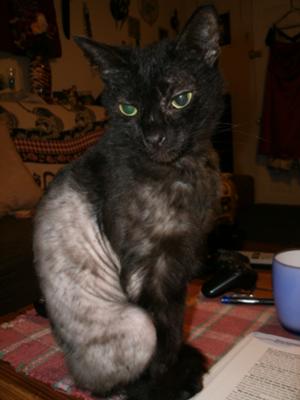
I've also twice now seen a cat that I think is supposed to be black...but who seems to be missing all his/her fur on one side! S/he is very skinny but ate like a horse during the last feeding session I observed so I'm guessing there's something skin-related going on rather than a worse, systemic thing, but it was still pretty alarming to see. My tentative guess is that this poor kitty has flea allergy dermatitis, given that s/he looks a heck of a lot like this, but it's hard to tell for sure.

Either way, if s/he ends up in the trap that will enable closer inspection as well as administration of some sort of topical flea treatment. In the meantime, though, I am seriously wondering if there's something safe we might be able to sprinkle on the food that could help reduce the parasite load for the ferals. Any suggestions would certainly be appreciated.

But back to my original point about shifting colony dynamics. I really shouldn't be surprised to see this sort of thing at all. I tend to think of spay/neuter purely in the sense of it being Kitty Birth Control, but it also impacts hormones. Which means that it will also likely impact the social organization of the colony, what with far fewer cats engaged in courtship and mating and all that accompanies those activities.

The newbie tabby male I described above has probably just moved in to fill what he sees as an opening. I didn't realize before the extent to which Blue was "guarding" the yard over the past few months (in addition to guarding his adopted babies). With him gone, and with JB/Tuxie neutered, there's been a decided drop in testosterone as of late. And I never noticed this until now, but in general it seems like the majority of long-term colony members are female, both spayed and unspayed. There's a much higher "turnover rate" with the boys, and quite a few have just seemed to disappear as mysteriously as they've appeared.

Tuesday, March 22, 2011

TNR Report #1: Blue and Grey

Hooray! I am happy to report that two cats were successfully trapped last night, and taken to the Humane Society for spaying/neutering today.

I really wanted to try and get three cats in (seeing as I've now got three traps -- four if you count the smaller "kitten trap" that came with one of the bigger ones) but the HS has a 2-cats-per-appointment limit right now except on special clinic days. I was surprised and somewhat disappointed to learn of that limit, though I can understand it from a resource standpoint. And I will definitely be on the lookout for the "special clinic days" where apparently you get to bring in more cats at one time.

On the major plus side, though, spay/neuter for feral cats is free this month (March 2011), so even though we're "only" going to manage to get four cats total done this week, that's at least $100 saved. The normal $25/cat fee is still pretty manageable as long as we work in increments, but still, kudos to the HSSV for offering the service for free even if for a limited time. It's this kind of thing that demonstrates and helps set a new example for shelters and animal-welfare organizations, in line with the realization that the goal should be fewer cats being turned over to shelters in the first place.

The cats we got last night were Blue (the female male Siamese mix who showed up with her his two "adopted" kittens around Christmas 2010)* and a feisty grey tuxedo boy (the same one shown here with his very protective mom, only he's a lot bigger now!).

Matt's little niece and nephew have been calling the grey and white kitty "Tuxedo" (or "Tuxie"), but I really think he needs a better, less generic name. He's probably only about eight months old, but he's clearly got quite the personality already: he's brash, bold, and insufferably charismatic. He just has this sort of swagger to him, like he's just totally awesome and knows it.

As one of the "braver ferals", he was pretty easy to trap: I had him chasing a feather-wand toy, and with that I was able to entice him into Matt's parents' house, wherein I managed to corral him in the bathroom. He panicked a bit when he realized the door was closed, and proceeded to literally climb the wall, right up to the top of the medicine cabinet (which is mounted next to the window -- which, much to Tuxie's dismay, was closed). When he realized he wasn't getting out, he climbed back down the cabinet and onto a shelf. He sat there, all scrunched up on a folded towel, until Matt came in and picked him up in a blanket and sort of eased him into the trap.

I should note that this is NOT an orthodox trapping technique, and in general, it is NOT advisable to try and pick up unsocialized cats. I was actually really surprised Matt was able to do it...my idea had been to just put the trap in the bathroom, cover it with a blanket, and then wait for Tuxie to enter it on his own (which he most likely would have, given the trap would have been the most 'cave-like' space available).

But it worked out fine in the end, and we got to at least spare Tuxie the sudden BANG-SLAM of the trap door closing behind him (which, though cats seem to "get over", freaks them the heck out to the point that they often wet themselves). There is no way the "corral in bathroom then place in trap" technique is going to work for the warier colony kitties -- they're just going to have to deal with the BANG-SLAM -- but in Tuxie's case it made sense to do it the way we did.

Blue (whose name fits her him somehow even though it's a "color" name -- more on her his personality in a bit) was trapped somewhat more straightforwardly, though plenty of sheer luck was certainly involved. After Tuxie was safely secured in his trap in the bathroom, I went outside, to where I'd put a second trap about an hour prior (though I hadn't set it...I'd just left it out there for the cats to sniff and examine). I crouched down next to the trap and went about preparing and setting it: opening the door, lining it with puppy-training pads (softer and more absorbent than newspaper), and pushing a small plate of sardines (nice and smelly!) to the back of the trap's interior.

Lo and behold, Blue came right up and sat watching me do all this. For whatever reason, the other cats (there were about 10 outside at that point) didn't bother coming over; apparently there was something more interesting to them on the other side of the yard. And once Blue smelled the sardines she he got very excited about her his discovery and walked straight into the trap as I sat there next to it. she he did actually step on the trigger, but by then I'd already released the catch manually and was thus able to at least reduce the volume of the BANG-SLAM for her him.

The rest was uneventful: into the bathroom she he went, her his trap placed a few feet away from Tuxie's and covered with a blanket. she he meowed a little when I moved the blanket to check and make sure the interior of the trap wasn't covered in sardine (as that would have made for a seriously stinky situation, come the next morning) but was otherwise quiet.

(In general she he seems to be a fairly quiet, subtle cat, and I don't think it's just because she's he's been living outside for however long. It's like her his entire bearing is quiet and watchful. She's He's very curious and has a playful side, but part of her him seems to be constantly in "analysis mode", making sure she he doesn't get carried away in any particular direction. She He comes across as very centered and mature, I guess, even though I'd estimate her his age to be no more than a year or two.)

Initially I had been thinking of putting the traps in the garage overnight, and that would still be an option if the need arose (due to managing appointments for more than two cats at once, etc.). Matt's parents' garage is a large, well-constructed building that has its own plumbing and everything, so while it's not heated, it definitely offers plenty of protection from the elements (and from any suburban predators, humans included). But the bathroom easily accommodated two cats, so there they stayed for the evening.

Then, this morning Matt's dad took the kitties to the clinic -- he generally gets up early anyway, so that worked out fine. He also picked them up this afternoon post-surgery, and they will remain in the house until the anaesthesia wears off (probably overnight at least).

So yeah. Overall, the first round went so smoothly that this whole project is looking a lot more doable. Hopefully tomorrow (Wednesday) goes just as well, because we get to do it again (albeit with different cats this time)! I am not sure which cats we'll try for, but I am hoping to get at least one of the less bold ones, and I imagine since we were able to trap last night's pair so quietly and unobtrusively the shy kitties won't have been startled away from any willingness to investigate the traps.


* As I've noted previously, Blue is more likely a "nervous stray" than a wild-born feral cat. However, given that she he is still so relatively wary, and given that she appeared to have a whole cadre of admirers following her around last night, I figured it made more sense to just go ahead and get her spayed BEFORE she got pregnant again!

[UPDATE/EDIT: Blue turned out to be a boy, as noted in my next post with more supporting detail. I was pretty surprised by this but in any case it certainly suggests a re-interpretation of why so many other boy kitties were following him around...my guess now is that they were trying to challenge him to fight!]

Saturday, March 5, 2011

Santa Clara's Feral Cats Need Help!


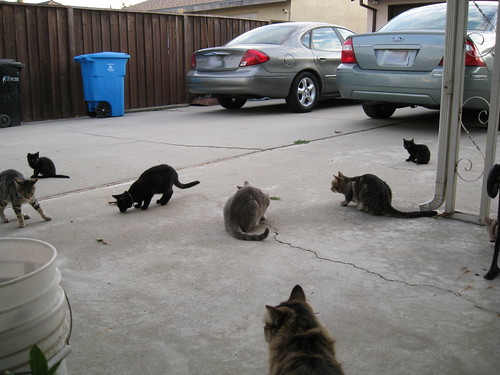
Above is a typical scene in my SO's parents' neighborhood (about 2 miles from where Matt and I live, in the same town). As I've noted previously, Matt's parents live at the epicenter of a pretty robust cat colony, and between their efforts and mine and Matt's, we've managed to get a total of nine (counting my three youngsters) cats spayed/neutered over the past three years or so.

And while that's certainly had some positive effect (as the nine cats in question are all currently alive, healthy, and either living happily in their adoptive home or outdoors with their companions)...well, the colony needs a lot more help. There are at least seven more cats out there of reproductive age who aren't yet fixed, and at least six kittens (including the two adorable little black ones in the photo above).

Plus, unfortunately it seems that some humans apparently think it's okay to abandon cats in that area. Right around Christmas 2010 a mother cat (a Siamese mix we've been calling "Blue") showed up with three babies in tow. And it's clear that Blue is not feral, but rather, a very nervous stray. Her coat is all scruffed up (that's one way you can tell a stray from a feral cat -- ferals are accustomed to taking care of themselves outdoors, but strays have a rough time of it), and she will approach humans...but she seems very leery of hands, which makes me wonder if maybe she was not only abandoned, but abused wherever she used to live (or, if she was lost by accident, mistreated by other humans before she found her way into this neighborhood).


Picture above shows Blue in the foreground. Her daughter Dominique is in the background.

Anyway, to make a long story short, there are at least thirteen cats in this colony that we really want to take in for spay/neuter (and rabies shots if possible). If all these cats end up reproducing again for even one generation, that's going to be...well, a lot more cats than the neighborhood can reasonably support.

And it just terrifies me to think of someone deciding to call Animal Control to round up and kill them. It's not their fault they're out there, after all, and in general they're no trouble to have about. But they would all live much happier, safer lives if we were able to take them in for Trap-Neuter-Return.

And I am sort of at my wit's end right now trying to figure out how to make that happen. The logistics are, in a word, daunting.

Thus, this post is mainly a call for advice, especially (though not limited to) from people who might have a clue about relevant groups and/or services in California's South Bay area.

Mind you, I know full well that the Humane Society of Silicon Valley supports TNR and offers trap rental, etc. for feral and stray cats. That's where most of the currently fixed kitties in the local colony went for their checkups and surgery, in fact. But how to get thirteen cats there in one go? I haven't the faintest.

I also know that Silicon Valley Animal Control has a low-cost spay/neuter service. But I don't trust them. Matt's parents initially tried taking Toby there (as a tiny, sick kitten) and almost immediately they said "Well, we can put her down for you...". Needless to say, Matt's mom left THAT place in a hurry (and today Toby is a lovely, healthy almost-4-year-old ladycat).

(I also recently confirmed, after contacting someone who works with Animal Control locally, that they are still pretty quick to indiscriminately kill. E.g., they will kill any kitten under four months old simply because they're too young to receive a rabies shot, and they will also kill adults who appear to be at all unwell, even if their illness is treatable. So while they may offer inexpensive spay/neuter surgery there is NO WAY I would bring any animal in there unless I got to bring at least two other people with me, at least one of which was really good at communicating/advocating in realtime and would be able to help guarantee that the animals would NOT be killed, and that if AC planned on killing them, we'd get a chance to take them elsewhere.)

But anyway. All that aside, here's the critical stuff I am attempting to work out:

1.) Transportation! I personally don't drive (can't, for neurological/disability reasons). Matt can drive, but his car is extremely small (a two-door Focus hatchback) and we'd only be able to fit maybe two or three traps in there at most.

Thus, really, what I am wondering is whether I might be able to find/hire an experienced driver with a van or something who has actually dealt before with transporting large numbers of cats at once. Like is this the sort of thing one could put an ad on Craigslist for? Or even better, is there some local feral-cat advocacy group that for whatever reason I've not personally found a way to get in touch with yet?

2.) Scheduling! Every clinic I've been able to find any information on locally says you need to have an appointment. But if you want to bring in a bunch of feral cats, it's sort of hard to GUARANTEE you're going to have a particular number of cats. It depends, after all, on how many end up walking into the traps! So if anyone knows anything...phone scripts for talking to clinic reps or anything else...that might make the appointment-making go more smoothly, PLEASE feel free to comment with that info (or point me at it).

3.) Help with trapping! Part of this ties into "transportation", as Matt's parents have only one trap and we'd thus need to rent a whole bunch more if we wanted to get the whole colony (or as much of it as possible) in one go. Then there would be the matter of monitoring the traps, covering them (so the cats won't be as frightened) once they're sprung, etc. I can do this myself for a few traps, but if we really want to go and do the Big Difference-Making Mass Trapping Day, we'd definitely need some additional humanpower.

4.) Event Planning! This one is kind of...optional, but definitely something I'm looking for information about. Because I've heard sometimes communities have "TNR events" where a bunch of vets will volunteer to spend a day doing spay/neuter surgery on kind of a mass basis. How does that kind of thing get initiated, though? I can't imagine it's just a matter of one person going in and talking to their vet.

So yeah. I would REALLY TREMENDOUSLY appreciate ANY input on any of the above matters. Note that I am NOT asking or looking for money here, just advice and/or links, contacts, and resources. All I ask is that people please not just tell me to "call the humane society" or "contact animal control", because I've tried doing both those things and neither led to any sort of help at all with transportation, trapping, etc.

I guess the bottom line is that I keep reading all these random news stories from various regions with headlines like "Local Feral Spay Day A Success!" and I keep wondering how the heck that sort of thing gets orchestrated and how it could potentially happen in my community.

Saturday, January 22, 2011

Veturday Round II

Brodie went in for his shot boosters and check-up this morning (following his siblings' visit last week). As I'd sort of suspected would be the case, he took the carrier and car ride with a lot less angst than his siblings. Even though he's the most timid around visitors to the house, he actually seems to be the bravest when it comes to things like Adventures In The Car. It's really interesting seeing how complex the siblings' personalities are in that regard...like you can't just label them as over-archingly "the brave one" or "the scaredy-cat" because they're all brave and scaredy about different sorts of things.

But I digress. Per the vet, Brodie appears to be in lovely health. No heart murmur either, hooray! The only small area of concern is that Brodie actually does appear to have some (probably genetic) susceptibility to gingivitis. He eats the same stuff as his siblings, his gums just seem more sensitive and for some reason food seems to "stick" more to his upper teeth. So in an effort to stave off further problems I am going to at least attempt to start brushing his teeth regularly. I tried it today and he wasn't entirely happy with having a little plastic thing shoved into his mouth, but he was a very good sport about it and I managed to at least touch all the relevant tooth-surfaces with the brush. Next time I might try one of the little "finger" brushes I got a while back but never really got into the habit of using on the kitties.

Oh and Brodie weighed in at a nice 13.5 pounds. Which the vet seemed totally happy with, and which looks like a good size for his overall frame (which is long and squarish but not as block-like as Shadow's).

In any case, I and the kitties are very glad to have all that vet business over with. Next up on the catblogging agenda: more pictures, and possibly some videos of the youngsters working out a new puzzle!