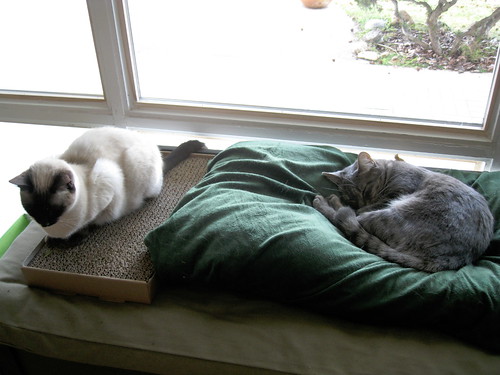
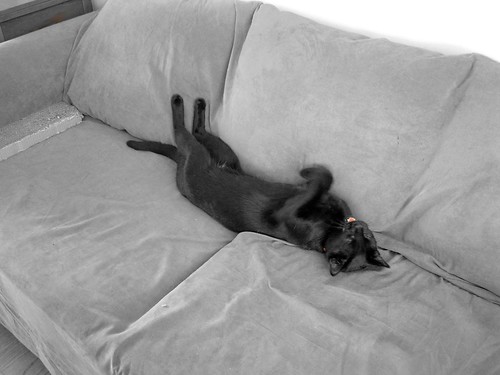
Coraline and Shadow are definitely both very high-energy cats. In Coraline's case this has been apparent since she was tiny. Shadow, however, has taken over a year to get to the point of enough confidence in his environment to really express the extent of his exuberant nature. He's still Brodie's favorite snuggle-buddy, of course, and can nap like a pro when he finally manages to wear himself out -- but that can take a while!
Accordingly (and much to my delight), he and Cora have actually become much more closely bonded over the past few months. As some may recall, Coraline and Brodie were actually adopted three weeks before Shadow simply due to the uncertainty inherent in trapping from a feral colony.
Brodie and Shadow got along famously from the moment the brothers were re-united, but Cora spent the first few weeks after her briefly-estranged sibling's arrival hissing and growling at him whenever he entered her sight. Eventually she came to accept him, but for ages she and Shadow were both closer friends with Brodie than with each other. Now, though, I'm seeing something different in shape but equal in (positive) magnitude developing between this particular sibling pair.
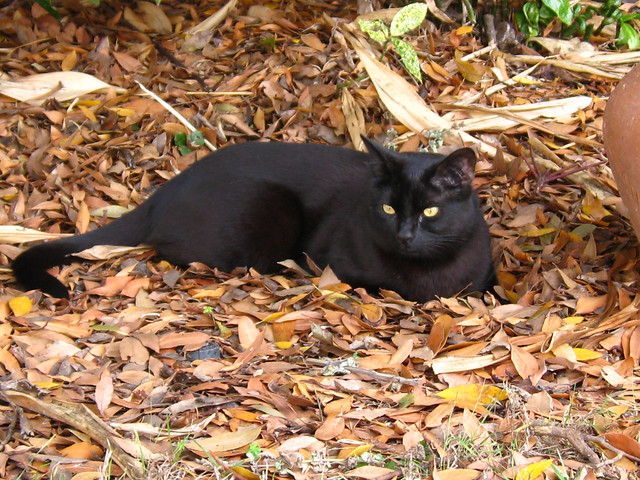
(Above image - Cora surveys the yard this past weekend, when I let her and Shadow out to run around a bit while I worked on my laptop on the patio.)
Brodie remains the go-to sibling for cuddles and free ear-washing (and the occasional but vigorous round of CHASEWRESTLEGRR, which even cats of the Garfield persuasion enjoy sometimes) but Cora has definitely gotten to the point where she knows that if she needs a partner in mischief or someone to tear randomly around the house with, Shadow is her guy.
It's also been neat seeing these two teach each other things. Cora has always been the most mechanically inclined and apt to experiment with objects of her own accord, while Shadow took months longer than either of his siblings to get to where he'd (for instance) bat treat-puzzle balls around just-so to dispense the crunchies within. It wasn't that he lacked the brainpower to operate the treat puzzles -- he's just always had the natural predisposition toward persuading others to do things for him (a trait he actually shares with Nikki).
Lately, though, he seems to have come around to the idea that there are some things he can better accomplish without running immediately to ask for help. E.g., he's become quite the expert at opening any door that isn't latched, and has managed to sneak into the bedroom behind me quite a few times recently!
(Above image - Shadow rests a while in the leaves after a vigorous game of Garden Tag with Cora. None of the kitties here have unrestricted outdoor access but on nice days these two really appreciate a chance to run off some of their energy in the back garden.)
Cora, in turn, seems to have experienced something of an epiphany in the opposite direction, as she seems to have become a lot more vocal all of a sudden, and has even adopted some of Shadow's "super secret weapons of human persuasion" (such as what I refer to as the "kittens of the damned stare" in addition to the "Lassie move" where the cat basically orders the human into a different part of the house and looks pointedly at the thing they're interested in, which in Cora's case is usually the back door!).
Of course both of these kitties have maintained their innate inclinations toward Explorer/Engineer (Cora) and Mr. Charisma (Shadow), but it's abundantly apparent that their growing friendship has led to a really neat expansion of both of their respective skill-sets. Which is just super cool to see.
This past weekend I visited some longtime friends (a couple) who have no cats, but who do have a dog. His name is named Skip, and he is about eight years old.
Skip and I have somewhat of a turbulent history, in the sense that when my friends first adopted him (at about a year old) he was so intimidatingly hyperkinetic and gregarious that I frankly had no idea how to handle his presence. I spent many a visit following his arrival in my friends' household trying to avoid Skip and silently attempting to will him away from sticking his nose in my food (or my butt, for that matter).
My instincts were also apparently more than a little bit "off" because somehow at one point I got it into my head that if I gave him my pizza crust he would leave me alone. As you can probably imagine, this is NOT what ended up happening. What ended up happening was that Skip determined I had to be the world's biggest pushover, and thus for as long as he's lived with my friends he's had a tendency to follow me around, well, like a puppy dog.
Now, of course I don't literally believe humans can be divided into "cat people" and "dog people" in a strictly binary sense. I've known plenty of folks who've lived happily with both species (and also with rabbits, goats, chickens, and even llamas in the case of my grandparents!). But in general I am quite comfortable describing myself as, by and large, a Cat Person. Cats have always just seemed a lot more respectful of others' personal space, "oh hai, here's my butt in your face!" moments notwithstanding.
They also generally smell better than dogs (superficial, I know, but it's true...most dogs I've met smell disconcertingly like stale cheese, whereas cats smell like lavender and autumn leaves and fresh earth to my admittedly atypical olfactory system) and they're (generally speaking) a lot more inclined toward the "parallel play" type of interaction I tend to prefer with most living creatures, at least when I'm expected to remain in the presence of said creatures for any length of time.
With cats, you can just be in a room doing your thing and they'll be doing their thing, and even without constantly being in each other's business, there's this wonderful ongoing invisible-reciprocity thing at work. Of course there are exceptions to this (I actually just sat down again after a brief but intense game of "run madly around the house" with Nikki, who had been pestering me with her most emphatic "I AM BORED, COME ENTERTAIN ME, HUMAN!" door-scratching routine) but on balance I meet far more "parallel-inclined" cats and far more dogs who seem to want and need a heck of a lot of "face time" and very direct forms of acknowledgment.
Dogs, by and large, tend to put me into the same vaguely-agitated state that small children (of the age when kids tend to be yelling "LOOKATME! LOOK AT ME! LOOK AT THIS! WATCH!" about everything) or human extroverts (of any age) do. As if they're constantly breathing down my neck going "Why are you so quiet? Are you upset? Are you bored? Are you lonely?? Are you okay? Are you SURE you aren't sad???", and then basically proceeding to repeatedly hassle me for some intangible response that I have no idea how to give.
That said, I've known a handful of truly excellent canines, such as my grandparents' old Australian Cattle Dog, Matilda. Matilda was outgoing to be sure, but she was so polite, and I remain indebted to her to this day for helping me find my way back to the house after I got lost in the snow as a youngster one winter. But overall at this point in my life I see dogs the same way I see children: fine, as long as they're other people's, and as long as they're not constantly jumping up in my face.
Which brings us back to Mr. Skip. At eight years old he's far from being a sedate dog but he's definitely mellower, and he's gotten a whole lot more thoughtful and patient. He still follows me around and gives me every manner of piteous begging-face, but his manners have improved tremendously and he is long past the age when he would actively stick his snout into my plate (or worse).
Anyhow, this last time I visited my friends and Skip, one really interesting thing I discovered was that there is actually some amount of crossover between relating to cats and relating to (at least some) dogs. Or at least there seems to be.
My guess is that it's something to do with practice -- as in, when you live with several nonhuman creatures day in and day out, you sort of end up shifting into a mode where you very readily and automatically start seeing them as "stakeholders" in the environment you share with them.
And when you experience that perspective-shift, suddenly you stop being as annoyed by whatever actions of theirs you don't quite understand.
Or something like that, at least.
In any event, during this past visit I actually managed to have a lot of fun interacting with Skip. The coolest part was where he approached me and taught me how to play a game he liked (one which mainly involved him running around the dining table playing a variant of "keep-away" with one of his toys). His humans had no part in showing me what to do; I just followed Skip's lead and found him to be a wonderfully clear communicator.
Again, partly I suspect much of this is due to the fact that he's older now than when I first met him, and I'm a lot more comfortable with mellow(er) older dogs than with hyperactive puppies and young dogs. But I am quite sure that something else -- something on my end -- has also changed, and I would wager my cats (especially Nikki, who is probably the most regally demanding cat I've ever met) are largely to thank for it!
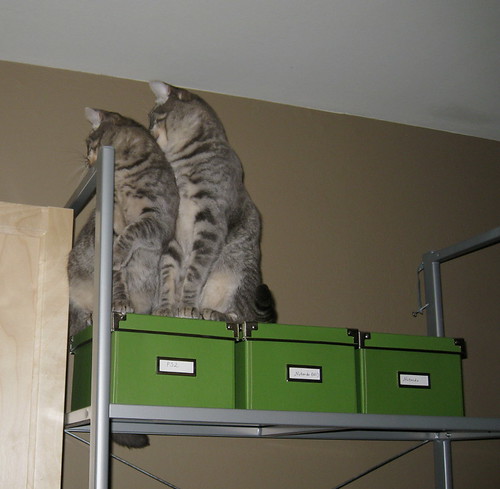
(Photo above shows Cora, Shadow, and Brodie snuggling on their new favorite shelf-bed.)
One subject that's been on my mind rather a lot lately is social maturity in cats. Small felines reach reproductive maturity anytime between about four and twelve months, but social maturity can come considerably later -- usually sometime between two and four years.
Why has this been on my mind? Well, mainly because Coraline, Brodie, and Shadow will be two years old in August, and it is clear that things are shifting within the Kitty Social Order around here, as well as with respect to individual cats.
All three youngsters seem to have gotten considerably more confident and more sure-footed over the past two months or so. This has been dramatically in evidence for Brodie in particular. Cora (who has always been the boldest and most assertive of the three) is thus having to deal with two brothers who no longer just defer to her when it comes to who gets to sit on the softest bed or the highest perching spot, or who simply aren't agile enough to get to such places.
Brodie, meanwhile seems to be reveling in his newfound assertiveness. While he is still very shy and cautious around unfamiliar humans, Brodie's interfeline negotiation toolbox now includes such items as "challenge sister for the top perch on the cat tree and chase her until she decides to give up and go sit somewhere else".
It is a wee bit odd, I must say, to see that sort of thing from someone who is generally such a polite cat. But given nobody ever has a scratch on his or her person following such a scuffle, I'd wager these tiffs are just a bit of sibling one-upmanship as opposed to serious fighting.
Much like human adolescence, social maturity is the prime time for cats to jockey for social positions. This may cause subtle and not-so-subtle shifting in the pecking order in a formerly peaceful, well-established cat family. This can be a time when a cat feels more confident and views an opportunity to elevate his status.
In other words, as cats near social maturity it is perfectly normal for them to start asserting themselves more. Thus, so long as nobody is getting hurt (which they aren't) and as long as nobody seems to be showing signs of undue stress (which I'm also not seeing) I figure it's probably best to just keep an eye on things and not worry overmuch.
After all, in amidst the "position-jockeying" Cora and Brodie continue to share napping spots on occasion and play cooperatively. They're very closely bonded still, something which is evident even in casual contexts (like in the picture below, when they were both watching a toy):
I am really beginning to see the benefits of raising littermates together in all this...clearly Cora, Brodie, and Shadow have managed to learn the finer points of claw-sheathing and bite-strength moderation. Kittens taken from their families very young may have issues later on with biting, etc., because they've not gotten the social experience that lets them learn what actually hurts vs. what simply makes a statement.
As for Shadow specifically, what I've noticed there is that he has recently gotten a lot quicker to assert his opinions to his siblings, as well as much bolder when it comes to standing his ground with the human members of the household. E.g., whereas before all I needed to do was look at him if he jumped onto an off-limits surface (such as the stove) and he would get right down, now he will stare straight back at me and hold his position until I literally get up and walk over there.
I have also lately been wowed repeatedly by Shadow's growing talent at anticipating and reading the actions and moods of his housemates (human and feline alike). He's gotten particularly adept at figuring out when I am about to give Nikki food in "her" room (she prefers to eat privately), sneaking in, and hiding under the futon. Of course Nikki knows when he's there even when I don't and generally she lets me know, but still.
It is amazing to consider the tiny little cues Shadow must be picking up on in order to determine "hey, if I go hide under here now, maybe I'll score some extra crunchies!" Because he just seems to KNOW what I am going to do, even before I get up to do it. He really does run circles around me (figuratively AND literally sometimes!) in this department. And his sense of humor (which is very much of the "trickster" variety) is developing in leaps and bounds. E.g., where he used to just randomly chase Nikki around the house (something that she did not appreciate), now he's more liable to do a kind of "fake-out" move wherein he simply jumps or runs in her general direction but then alters his course just prior to breaching Nikki's personal space boundary.
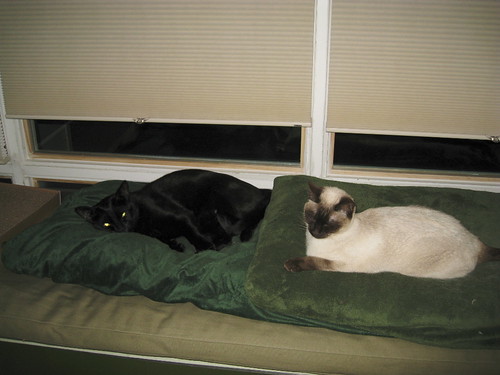
Nikki, meanwhile, nowdeems him worthy of close-range pillow-napping (he used to get away with cuddling up to her occasionally before, but usually she'd swat him if she "caught" him making such an attempt. Now she knowingly lets him sit near her. Hopefully he realizes what an honor that is!):
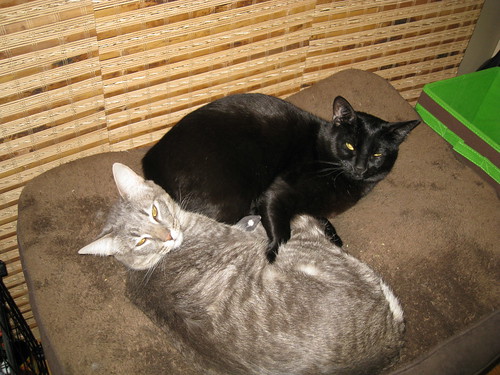
...and of course, he and Brodie are still total snugglebuddies:
Coraline, as noted above, has always been a very confident cat, so her recent advances in that area (while there have certainly been a few) haven't been as dramatic as her brothers'.
Cora, looking lioness-like as she captures the feather toy
Primarily what I've observed with regard to her lately is that she's gotten more strategic. I've had to go through yet another round of cat-proofing in the house: securing shelves, moving items that could be knocked down, and applying non-skid material to surfaces that weren't necessarily intended to be for kitty-climbing (but which, I figure, I'd better make safe for such activities since it seems they're going to happen anyway!).
Additionally, much to my utter bewilderment, Cora seems to be trying to befriend (or at least develop some sort of mutually amicable relationship with) Nikki. Nikki now lets her much further into her substantive "personal space bubble" than previously:
(The above picture was taken just after Cora had made a "brrrt!" greeting-noise at Nikki and rolled over on her back.)
Cora will happily challenge her brothers for a favored path or resource, but somehow, it seems she's come to see Nikki as someone meriting a certain degree of deference. Which is something I am kind of relieved about, given the very strong personalities of both girlcats here. Upon introducing them I figured someone was going to have to start granting the right of way. And it does make sense it would be Nikki, given her seniority and relative worldliness.
Anyway, needless to say, I am very glad I managed to outfit my desk area and office closet with a whole new set of climbing, perching, and napping-spot opportunities recently. Since currently none of the four cats here (not even Nikki, since being injured fighting outside late last year) have unescorted access to the outdoors, it is really important that they have sufficient indoor territory, especially as they continue to mature and seek their place(s) in their home.
I want to do a series of videos showing interactions between cats and other cats, between cats and their environment, and between humans and cats. Mainly I want to highlight two things with these videos: (1) things cats do and ways they might respond and communicate that aren't commonly noticed or mentioned, and (2) how humans might, by taking feline nature and individual cat-personalities into account, interact more respectfully and on a deeper level than before with cats.
The first video of this sort is embedded below:
It's a bit "rough", especially in terms of the audio...unfortunately when I was filming the water heater in my house (which is old and nearing time for replacement) was making all these obnoxious banging noises, which the camera microphone picked up even though I was in a separate room from the heater.
I also didn't script the video due to the fact that I was not sure what the cats (Cora and Shadow in this case) were going to do, and hence my narration is not super articulate. I did attempt to add captions, though, so hopefully that compensates for some of the audio issues.
Anyway, basically in this video I am trying to convey something about approaching cats (as a human living or otherwise interacting with them). Because one thing I see a lot is humans who don't seem to consider whether or not a cat might WANT to be petted or picked up. And a lot of people don't seem to even have an idea that cats CAN communicate this kind of thing, I mean outside something really egregiously obvious like running away or squirming.
But I am quite certain there's a heck of a lot being transmitted by the cat before they get to the point of needing to do something really blatant. While of course I can't claim a direct pipeline into the feline mind, I've definitely gotten the sense over time that cats prefer a modicum of politeness on the part of their human(s) when being approached by same. And while I'm not perfect at the finer points of feline politeness myself, I certainly plan to keep trying to get better.
This particular video just sort of introduces the topic of approaching cats, without getting too deeply into explanations. Initially Cora and Shadow were sitting on the bed together, but then they engage in a few seconds of grooming leading to (unserious) face-biting followed by Cora deciding she was done napping and proceeding to amuse herself jumping about the room and climbing on things. Shadow, meanwhile, stayed on the bed for some more relaxation with me. The end of the video hence trails off a bit into a rambling description of Shadow's tendency to pick up human words...of course that's not the ONLY thing he does that's interesting or worth noting, but it's what I ended up talking about in this case.
So, like I say in the video, hopefully future chapters of this will be better planned out. But I do really like the idea of observing cats in real-time like this. The next video, which I hope to have up before this week is out, will be on the concept of inviting cats (to sit with you, to share in some activity, etc.).
Recently I tried looking up studies and/or scholarly articles on the phenomenon of Cats Knocking Things Over, but didn't come up with any interesting results. The majority of writing on this subject seems to be in the context of advice on "cat behavior problems", e.g., Dealing With Cats That Knock Things Down, How can I get my cat to stop knocking stuff over?, etc.
(Of course, if anyone has any links to papers on this subject please feel free to share!)
But anyway. It occurred to me, upon seeing Shadow (one of three ex-feral littermates sharing my home) push a container of cat treats off my desk for the nth time earlier today, that (if it was indeed being done deliberately) such an action might represent a fairly well-developed understanding of certain physical principles. I.e., the fact that if one cannot readily access the contents of a treat-containing object, one might be able to gain access via utilizing the tendency of objects to fall over when pushed or similarly manipulated.
(Full disclosure: as a person on the autistic spectrum who is also interested in neuroscience and relevant cognitive research, I must admit it tends to catch my attention whenever I encounter what to me looks like an interesting ability or trait, in any species, being largely written off as a "behavior problem". Often it seems to me something is being missed when this occurs, so I'm driven to investigate in situations like this!)
Certainly the standard "I am not a professional researcher, this was all done completely informally, my home is not a laboratory, etc." disclaimer must be applied to these results. Moreover, I am well aware that interpretation is not data (and vice versa), and in truth the only thing that can be said for sure is that at least one of my cats pretty consistently knocks over objects when is is conceivable that he has reason to believe these objects could contain treats.
The following three videos appear in chronological order. All were filmed on 5 September 2010, in the afternoon, within the space of maybe twenty minutes.
In this first video ("Cats and Gravity I"), Shadow is shown pushing a sealed container of treats off my desk.
He had precedent for doing this, as this particular container is the usual one I put the kitties' daily allotment of treats in. Once, about a week ago, I left the lid part-way off, to see what he would do (seeing as he'd definitely be able to smell the treats within). And in that case he proceeded to nudge the container around with his nose until it fell off the table, scattering treats hither and thither, much to his and his siblings' delight.
Now, I am fairly certain that this first knockdown was an accident. However, since then, Shadow has pushed the treat container off multiple other surfaces (besides the coffee table), on multiple separate occasions. "Cats and Gravity I", then, seems like it could very well represent Shadow's having learned that "if I push this container, sometimes treats fall out!" I don't know that anyone in the cognitive research field actually believes this level of reasoning is beyond the domestic feline (I suspect not) but in any event, it makes for a good "baseline" data point in terms of the variables I am interested in observing.
In this next video ("Cats and Gravity II"), we have an interesting situation involving three cats. You may remember Coraline and Brodie from all those string and zip-tie trials I ran as a rough check of what experimental design conditions might be improved so that cats could better demonstrate their actual cognitive capacities in string-pulling tasks. In the case of that set of puzzles, Cora and Brodie were the only participating felines; Shadow preferred to simply watch.
However, in "Cats and Gravity II", you will observe that Brodie "experiments" with the treat-containing bottle but doesn't succeed in getting anything out of it, whereas Shadow makes one single decisive swipe and sends the thing crashing down. Note that this bottle is different from the treat container in the first video, but it is one that I've put treats in several times prior to this, so the cats would definitely be familiar with it.
(Coraline, meanwhile, is ignoring the whole business and seems more excited about the fact that I've gotten up from my computer chair, giving her an opening to steal it. To me this mainly suggests that at different points in time, different cats may have very different priorities!)
And then we come to "Cats and Gravity III". The outcome of this scenario completely caught me off guard (you may even be able to hear me exclaim "HOLY CRAP!" at one point). In this case I took a treat container that would be new to all the cats (another empty vitamin bottle, this time a dark purple one slightly larger than the white one used in "Cats and Gravity II"). I let them watch me putting treats into it, and then placed this bottle on top of a small end table in the living room (a different surface in a different part of the house than my desk, to control for position habit).
In this case, the video shows that initially none of the cats really showed interest in the new treat bottle when I first placed it on the end table. However, after I went over and shook it a bit, Shadow went over to the table, put his front paws on the top surface, and then proceeded to lift the bottle up with his mouth and throw it down onto the floor. (That's where I exclaimed "HOLY CRAP!", by the way.)
So...what to make of this?
Subjectively speaking (yes, I'm about to offer an interpretation), it looked to me like Shadow spontaneously came up with a really creative way of getting the treats he knew were inside the purple bottle. Which would suggest that he's learned to generalize beyond "if I paw at this maybe it will fall and treats will come out" and now understands that it is not the mechanical motion of pawing or nosing that's important, but rather, the falling of the bottle itself, if one's goal is to get the treats out of the bottle. This, to me, seems pretty significant, and again I'm curious to know if there's any literature out there saying one thing or another about this type of cognition in felines.
However, this was of course a tiny sample set. And I did not do this series of "mini-trials" in response to another study I'd be able to cite and/or comment on -- like I said at the beginning, I couldn't find any studies about cats knocking stuff over. No peer-reviewed references = not "ResearchBlogging". Plus, for all I know, cats' understanding of gravitational cause-and-effect is already well documented and known and I just fail at searching for this documentation.
That said, at the very least, I think anyone who really wants to study cats' understanding of cause-and-effect as it pertains to objects in a broader sense would do well to try out a variety of different scenarios involving different types of objects, and requiring different types of attentiveness and planning on the cats' part.
I find it terribly problematic (and this goes back to my discussion of the string experiments again) when a single particular test is taken (whether by the study authors, the media, or both) as meaning something globally significant about a given population's abilities or lack thereof. In the absence of a single task (or task type) with huge amounts of existing data backing up its ability to test "general" cognitive ability in a given domain, multiple tasks of varying attributes would seem to me required for appropriate levels of rigor.
Also, I have to say that another reason I wanted to post these videos is because now more than ever I am beginning to think it is very important to have as much of an experiment on record (for multiple parties to view and evaluate) as possible. Even though I (hopefully) disclaimered the heck out of my string experiments, I still would rather do things as close to "right" as possible for a layperson -- just because I'm not a real researcher doesn't mean I can't practice holding my informal stuff to higher standards.
Finally, I would just like to say that I would be extremely interested to get people's comments on what it looks like is actually happening in the videos above. As in, if you think Shadow is doing what he's doing deliberately, what aspects of his actions lead you to think that? I'm curious about this because I see my cats doing all sorts of things all the time, some of which (to me) look "deliberate", whereas other things they do look thoroughly "accidental". Only I haven't come up with a good way to describe what "deliberateness" looks like in quantitative terms.
I suspect that in general this sort of issue comes up a lot in animal cognition research, which has me curious as to whether there even exists any kind of objective way to measure something so "internal". Behaviorism (in my opinion) fails miserably to account for everything that could potentially be important (for one thing it often seems to completely fail to account for, say, different sensory and perceptual modalities on the part of the researcher vs. subject), and much of what I hear from "evolutionary psychology" sounds like it's been pulled straight from someone's nether orifice, to put it politely. So I'd be really intrigued to know what other tools or paradigms may currently be out there that might be more promising.
Scene: computer room, my house, around 7:30 PM this evening
Shadow (from the floor behind my chair): "YAAAAAAOW! YAAAAOW! MYOOOOOUUUU! MRRREW!"
Anne: "What?"
Shadow: "YAAAAAOW! REEEE! MIEW! MMMMM!"
Anne: "What, little guy?"
Shadow: "Nrrrrrrr. Miew. YAAAO!"
Anne (gets up from chair): "Okay, fine, Lassie, show me what you want."
Shadow: *gets up, trots into the hallway*
Anne: *follows, waits to see which direction Shadow seems to be going in*
Shadow: *heads toward kitchen*
Anne: *follows*
Shadow: *plunks self down on linoleum, looks at Anne, looks out window*
Anne: "You want me to sit down?"
Shadow: *motions in the affirmative*
***
So, I sit down, right on the linoleum (which is actually linoleum and not vinyl). Shadow proceeds to snuggle up against my leg. I hear the purr motor start going.
Seated there, I notice that there's quite a lovely breeze coming through the back screen door. The air smells fresh and carries little notes of back-yard with it: tomato leaves, pepper, dry grass. Then I look out the large window overlooking the patio.
Through the trellised semi-roof over the concrete surface next to the garden I see a huge flock of birds making their way across the sky. They're too far away for me to tell what type of bird they are; all I can see is that they're dark-colored, too small to be crows, too large to be sparrows.
Shadow and I both sit there for a while. I don't keep track of exactly how long. The birds pass in waves: one group, then another, then another. The breeze continues to blow. Shadow climbs into my lap, still purring.
Eventually, of course, I have to get up, so I do. But not before thanking Shadow.
***
Cats communicate. They may not speak (in English or any other human language) but they certainly have plenty to say. I do not claim to understand cats in general, or any specific cat, perfectly, and I find it unnerving (and often a sign of bad ethics) when any human makes such a claim.
However, in living with cats and noting the patterns of how they interact with me, with other cats, with objects in their environment, etc., I have definitely come to realize certain things about listening. Not listening with ears, per se. -- more like (and readers of Michael Ende will know what I mean here) Momo-listening.
What cats have to say can be very subtle. Shadow meows loudly and often but that is only a miniscule part of what he says. Yes, he often wants a snack, and sometimes it's clear he wants me to get one of those wand-type toys he loves and wiggle the string so he can chase the feather-tailed mouse or whatever happen to be attached. But other times he just plain surprises me.
***
The incident related above is foremost in my mind as I write this, yet it is far from isolated. I have been astounded more times than I can count at the complexity and delicacy of what my cats tell me, how their actions illustrate what they're noticing and paying attention to in the world around them.
There is just not much in the human culture with which I am most familiar (or its common vocabularies) that prepares someone for this kind of thing.
For listening to cats involves a lot of what I would call "the cognitive equivalent of peripheral vision".
It involves a lot of not as well: as in, not immediately assuming the cat just wants food, or even play, or generalized "attention". It involves not placing fixed, arbitrary limits on your idea of what cats are capable of thinking, experiencing, and doing.
This is, in part, because cats are so good at being cats, they don't actively require our approval or permission to continue doing so throughout their lives. In other words, their catness is not dependent on being judged proper or sufficent by humans; catness simply is, and cats are surely cats even when no-one is looking.
This means that a human might "keep" a cat, feed her, change her litter, pat her head and call her a good cat on occasion -- presuming the whole while that their human view of their coexistence encompasses the whole of the cat's existence and experience. When in fact nothing could be further from the truth. The truth is that only cats have subjective knowledge of what being a cat feels like, and the truth is also that cattish priorities very often differ from typical human ones.
As for me, while certainly I am not a cat, I am very interested in what they have to say. I want very much for them to feel like they can show me where to sit to let a nice breeze wash over one, and where one might get to witness a dazzling display of avian migration. I want them to know that I see their priorities and interests as valid and genuine. I do not know the degree to which this will ultimately be possible, but I am sure as heck willing to keep trying my darndest to listen.
(a) Most of the popular articles regarding that study made what looked to me like unwarranted interpretive leaps (sadly not much of a surprise there these days), and
(b) While the study itself read as more "neutrally investigative" and data-focused than the popular articles, it did not seem as if the experimental setup necessarily accounted for feline sensory modalities, and hence may not have permitted a true test of the cats' cognitive capacities in the area of physical causality.
So, in light of item (b) above, and in light of the fact that I had all the necessary components on hand to create a setup similar to that used in the aforementioned study, I decided to see if my own feline housemates might be interested in trying their hand (or rather, paw) at some string-pulling.
Of course I am not aiming to present my own "results" as Real Scientific Data; they were, after all, quite informally obtained from a tiny sample set. At the absolute most, observations presented herein might represent a sort of "proof of concept", i.e., how setups could be improved in future experiments to increase the likelihood of meaningful results. Overall, though, I mainly did this for fun -- for me, and for the cats!
BACKGROUND
Four cats were offered the opportunity to participate in this activity:
The three younger cats (Coraline, Brodie, and Shadow) were littermates, born into a feral colony. I adopted them when they were between 7 and 10 weeks of age. The elder cat (Nikki) is unrelated to the others, was born into a cattery, and lived with my parents until early 2010.
All four cats had lived with me for at least six months prior to the experiment, and since the experiment took place in my' home, they did not have to acclimate to an unfamiliar environment beforehand.
PREDICTIONS
Predictions going into the experiment were as follows:
(1) At least one cat (of the four) would demonstrate both motivation and ability to complete at least one task case successfully.
(2) Performance (in motivated cats) would improve when the treats were made more visually obvious, i.e., via use of color and size contrast.
(3) Performance might improve if a less flexible medium (i.e., plastic zip ties rather than string) was used, as this would provide faster feedback to the cats regarding their efforts and would be less likely to induce distraction (cats often find strings, and their movements, extremely interesting in their own right).
SETUP
The setup used in this exercise was based on the description provided by the study1:
The apparatus consisted of a box of base size 49 × 40 cm with clear Perspex walls on three sides and a wire mesh lid. The top of the box hinged off the base to allow access to the inside. The base was made of chipboard with a white plastic surface, and protruded from the box at the front by 9 cm, providing a smooth surface and good contrast for the strings. A 1-cm gap at the base of the front wall allowed the strings to pass from the front accessible end into the inaccessible part of the box. A clear Perspex bridge (base size 11 cm × 6 cm) was used in trials where there are two crossed strings to prevent the strings getting tangled. Every part of the set-up was visible to the cats at any time. The strings were blue rope (∅ 5 mm), with a length of 25 cm (long) and 10 cm (short). Cat treats were attached to the strings to act as rewards for succeeding in the task. The reward for each trial was approximately 10 g of mashed tuna or pilchards, or a small cat biscuit.
Some articles referencing the study also included a photograph of the apparatus used, which I attempted to replicate as closely as possible given available materials.
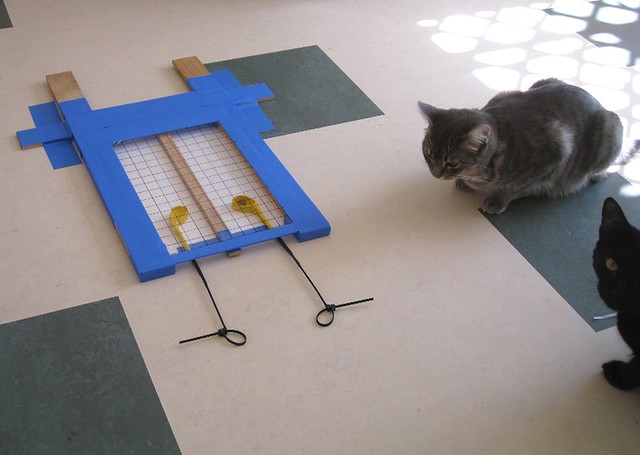
Main Structure
To make the main structure of the apparatus, I used several pieces of scrap, held together with blue painter's tape in a rectangular "frame" shape. To the bottom side of the frame I attached a sheet of thick white watercolor paper.
To the top side of the frame I attached a piece of Plexiglas with a grid pattern drawn on it -- however, upon closer reading of the study apparatus description (after I'd already completed my experiment), I noted that the original study had used a plain wire mesh on the top of the frame.
(Image showing main structure of test apparatus I built)
This meant that, contrary to my original (incorrect) impression, the cats more than likely would have indeed been able to smell the treats, as wire mesh blocked their physical access to the treats via the top of the box, but not the transmission of odors. If I were to try the experiment again at home I would use a piece of window screen or similar material for the lid of the box, rather than Plexiglas.
Another difference (albeit a deliberate one in this instance) between my setup and the referenced study's setup was the fact that in some trials I employed a central wooden divider that extended the interior length of the box (parallel to its left and right sides).
The purpose of this divider was to prevent the strings or zip tie mechanisms (more on that in a moment) from interfering with each other physically at all during "parallel string" trials, as I saw the potential for distraction if one string ended up touching the other while the cat was pulling on it, etc. However, in practice this divider turned out to be unnecessary, as when I removed it the cats' performance did not change and the strings/zip ties did not get tangled at all.
Treat Delivery Media
I experimented with two primary variables in terms of the treat-delivery media:
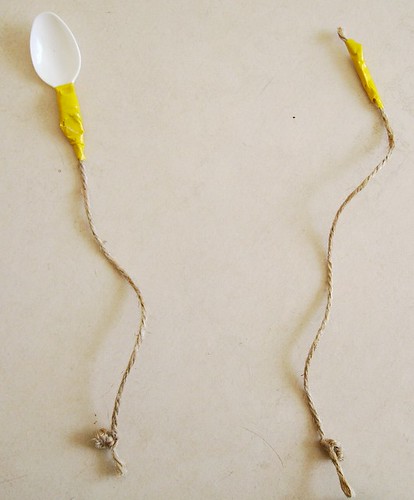
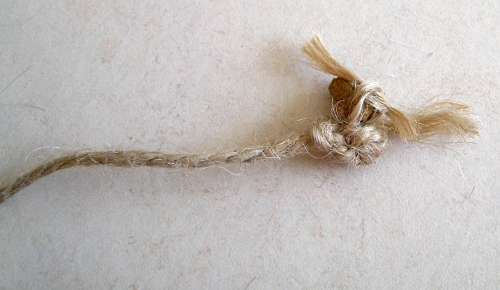
(1) Flexibility: In some trials I used actual strings (lengths of very flexible sisal twine), with or without a "treat container" at one end (see below):
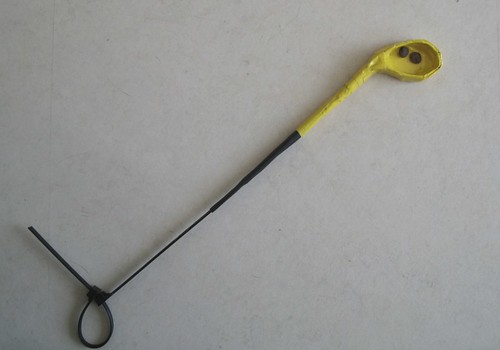
In others I used plastic zip ties modified to include a small "cup" on one end to hold treats.
(Image shows one of the zip tie/treat cup mechanisms employed)
(2) Contrast: In the first few trials I used unmodified sisal twine lengths and simply tied a piece of dry cat food or chicken jerky to the end of the treat-carrying piece (see image below, note the lack of visual contrast):
In the second few trials I used yellow "cups" filled with a small amount of dry cat food attached to the ends of plastic zip ties.
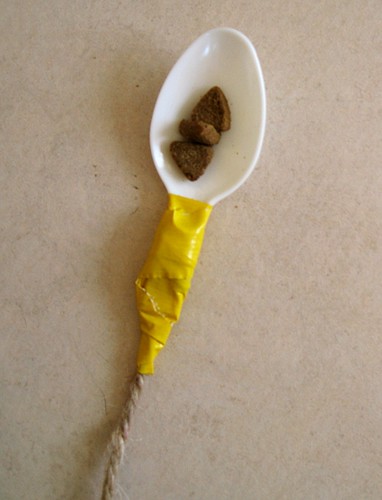
In the third round of trials I went back to using the sisal twine, but attached the end of a white plastic spoon as a treat container.
The goal here was to see what, if any, impact visual contrast had on the cats' ability to correctly identify the treat-carrying piece (thus distinguishing it from the "dummy" piece). One major criticism I had of the original study was that (inasmuch as I could tell from the description and photos available) it did not seem as if the treats were sufficiently visible to the cats.
Since, as I noted in my prior post, cats have fairly poor close-range visual acuity for fine details, I surmised that the treat holder needed to be significantly larger/wider than the end of the string (or zip tie) in order for them to be able to distinguish it properly. I also figured that it would be helpful for the treats themselves to stand out color-wise against the background of their container or cup.
TRAINING
I did not employ a formal "training phase" as the study described doing. However, I did present the treat-delivering string and zip tie pieces to the cats for inspection (prior to inserting them into the puzzle box). During this activity some of the string/zip tie pieces contained treats and some did not.
I also left the apparatus on the floor for several hours prior to starting any task trials, so that the cats would be able to investigate it at their leisure and not be distracted by the sheer novelty of the equipment when the task trials began.
RESULTS & DISCUSSION
Participation Variation
Of the four individual cats presented with the test equipment, two (Coraline and Brodie) completed various task cases successfully. Shadow was very interested in watching his siblings but declined to participate himself, and Nikki seemed totally uninterested in the activity.
Having lived with these particular cats for some time now I am not surprised by this outcome, given their respective personalities and predilections; Coraline and Brodie (Coraline especially) have always been the most mechanically inclined of the group, whereas Shadow is more inclined to solicit favors from humans (i.e., he'd rather meow at me to GIVE him a treat than try and get one himself).
Nikki, meanwhile, just tends to operate on an agenda all her own, and while at some point I can see her getting interested in a string puzzle of some sort, she wasn't interested on the day(s) on which I ran trials.
I should note that I do not draw any conclusions (negative or positive) about the non-participant cats' understanding of physical cause and effect based on their non-participation in this particular exercise. Since neither of the non-participants even attempted to complete the task, all I figure is warranted in terms of conclusion is that the materials and situation failed to inspire their interest, which of course says absolutely nothing about their capacity to cogitate about string and its uses.
Social Factors
By "social factors" here I refer to the presence/absence of multiple cats near the apparatus setup during task trials. Initially I tried testing one cat at a time, however, for the younger cats this proved impossible. No single cat would participate or do anything with the apparatus at all when separated (via a closed door in the house) from his or her siblings. Instead, the lone cat would wander around looking for his/her siblings, while the sibling cats would scratch at the door.
Once I let all the cats wander about freely, though, the three younger ones were plenty interested in the apparatus and two of them participated consistently over the course of three days. To me this suggests social factors might be more important to cats (especially related cats who get along well) than many would necessarily suspect. Having all the cats accessing the setup simultaneously did make certain aspects of the experiment more difficult to organize but it was certainly a better situation than zero participation, as I had when I attempted to test a single lone cat at a time.
As for Nikki's non-interest in the setup, social factors may have played a role her as well -- she tolerates the others but does not seem to like being very near them. I may try taking the apparatus out to the patio at some point and seeing if she might show more interest there -- she seems to be a lot more inhibited indoors, will only play with toys in the yard, etc.
Basic Observations
Again, as this was an informal/fun exercise and not an Official Scientific Experiment, I did not keep a precise count of how many times a given cat solved a task -- since I was the sole person setting up and running everything, it was not possible to carefully track every variable. However, I did note whenever a cat was able to solve a particular task case 2 or more times, and I considered that to be my basis for "success".
As expected, none of the cats completed a task in which a treat was tied to the end of a string. They all seemed vaguely interested in the strings as strings, but did not appear to even realize that one of them had a treat attached. I expect that this effect was compounded to a degree not necessarily present in the referenced study due to my use of plexiglas rather than wire mesh (which they'd have been able to smell the treats through) as a box lid. Unfortunately I did not get any video footage of this phase.
During the zip tie trials, Brodie and Coraline both consistently solved the parallel case. Their success was independent of "position habit", meaning that I was able to switch what side the treats were on and/or move the apparatus to a different room in the house and they still knew what zip tie to pull on to get the treats.
Brodie solving parallel zip tie task (room #1, treats on left side):
Brodie solving parallel zip tie task (room #2, treats on right side):
Cora demonstrates her zip tie prowess here:
(This one is actually an "amusing out-take" candidate -- I had not yet properly secured the apparatus to the floor before this trial, and Cora got her claw stuck in the treat container after she pulled it out, so we had a bit of a treat explosion! Her brothers, of course, were pleased by this turn of events.)
I did not end up doing a "crossed" case with the zip ties, because I discovered that the ties were too thick to fit under the 1 cm gap at the front of the box when stacked on top of one another. Refinement of this task would definitely account for this issue.
In the "string and spoon" phase (in which the treats were placed into the end of a white plastic spoon attached to one of the pieces of sisal twine), again, both Coraline and Brodie were successful at the parallel strings task. Unfortunately (due to disorganization and logistical wrangling difficulties on my part) I did not get a video of Brodie doing this but I got two of Coraline:
In the "crossed strings" case, Coraline had no trouble with this at all. I don't think she went for the "wrong" string even once. Brodie did not do as well here, however, he has always been very interested in string as a toy, and it seemed like when the strings were crossed it was a lot more fun to play with them than try to figure out which one had a treat attached to it.
The video below shows Cora easily solving the crossed-strings case:
(To me it certainly LOOKS like she knows darn well what the function of the string is, but I am not sure how to quantify this observation!)
CONCLUSION
In conclusion I note that my predictions (1) and (2) turned out to be accurate inasmuch as I could tell. Two out of four cats-in-residence completed at least two types of task each, which to me suggests that their performance was unlikely to have been the result of "random luck". However, of course in a formal study many more data points would be taken and results might differ.
As for the contrast issue, while again more data would be a good thing to have here, it really did seem based on what I observed that if the cats could clearly see the treats, those motivated to obtain them had no trouble doing so.
As for whether the zip tie mechanism improved performance (due to it being easier to physically manipulate than the string), it did look like this was probably the case, at least for the parallel task. Again, physical constraints of the apparatus prevented me from trying a true "crossed zip tie" case.
Finally, I find myself really wishing there were some way to quantify or better express what looks to me like "purposefulness" in Cora's performance on the crossed strings task. Perhaps, though, the difficulty of quantifying such impressions is why well-designed experiments employ numerous trials through which many data points are obtained, so that one is not relying upon subjective impressions, but rather, probability.
And all that said, I do have to say that trying this experiment (fumbling as my attempt was...) definitely turned out to be highly enjoyable, both for me and for the participating (and spectator) cats. I've since been strongly inspired to come up with ways of feeding them more creative than just dumping food in a bowl, as they seem to greatly enjoy "outsmarting" their food, which I suppose is quite appropriate for a small carnivorous predator species!
1-Whitt, E., Douglas, M., Osthaus, B., & Hocking, I. (2009). Domestic cats (Felis catus) do not show causal understanding in a string-pulling task Animal Cognition, 12 (5), 739-743 DOI: 10.1007/s10071-009-0228-x
Since adopting the Formerly Feral Trio (i.e., Coraline, Brodie, and Shadow) I've had countless scary dreams in which all of them somehow manage to escape the house. But until this past Thursday this never happened in real life.
Before going further I should of course note that nobody disappeared or came to any harm during this brief but intense adventure.
So what exactly happened? Well, firstly I should point out a few things about the kitchen here. There are two doors to the outside: one with a "security"-type screen behind the solid door, and one sliding glass door with a standard-issue screen behind it. Both doors lead to the back yard. The sliding glass door locks and latches just fine, but the sliding screen door does not. Nevertheless, until yesterday I had seen the cats climbing the screen but not, you know, actually operating the door. I mean yes I'd seen Cora jumping at the handle of the glass slider but as occurs in many such cases, her tremendous mechanical intelligence was thwarted by lack of opposable thumbs.
But...as I learned yesterday, you don't need a handle to work a screen door that doesn't latch right. All you need is motivation and a nice sharp set of claws!
It was early morning. Matt was getting ready for work and I was preparing to take the bus to the biotech lab I volunteer at (yep, I'm still job-searching). I had opened the glass slider to look at the vegetable garden (and my catnip plants!) and then went to brush my teeth or something of that nature.
When I returned to the main living area (the living room and kitchen are all sort of one big room, yay midcentury open floorplans!) I noticed it was quiet...too quiet. Then I happened to glance out to the patio and saw Cora there, sniffing nonchalantly at the ground. "Ack!" I thought. But I was not really wigged yet at that point, because Cora knows the yard pretty well. But THEN I looked past Cora and saw...Brodie. Blinking up at me with what can only be described as a "deer in headlights" look. I did not see Shadow at first but within seconds of seeing Brodie, Shadow poked his head from behind a bush.
Then I saw the "evidence" that had led to this whole situation -- the screen door was open just enough for a cat (or three of them) to squeeze through. And I knew I hadn't left it open...THAT I am very careful about.
Quickly I mentally resigned myself to possibly being late for lab. I was especially concerned about Brodie. Cora and Shadow have both been out in the yard with me (sans harness, but under close supervision) a few times, and both have stayed in the garden and not seemed particularly jumpy about neighbors' lawnmower sounds and dogs barking and whatnot. Brodie, however, is still working on harness acclimation, so to just see him sitting there in the yard really threw me a bit
BUT! As it turned out, it only ended up taking me TWO MINUTES to literally herd all three youngsters into the house. I just opened the screen door as wide as it would go and tossed a few pieces of dry food (which they all love; I've been trying to feed them more wet but still they get a few grain-free crunchies every day) into the kitchen. In they all went, trotting merrily in single file. It was quite a sight to behold! And quite a relief that nobody got spooked enough to disappear.
Needless to say, after this I will DEFINITELY be keeping the glass door closed on the slider whenever I can't be right there to watch it!
Oh, and as for who the culprit was? The cats aren't telling, but I strongly suspect Cora did it first. Shadow showed me today he could operate the screen too, though, so who knows for certain.
One of the very first things I ever noticed about Coraline was how observant, and how much of a planner she was. Even as a tiny two-month-old kitten, I could see her looking around whatever room she was in and figuring out just how everything fit together, and how she might be able to use available objects to her advantage (i.e., to get onto interesting-looking high shelves).
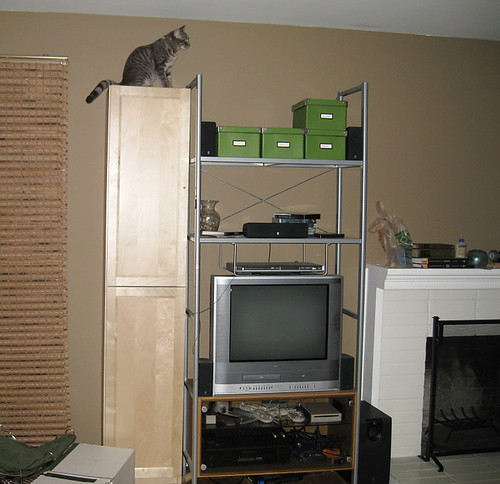
And, last night she figured out how to get to what is probably the highest point in the entire house -- the top of the DVD cabinet in the living room. It was really amazing to watch. First she jumped onto the mantel over the fireplace, then she jumped to the entertainment center, and then she made it to the top of the cabinet. And proceeded to sit there like an amber-eyed feline gargoyle as Matt and I watched our pre-bedtime Buffy episode.
Anyway, below is a picture of Cora quite triumphant atop her newly-discovered perch:
...and here is a video I took this evening of her making the upward journey:
I put one of her favorite feather toys on top of the DVD cabinet (when she was sitting where I knew she'd see me). And within seconds she made her way up there, knocked the toy down, and returned to the floor via the same route she'd come...and went right to where the toy had fallen.
I just thought that was pretty neat. And very very indicative of the fact that, yes, cats can indeed have rather complex planning and problem-solving abilities. Not that this is a surprise to me!
Also, it is interesting to see the different interests/priorities/predilections of different cats when it comes to such things as vertical terrain-exploration. Both girl kitties here (Cora and Nikki) are majorly into the climbing and the leaping.
Whereas the boys (Shadow and Brodie) are still a lot more likely to try and grab onto objects with their claws and scramble/crawl their way up. They will sometimes jump high when going after interactive toys, but they're not so much for the indoor climbing-gym stuff.
Cora and Nikki both also seem to do this thing where they jump very high in a manner that looks practically effortless; that is, there's not a whole lot of "wind-up". Which makes it almost look like teleportation sometimes!
I am a small piece of the universe observing itself. In this capacity, I am an engineer, science geek, sf/fantasy fan, amateur artist, cat appreciator, hyperlexic infovore, and maker of various and random quasi-functional objects.