Monday, June 21, 2010

On Barn Cats

This past Saturday, Matt (my SO) and I attended his family's annual picnic. Usually these events are held at a park local to us, but this year some of Matt's mom's cousins, who live on a sizable piece of farmland about 2 hours north-ish from here, offered to host at their place. The primary crop produced by Matt's relatives on this farmland is almond trees (they've got something like 40 acres of them) but there are also a few chickens and some sheep, etc. This setting definitely made for an interesting picnic experience, but most interesting (to me) was getting to meet a whole lot of cats!

According to the farm-resident relatives, there are actually something like 40 cats (!!!) living on the property, a population consisting of about half kittens and half adult cats. I did not see all these cats personally, but I did not expect to, seeing as we were there during afternoon hours (a.k.a. naptime for kitties) and the place was huge (meaning there were lots of potential hiding and secluded sleeping spots).

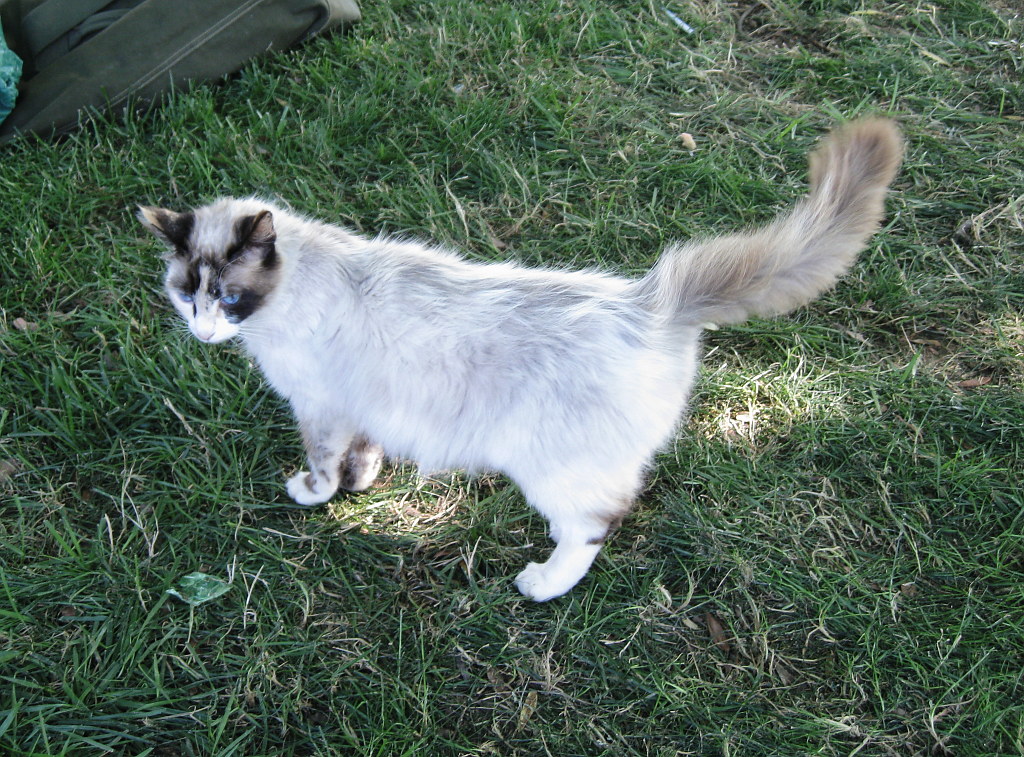
The first cat I met, pictured below, is named Diamond. Matt's mom was actually holding her when Matt and I walked up to the picnic area.


She was extremely curious, social with humans (and dogs, and other cats), and persistent -- eventually one of the younger cousins was told to go put her in the barn because she kept jumping on the picnic tables and trying to stick her nose in the chip-dip. But she got out of the barn easily. Hee. And she was also one of the most unique-looking cats I've ever seen: small (she was about a year old and probably weighed about six pounds) but with a feathery Maine Coon-ish tail, blue eyes, light-colored body, and "tortie point" coloration.

Diamond is now spayed but she did have a litter of kittens a few months ago. Matt is shown holding two of them: a little marmalade boy named OnyxTiger and a calico girl whose name I unfortunately cannot recall.


Like their mother these little ones were very sweet and inquisitive, though the girl kitten was quite a bit more adventurous. When I was holding her she sort of tried to climb up the back of my neck and probably would have ended up IN my backpack if the zipper had been open. Reminded me a lot of Cora in that regard!

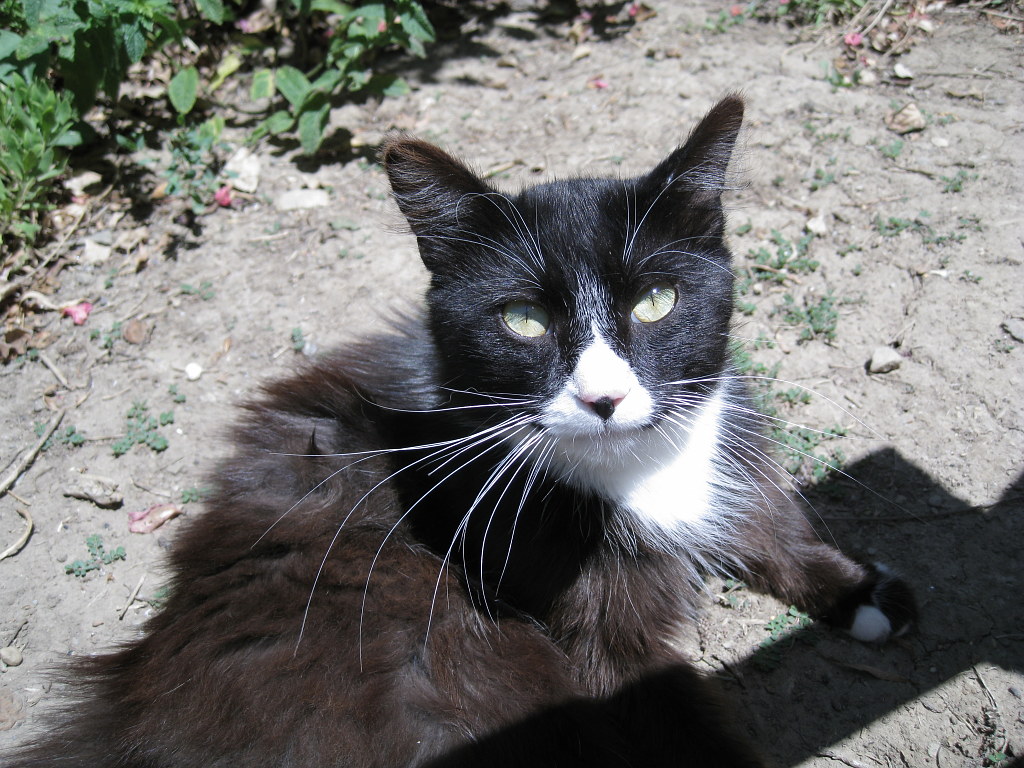
Diamond's brother Mooglu (was originally going to be "Mowgli" but the kids kept saying "Mooglu" and it stuck) was similarly curious about all the strange humans gallivanting around. He hung out and watched the festivities from the porch or front garden most of the time. He was about Diamond's size (must be a "small cat gene" in that population) and a very handsome tuxedo brownish-black-and-white.


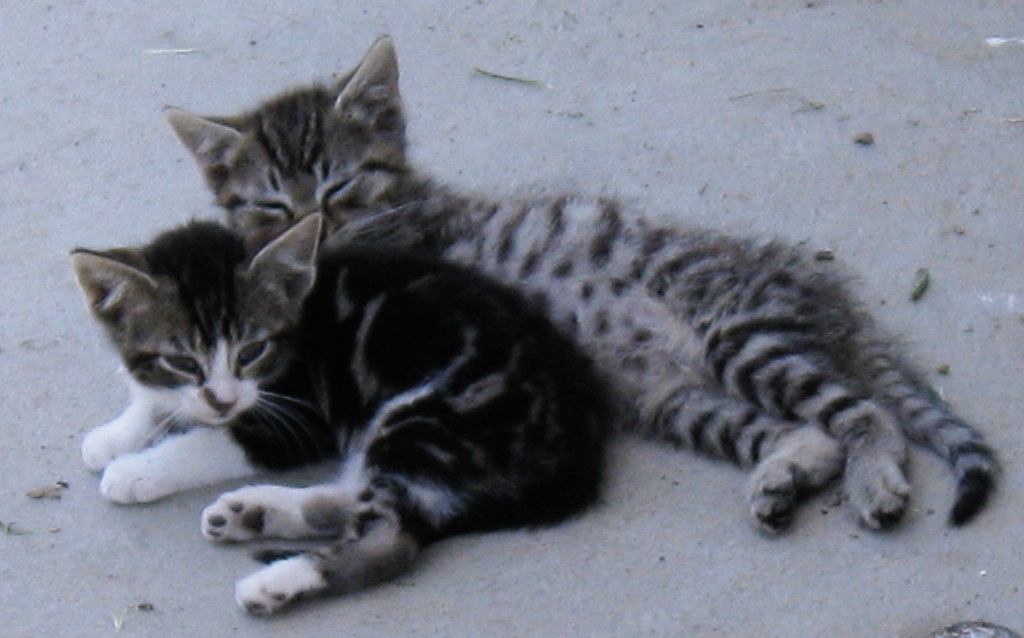
These two young kittens were lounging out by the barn most of the day. They don't have names yet.


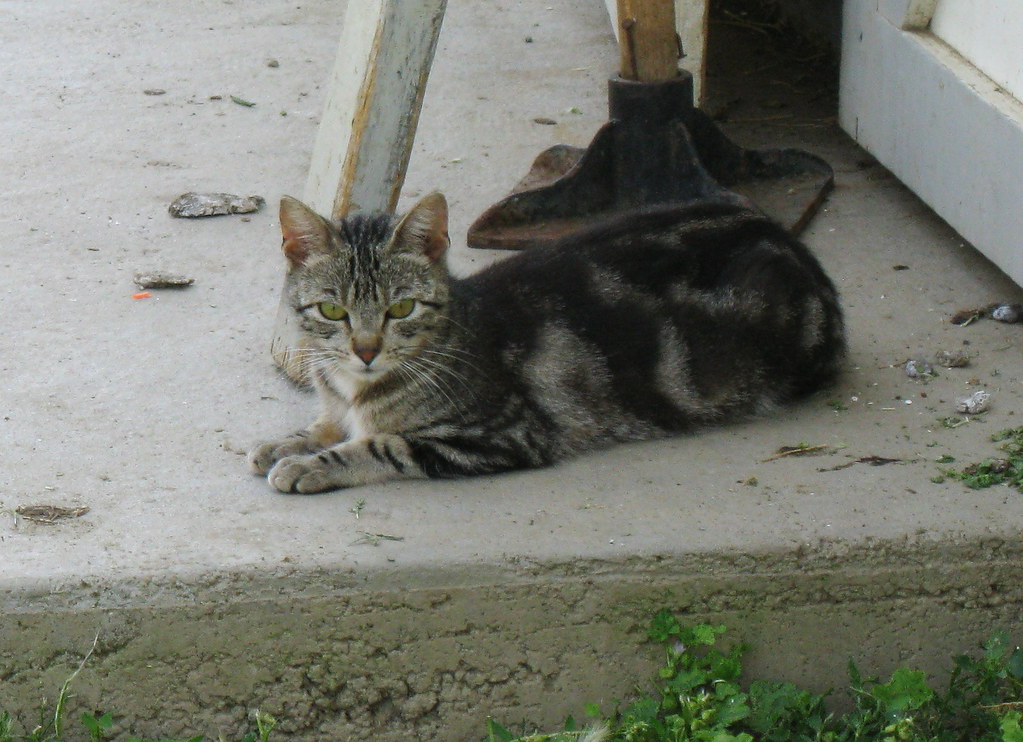
This pretty marble tabby girl is called Pocahontas.


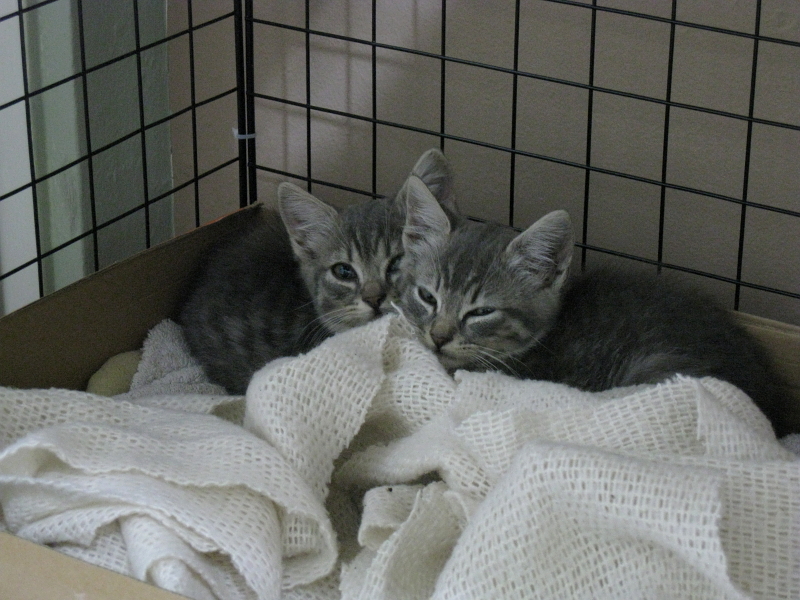
And then there was this little grey fellow -- a very young kitten, probably no more than 3 or 4 weeks old.


When I first saw him something definitely seemed weird about the situation because it is not often you see a kitty that young without his mama. He was just sitting on one edge of the concrete platform thing at the barn entrance all by himself. I went over to let him sniff my finger (a cat greeting that is more polite, IMO, than just going up and petting them) and he did so. But when I got close to him I saw that his eyes were fused shut!

I thought at first maybe he was REALLY young and his eyes just were not open yet, however it turned out that he had some sort of eye infection that was causing his eyelids to stick. Kittens' eyes should be open by around 9 days and (tiny as he was) he was definitely older than that. I also learned that he was apparently the sole survivor of a litter that had been very sickly from the start, and that the mother kitty (who I did not see) had not been very attentive. Just as with humans, not all cats necessarily have the best parenting skills. And while Little Grey Kitten was apparently being sporadically nursed by another female cat, he was definitely not getting enough milk to thrive on. Kittens are supposed to have fat little round bellies and this little guy just felt like fur and air.

But! The day had somewhat of a happy ending for Little Grey Kitten, because another relative at the picnic (who I briefly spoke to -- she was definitely a Cat Person) got permission from the farm-folks to take him home with her, where she would be able to bottle-feed him, get him antibiotics for his eyes, etc. I really hope he pulls through, and I am SO glad there was someone else in attendance whose household cat-carrying capacity was not at its limit (as mine is with four felines-in-residence).

I would guess that most modern humans who did not grow up in farm-type settings and who've known cats primarily in the "companion" context might find the life of a barn cat to be quite unusual, perhaps even disconcerting. These are definitely not "kept" cats. They face some very harsh realities, such as the fact of being not just predators in the rural zones they inhabit, but prey for coyotes and the like. Aside from rabies vaccines, they probably rarely see the vet; sick barn cats either get better on their own or "disappear" as they succumb to illness. Most of them have a few fleas here and there, and this is not considered a big deal.

However, they have a lot more autonomy and freedom to come and go than the average house-cat. And their lifestyle certainly permits them to constantly engage in normal feline activities (hunting, territory-marking, etc.) without human interference or scolding. Some of them are spayed or neutered, of course, but not all, as (due to the aforementioned coyote predation issue) the farm-folks want to assure there are enough cats at any given time to properly deal with crop-threatening rodent pests.

Furthermore, these cats looked tremendously happy; trotting around the farm, eyes bright and sparkling, tails aloft like banners, greeting humans, dogs, and other cats alike with purrs and face-rubs. They also, aside from the aforementioned miscellaneous flea, looked to be extremely healthy: lean (but not too skinny) and glossy-furred.

Of course housecats can be, and often are, just as happy and healthy. Most will not wander far even if allowed outside, and hence I would certainly not consider them to categorically be "prisoners"; cats are territorial and tend to get very attached to places, after all. And there are ways to provide cats with plenty of human-acceptable outlets for necessary feline actions in human homes and suburban yards. My point here is hence not to suggest that either the housecat life or the barn cat life is fundamentally "better", but rather, to express considerable awe at the impressive adaptability of cats.

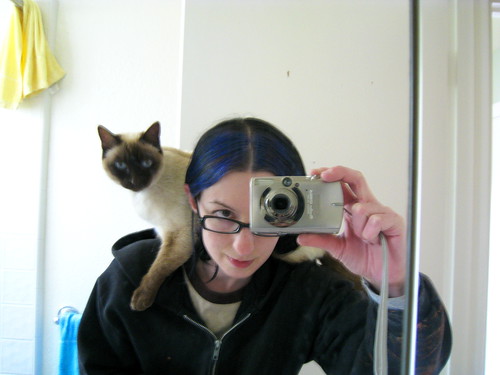
We humans call them "domestic" felines, however it seems clear to me that cats can do very well in any number of situations. It is almost as if they have a number of different "programs" they can potentially run depending on their early life circumstances. It rather amazes me to consider that the silent feral cat who only comes to the food bowl at night when humans aren't around, the super-socialized housecat riding around on her human's shoulder, and the friendly-but-scrappy mouser-extraordinaire barn cat are, genetically speaking, members of the same species.

Moreover, having observed cats in all these settings, I find myself amazed even further at the way each sort of life can be equally rich despite every path looking so radically different from every other. Of course I am not saying that it doesn't matter at all how we (humans) treat cats, so hopefully it does not come across that way. But I think there is a difference between treating someone ethically and respectfully, and trying to prescribe a particular sort of life for every member of a given species as the only possible acceptable one.

Wednesday, June 16, 2010

Carnivorous By Nature


Felis Cattus, is your taxonomic nomenclature,
an endothermic quadruped carnivorous by nature?
Your visual, olfactory and auditory senses
contribute to your hunting skills, and natural defenses.

I find myself intrigued by your subvocal oscillations,
a singular development of cat communications
that obviates your basic hedonistic predilection
for a rhythmic stroking of your fur, to demonstrate affection.

- From "Ode to Spot", a poem read by the android Data in the Star Trek: The Next Generation episode, 'Schisms'


A few years ago, while visiting Matt's parents (Matt being my Significant Other; his parents live locally to us) I witnessed a scene that probably plays out all the time in nature, but which I don't see all that often when I click links entitled "cute kitten video!!" In the back yard, a tiny (probably 7 weeks old at most) feral kitten was gleefully flinging an object around. Initially my reaction was typical: along the lines of "aww, how adorable!" But then I got a closer look at the object...and saw that it was a partly-eaten dead bird (most likely a house sparrow). Which I have to admit gave me a bit of a jolt. But that jolt was only momentary because I remembered, hey, this is a cat. Cuteness does not equal vegetarianism, after all!

So yeah. Personally I tend toward a vegetarian diet and prefer plant-based foods for myself whenever feasible. However this does not mean I would ever be tempted to impose my preferences and choices in this regard on my cats. Moreover, while I certainly disagree with factory farming practices and don't think I could stand hanging around in a slaughterhouse, I do accept that nature includes carnivores, herbivores, and omnivores, and somehow I doubt things would go well for life on Earth if all the carnivores suddenly disappeared!

But on to the main point of this post, which is to discuss a weird thing I've noticed looking around in the "pet" sections of grocery stores and the like. And that is the way products (especially food) for dogs and cats are marketed, formulated, and made available. I don't want to take the time right now to go around photographing display shelves and ingredients labels, so take this for what it's worth, but I suspect most people who've looked at these items will be familiar with what I am describing here.

Basically it looks to me like there's this perception of cats as being these dainty little creatures whose sensibilities might even be described as "delicate". Whereas dogs (with the exception of the "toy" breeds) are associated with a sort of rough-and-tumble "outdoorsiness" (or something along those lines). Dog food cans and bags tend to employ "strong"-looking or blocky lettering and dark or bold colors; cat food packaging is heavy on the pastels and the flowery script. Dogs and cats can of course be either male or female, but in many cases it seems like cat products look stereotypically "feminine" whereas dog products look stereotypically "masculine".

Now of course I am not claiming that the observations above are universally or 100% true for all foods and other products. For instance, foods marketed as being "natural" or "holistic" tend to use similar (frequently neutral or "artsy"-looking) packaging colors and designs for both cats and dogs. And there are certainly exceptions to the "all dogs are boys, all cats are girls" imagery; i.e., the archetypically masculine tomcat and the fluffy pink-beribboned poodle both show up repeatedly in popular culture. But I still think the overall trends otherwise I am describing here are at least prevalent enough to be worth mentioning.

All that said, I want to specifically focus on food here. Biologically speaking, cats are obligate carnivores (meaning they must consume the particular nutrients found in the flesh of other animals in order to survive). Dogs, while also technically carnivores, can eat a more omnivorous diet and tend to have less digestive trouble with grains than cats do. Yet the marketing and available selection of cat and dog foods and treats in many of the stores I've visited would suggest the exact opposite!

To illustrate what I mean, I was in one store recently (a local hardware store that is really more of a "general household goods" emporium, i.e., they carry lots of gardening equipment and rugs in addition to nuts, bolts, and tools) and in their "pet" aisle I noticed several things. One was that the selection of dog food was about twice as large as the selection of cat food. Another was that the dog food selection included at least one of the "natural" brands, noted as being high meat/low grain. The cat section included no such option; if I'd been restricted to buying food there, I'd have been completely out of luck as there was nothing Brodie (who gets severe stomach upset from corn and probably barley as well) could safely eat.

I have noticed the same trend in most grocery stores as far as treats are concerned. Treats of course are not a necessity, but as long as one isn't over-feeding one's cats or dogs, they can be a nice little mid-day surprise or supplement. But ye gads. Dogs get all this nice jerky stuff -- essentially pure meat -- while cats get these little "Fun Shaped" crunchy or chewy things that are, of course, predominantly corn. What. The. Heck.

So yeah. I am not sitting here fuming in outrage over all this -- there are, after all, multiple local pet supply stores where I can easily find reasonably species-appropriate cat food -- but this sort of thing does confuse and annoy me. It just seems like there's this bizarre cultural stereotype of cats being dainty, girlish...salad-eaters, or something, that is totally incongruous with their carnivorous reality*. And I don't think it does anyone, much less cats themselves, any service to misrepresent or disregard this reality.

* Not that there is anything wrong with being girlish, my point is more that there seems to be a conflation of cats with feminine with needing-less-meat, etc., which makes no sense at all, and wouldn't if applied to dogs or humans either!


Friday, June 11, 2010

Shadow Teaches Himself To Sit

...and I got it on video! See below:


Seriously, I have no idea why some people think cats are incapable of doing this kind of thing, or that they invariably "don't have the personality for it". Maybe that viewpoint is getting less common than it used to be, but still. This is easy stuff for Shadow.

I almost feel kind of weird doing stuff like this as I really don't want to...patronize him or anything, but the thing with him is that he seems to really enjoy this sort of "trick". It's a fun game for him, as he really enjoys communicating reciprocally (both with humans and with other cats) and he just seems so pleased with himself when he gets the treat!

(Also note Happy Tail-In-The-Air when I offer him another piece of chicken!)

Friday, June 4, 2010

Cora and Brodie, Then and Now

This picture was taken only a few days after Cora and Brodie first came home with me (they were just about 7-8 weeks old):


...and this one was taken recently (they're about 10 months old here):


It is amazing how much they've grown and changed AND how much they've essentially stayed the same in some respects. They are still utterly devoted to each other, at any rate (Brodie and Shadow are best friends as well -- Brodie is like the "glue" of the sibling trio).

(Oh and if it is not apparent, in both pictures Cora is on the left and Brodie is on the right. They also started off roughly the same size -- about 2 pounds when they moved in -- but now Brodie is nearly twice Cora's weight and quite a bit longer/taller than she is.)

Friday, May 28, 2010

Friday Picture Post!

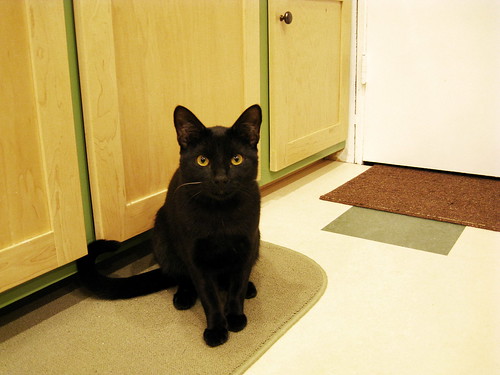
Shadow in the kitchen (staring at me -- he does that sometimes when he is in "play mode" and wants me to get a toy out for him!).


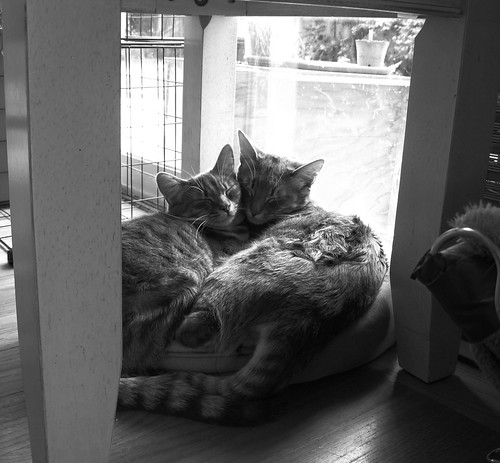
Shadow and Brodie, snugglebrothers! I love how Shadow is all smooshy-faced into Brodie's chest:


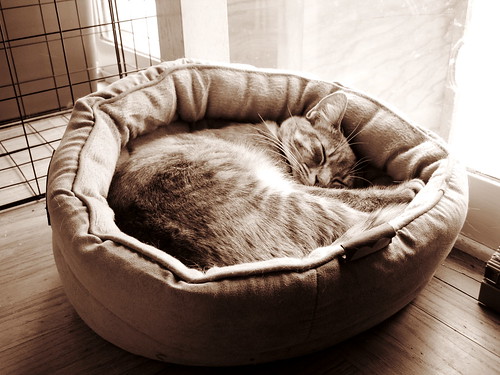
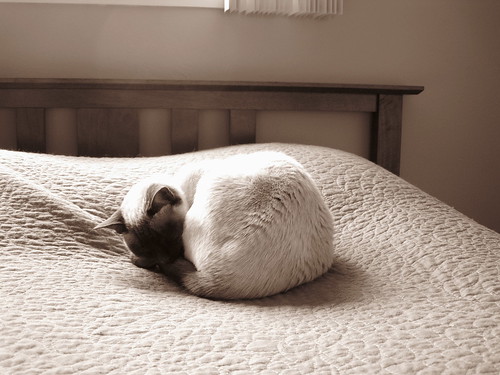
Cora all curled up in the little round cat bed (I swear, sometimes I wish I could morph into a cat just for the sake of the naps!):


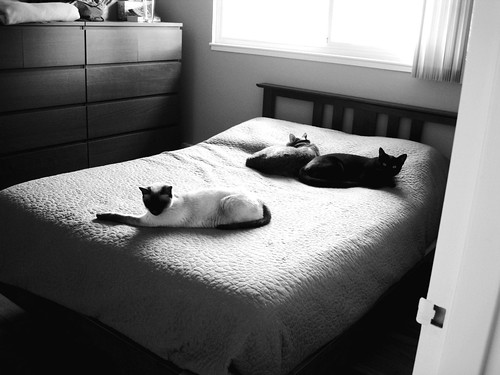
Stylish kitties are stylish - Nikki, Shadow, and Brodie lounge artfully on the bed:


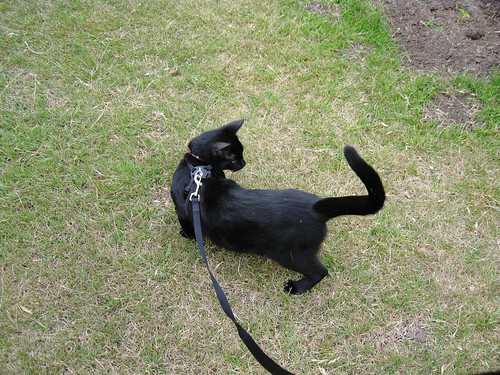
Shadow tries out the harness, in the back yard:


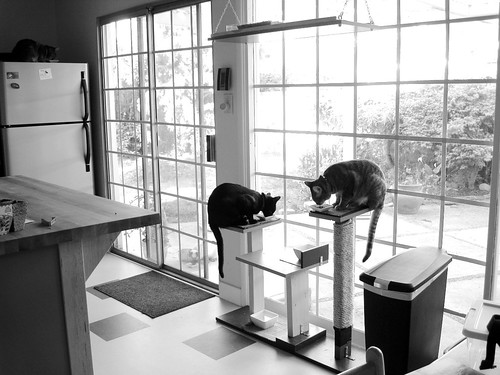
Breakfast time! Brodie and Shadow are on the cat platform, Cora is on top of the fridge, and Nikki is just outside the patio door (everyone is very excited about getting their wet food!):


Brodie, the archetypical kittyloaf!

Wednesday, May 26, 2010

Nikki's Overnight Adventure: More Thoughts On Outdoor Access for Cats

So, I had a bit of a scare last Friday night. Everything (and everyone, human and feline alike) is fine and accounted for now, save for the fact that my nerves are still slightly rattled. You see, Nikki (the only feline-in-residence who currently has any sort of unescorted outdoor access) did not come home on Friday night.

She went outside at around 3 PM and I saw her around the back yard every so often for the next few hours. But then dinnertime came and went, as did 7:30 PM (when I generally try to make sure she's indoors for the night, as most cats who get hit by cars do so after dark).

By 8 PM I still had seen no sign of her, not even when I went outside and opened a can of food (I recently discovered that while she disdains the expensive hippie wet food I've offered, she's quite the fiend for Fancy Feast).

I walked up and down the street and checked all her usual spots (under neighbors' bushes, etc.), but did not see or hear her anywhere (if she's outside and nearby, she usually answers if I call her name and meow).

Needless to say, I was worried. Very very worried. Apparently I have inherited the Corwin familial tendency to assume the absolute worst whenever someone I care about is out of my sight (and past due their usual arrival time back home). All these positively awful scenarios kept popping into my head, and I kept going round and round wondering if maybe I should have tried to turn her into an indoor-only cat, but then reminding myself that it's not like I forced her to go outside, and frankly she is probably better at gauging outdoor dangers than I am.

So...essentially I spent the better part of last Friday evening pacing around the living room, staring pointedly out the windows, periodically going out and calling Nikki's name, listening as hard as I could for any sort of answer, and generally Freaking Out.

(As an aside, Shadow was sort of following me around the house all evening, looking up at me and mewing and then curling up and purring on my lap when I sat down. He is turning out to be quite the Empathy Cat!)

At a certain point, though, I managed to convince myself that worrying would not bring Nikki back home safely, so I put some food out (near both the front and back doors), wedged the gate to the back yard open using the trash can (so she could get into the back yard more easily), and went to bed.

I woke up at 4 AM to use the bathroom and checked once again then to see if Nikki had perhaps returned, but still no luck. The food bowl I'd put on the front porch was empty, but that didn't tell me much, considering there are at least 5 other outdoor-access cats living on my street (not to mention a cadre of squirrels, and most probably opossums and racoons as well), so it could have been anyone. I went back to bed still worried (enough to dream, TWICE, about the situation) but exhausted enough to crash for another few hours.

Then, at 7 AM, I heard Shadow shrieking at the bedroom door (one of these days I simply must record some of the noises he makes, they're pretty incredible) so I figured it was as good a time as any to get up. I went into the kitchen and started preparing the kitties their morning breakfast (they get a portion of canned food in the AM and some dry food later in the day). I got out four dishes, figuring I would put a bit out on the front porch again for Nikki (just in case).

But, as it turned out, I never even got a chance to finish filling the cat dishes before Nikki ran up (yowling all the way!) across the back patio toward the kitchen door. I opened the door and she hopped inside without a moment's hesitation. She inhaled her food like she'd never seen food before, then proceeded to jump onto the stove (it wasn't on, don't worry) and try to lick the grease off the pan Matt had cooked hamburgers in the previous night! (Which means she had to be starving because I have never before seen her go for anything like that).

I gave her a handful of dry food after watching her a bit to make sure she wasn't going to hork up the canned stuff from eating it too fast, so she ate that, and then trundled off to my bed and slept. And slept and slept and slept, not even getting up or giving us an Annoyed Look when Matt and I made the bed (pulled the quilt up, etc.).


Nikki, all crashed out after her adventure!


She looks fine (no scratches, limping, etc.) and clearly her appetite is intact so I don't think anything awful happened to her. However, I did get the impression that she had probably been trapped somewhere (such as in a neighbor's garage -- she loves exploring garages for some reason) because of how hungry she was and the way she RAN into the kitchen like she had just escaped something. Her eyes were very wide and she was chattering at me in a "you would not BELIEVE the night I had!!!" manner.

In any case, I am just terribly relieved Nikki is okay. It's been a few days now and she is back to her usual energetic, demanding, vigilant security-guard-cat self. I've still been letting her outside every so often during the day but I've been making sure she's in for the night by 5 or 6 PM. And so far, ever since her adventure, she's been a lot more inclined to stick around the yard.

I know some people would probably think I'm being awfully irresponsible for letting Nikki out at all, especially after her overnight trip to who-knows-where. But as I explained in my post on "indoor-outdoor agnosticism", I personally do not hold firm beliefs either way about whether cats-in-general should or shouldn't be allowed outdoors unsupervised.

Rather, I think the decision is always going to be a very individual one based on each individual cat and his or her particular circumstances. And in Nikki's case, I can just see this huge difference in her overall demeanor and stress level when she's allowed out at least part-time versus when she's kept in 24-7.

Moreover, she seems very good about avoiding situations once she's determined they are Not Good in some way. If she was indeed trapped in a garage or something along those lines, my guess is she'll be much more careful to avoid that sort of thing in the future. So in a sense I am actually a little less worried when she goes out now, because of the fact that she came back after having been out all night; I know at least that she knows where "home" is.

So while the type of "compromise" she and I maintain in that regard seems to be ever-evolving, I guess what it comes down to is that I don't want to mistake my own tendency to worry when I can't see her for the actuality of serious danger. That, to me, seems like the sort of mistake that tends to lead to improper use of power (and humans have a lot of power over cats).

And in general I don't believe in using one incident of something scary happening as "proof" that someone needs to have their liberty to do something they love completely taken away.1


1 - PLEASE don't take this as meaning that I believe "all cats need to be allowed outside, otherwise you-the-human are abusing your power". I don't believe any such thing (if I did, why would three out of four felines living with me currently be indoor-only-unless-leashed?), and I think I've said so multiple times already. But I just want to make absolutely sure I am not misunderstood on this.

The actual point I am trying to make here is more along the lines of "I need to be careful not to confuse alleviating my own worries with actually making the best possible decision in a given cat's particular circumstances".

Which is a point that I think applies to relationships (particularly where power differentials are present, regardless of species membership) in general.

That is, when one person is in a position to control the amount or type of risk someone else is exposed to, it is not valid ethical reasoning for the more powerful party to simply decide "oh, I will just keep the other person under lock and key all the time, that way I won't need to worry about them".

Because in that case it's not actually about keeping the other person* safe. It's about the powerful person using their power to eliminate their own discomfort. Which is not the same thing as, say, using one's power to accurately assess risk and balance their decisions with the needs and wants of the less powerful person. I think it's important not to muddle the former with the latter, as that sort of muddling tends to lead to the total disregard of the less powerful person's needs, wants, autonomy, etc.

In other words, I feel that I have pretty rigorously assessed the cost-benefit scenarios associated with letting Nikki out sometimes or keeping her in all the time. And based on the relative quietness of the neighborhood here, lack of coyotes or other predators likely to attack domestic cats, presence of other outdoor cats who seem to be in good health (one of whom I know is 11 years old), etc., I figure there is a much higher probability of Nikki going on to live a good, long life than there is of her meeting an early, horrible death even if she has part-time outdoor access.

Oh, and bird enthusiasts need not worry about Nikki depleting the local sparrow supply -- whatever her other talents, she's a total failure as a hunter. She has no stealth and no sense of timing whatsoever. I mean, seriously, it's pretty hard to catch birds when you're running toward them yelling in Siamese fire-truck tones the whole way!


* In my personal lexicon, "person" is not restricted to meaning "human". And this should not be taken as "anthropomorphism", but as one of the ways I try to express respect for cats and various other non-human species.


Monday, May 24, 2010

What I've Learned About Litter Boxes

Ah, the litter box -- essential to every home where cats spend time indoors, seemingly simple, yet often fraught with complexity in terms of what it takes to create an ideal setup.

I never expected to spend as much time as I have since the current resident felines moved in figuring this out, but seeing as we've had zero problems in that department so far around here, I consider every moment spend pondering the intricacies of litter substrates, containers, and locations, to be well worth it.

I have to admit that when I was growing up, I lacked the appreciation I currently have for the importance of creating restroom facilities for cats that truly appeal to and meet feline criteria. Poor Tim (our family's Siamese guy, who we had from when I was in 5th grade through my senior year of high school) often had to put up with some truly terrible box conditions simply because we humans were not vigilant enough about keeping it clean.

Granted, at the time we did not have the wonderful invention that is clumping litter, but still. Since the box was in the downstairs basement bathroom it was very easy to just forget about it for days, and not give it much of a thought until Tim chose to communicate his displeasure with his toilet conditions by, say, crapping right in the center of my beanbag chair (for which I don't blame him one bit!).

In any case, I have learned (from my youthful irresponsibility and from a variety of cat-related books and online resources) a number of things that I believe have permitted a much better environment for the felines who now share my home. Among these valuable pieces of information are:

(1) Have more than one box.

This is absolutely essential in a multi-cat home (and possibly essential even if you only have one cat, if said cat is very young, very old, ill, or if your home has multiple stories).

One of the most eye-opening things I've learned of late has been just how very important territory is to cats, and the litter box is often one of the most contested and worried-about bits of real estate in the feline's home environment. Hence, one litter box for 2 or more cats is pretty much a recipe for territorial disputes, quite possibly of the smelly variety. Moreover, if such disputes are taking place, it's a sure bet the kitties involved are going to be stressed and hence unhappy much of the time, which obviously isn't good.

Luckily, there's a simple solution -- multiple litter boxes (and this is important) placed in different rooms, or different areas of the house. This effectively "splits up" the pottying territory, making it impossible for more dominant cats to "guard" the only available bathroom.

Furthermore, having multiple boxes actually makes for easier cleaning, as odd as that may sound -- but it makes sense when you consider that each box is likely to have a much lower concentration of waste.

As for exactly how many boxes, that is going to depend on a number of things. Most guidelines I've read as of late suggest "one box per cat, plus one extra". And my guess is that this is a wonderful guideline to follow, likely to pretty much guarantee zero territorial battles over bathrooming space.

However, I must admit that I have not personally managed to fulfill this guideline in my household -- we only have three boxes currently. I would love to have another box, but I can't for the life of me figure out where to put it. If the (one and only) bathroom were larger I'd put one in there, but the size it is now, there's literally nowhere to put a litter box where it wouldn't interfere with opening and closing the bathroom door.

The living room, meanwhile, is a "play zone" and the kitchen is a "food zone", so I don't want to put litter boxes in either of those rooms, because cats generally don't like to crap where they eat or play anyway. So for now we are sort of stuck with the three-box arrangement. I also realize that my litter box locations are not the best (two of them are in closets, albeit ones that are never closed) in terms of providing the cats with maximum visibility whilst going about their business, but I couldn't exactly put them where everyone would be tripping over them. So I did not have a whole lot of options in that regard.

[And my house isn't tiny, it's just laid out such that the majority of the area is a big, open space (living room plus kitchen) and the rest is divided up into very small rooms connected by a short hallway.]

So far all the cats seem fine with this three-box arrangement -- nobody has complained (and by "complained" I of course mean "crapped in my shoe to communicate their displeasure with the facilities"), at least. Plus, since Nikki has yard access, she can do her business outdoors (at least on some days); thankfully she prefers un-used (by humans) corners of the yard as opposed to the vegetable garden for that purpose. But I just keep thinking there must be some creative solution I haven't thought of, whereby I could stick another box somewhere just for that extra peace of mind it would provide.

Also, I have to say that figuring out where the boxes will go has definitely solidified my sense of my house's "cat-carrying capacity". I would definitely not want to be figuring out where I'd put six or seven litter boxes, which tells me that four cats is probably my ideal maximum for this living space, so that is what I am sticking to.

(2) Get your litter boxes at the hardware store, not the pet store.

These days when I go into the pet store, I almost have to laugh at the kitty bathroom facilities they offer. They're so small! And the sides are so low! Or they've got elaborate covers over them, inside which I cannot see how an average-sized cat could even turn around, let alone poop comfortably. And they're ridiculously expensive, for what they are.

I've had much, much better luck with (a) large plastic storage containers (20 gallon or larger, with FLAT bottoms, not the kind with weird grooves in them) -- the high sides do a worthwhile job of reducing "litter scatter", and (b) cement mixing pans.

Currently I have two storage-container boxes and one cement-mixing-bin box. They were all cheap, cheap, cheap (under $10 apiece, if I recall correctly) and all the cats here use them enthusiastically.

Below are pictures of my various "litter box stations", with a bit of commentary on each:


Box #1


Box #1 is located in the spare bedroom/"library" (it's a very small room with bookcases taking up one entire wall, a futon under the window, and a small table in front of the futon). This one is made from an Ikea Snalis storage box, which we've had since Cora and Brodie were tiny (back in October 2009). It has held up very well so far and this box gets a lot of "traffic", even though it's a bit smaller surface-area-wise than the other two boxes. So I am guessing the kitties like the location.

The one hurdle about this box's placement I haven't yet had to deal with (but have thought about) is: what if we actually have overnight guests at some point? Matt and I are kind of hermit-y and don't have many people over, but it presumably could happen. And my guess is that most people would not want to sleep in a room right next to an evening feature of "Kitty Takes A Dump At Midnight".

But I know cats don't like having their boxes moved all of a sudden and I certainly don't want to stress them, especially given that the mere fact of having guests at all would probably wig them a little.

So I am guessing that what I might do is plan way ahead for any overnight guests, and move the litter box out into the hallway (as gradually as possible). But in the meantime, I will certainly leave the box in that room because it's probably the least used-by-humans room in the house, making it perfect most of the time to house a kitty bathroom.


Box #2:


Box #2 is a clear Rubbermaid storage bin. Slightly larger than Box #1, and with the "step-in cutout" on the long side of the box rather than the short end, this one is located in the hall closet next to the bathroom. This closet has 2 sliding doors but we never close the one on the litter box side, whereas the other side is pretty much always closed because that's where the water heater is. So it's really more like the litter box is in a little "alcove" thing in the hallway, which is a good place for it logistics-wise because that way I'm not liable to accidentally step in it.

It actually took the kitties a rather long time to notice this box was even there, though that could be simply because it's the newest of the three boxes and by the time I added it to the set, everyone had become accustomed to using the boxes in the 2 other locations. But they do use it now (at least, the three younger cats do -- I've never seen Nikki even acknowledge Box #2), and for some reason it seems to get a lot of night-time traffic.

Eventually I would like to perhaps take that one closet door off completely and perhaps paint the shelves above the box (making a tidy little cat-nook; I already use it to store extra litter and other cat supplies in plastic containers). But for now it does the job as-is.


Box #3:


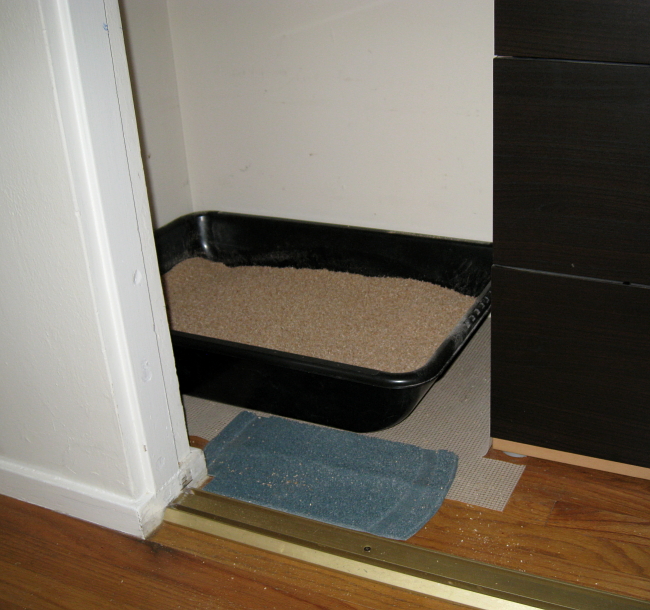
Box #3 is a large black cement mixing pan I got for about $6 at the little hardware store down the street. If the sides were just a bit higher (they're about 6") I would probably consider it to be the Most Perfect Litter Box Ever. It has a ton of surface area (which was the main reason I got it -- my boy cats especially are big guys, and still growing, and I wanted to have something they'd be able to turn around in, etc., once they reached full size). It has a smooth bottom with NO grooves, which is rounded at both ends, so scooping is very easy, and litter clumps are far less likely to break up.

(There is a commercially available litter box with a similar design, but you will pay more for it than you would pay for a cement mixing bin. Its sides are a bit higher than those of the cement bin, though, so for some people that alone might be worth the additional cost.)

I have this box placed on one side of the closet in the computer/office room. Matt and I completely removed the doors from this closet (they were huge mirrored affairs that Matt disliked from the get-go anyway) so it is not a very "closety" space anymore. All four kitties seem very pleased with Box #3, especially Nikki, who likes to be able to see all around her while using the facilities.

Mind you, none of my cats seem to be the types to stick their butts over the edge of the box and "miss" or produce horizontal "over-spray". If your kitties have these sorts of tendencies, the sides on the cement mixing bin might be too low for you to consider. As it is, I am glad that I had a "corner" location to place this box in (I attached plastic shelf liner to the adjacent walls, just in case...) because there is definitely more scatter from this box than from the storage containers. But I don't really want a higher sided box in that location because it's right near the doorway to the room and higher sides would probably eliminate the visibility advantage. And really the scatter is not THAT bad, as long as I keep on top of it with the mini-Dyson-vac!


(3) Avoid covered boxes.

Now, there are exceptions to this one...some shy or self-conscious cats prefer to do their business in a cave, so to speak. But the majority of cats are far less inclined to appreciate a cover on their litter box, and more inclined to appreciate the extra head-room, visibility, and fresh-airiness that a lidless box provides.

I have known many cats who use covered boxes without complaint, but seeing as I wanted to pre-emptively prevent litter box problems when it came to my kitties, I decided to go with lidless boxes from the get-go. Which is one reason plastic storage containers are so nice...they provide all the litter-scatter protection of a covered box without the cover!

Plus, not having a cover makes the box way easier to clean...you don't have to disconnect or remove anything, whether you're scooping or dumping and scrubbing the whole box. There are no little plastic clasps to break or get stuck, no litter-cement stuck in odd little nooks and crannies...just smooth surface all over. Lovely, as such things go! And of course there's the advantage of you being able to SEE the poop when it's there, rather than having it build up out of sight, creating much grossness for the cat and also for you later when you finally go deal with the mess.

(Oh and regarding electronic "self cleaning" litter boxes? I've never tried one, and don't plan to. All I can think of when I see those things is how they're full of small and moving parts that would ALL have to be periodically cleaned, which I know would be a huge hassle for me. I much prefer the low-tech simplicity of "all one piece" boxes. Your, and your cats', mileage may vary, though.)

About the only covered box I would ever consider would be one with holes, or mesh, on all sides, to allow for air flow and visibility. But there is no way I am going to want to "trap odors inside"...that right there is a major recipe for litter box avoidance. Not to mention the fact that, in a multi-cat situation, covered boxes provide the perfect opportunity for ambushes, which can lead to shy cats avoiding the box altogether and deciding that your laundry basket (or worse) makes a safer toilet.

I just didn't want to set up the conditions to foster ANY litter box avoidance, and for me, the fact that occasionally I have to walk by a box and see (and smell) a turd sitting there is MUCH preferable to stressed, box-avoiding kitties and probably extra messes to clean up in places much less scoop-friendly than the litter box.

(4) Scoop more than once a day.

This is especially important in multi-cat situations (singlet kitties may not require it, but it depends on the individual cat). I scoop all boxes twice a day minimum, sometimes more. It's part of my morning routine and evening routine now, and I would feel very weird if I didn't do it. Letting waste build up not only makes box avoidance more likely, but gets awfully smelly very fast, and can even end up costing you (as you will surely go through more litter that way).

Seriously. You do not want your kitty to have to step through piles of his/her own waste in order to use the toilet. If you need help managing litter boxes, get help. (I realize this is easier said than done, though, if you need help that badly, so I do not mean to denigrate anyone's situation). I guess what I'm saying is, keeping the box inviting (which means clean) should be a priority, not an after-thought or optional consideration when it comes to creating a good home for cats.

(5) Avoid scented / perfumed litter, "pet area" air fresheners, etc..

This one was very easy for me as I myself can't stand the smells of most scented products, litter included. Plus it is just patently apparent to me that covering up an odor is not going to fool a cat! Dirty litter is still dirty, no matter how much it might smell like the choke-inducing soap in your Great Aunt Effie's bathroom cabinet. Same goes for potpourri-spray around the litter box, or scented candles or whatnot. No cat with a crap-filled box is going to smell the aroma of Cinnamon-Citrus Breeze and think "oh how wonderful!" More likely, the cat will use the box grudgingly, if at all, and become that much more liable to go seek out a less asphyxiating bathroom location.

(And again, YMMV on this one -- I am not trying to be a judgmental zealot here, but it just seems to me like common sense that you wouldn't use a heavily-perfumed product in a toilet facility for someone with an extremely keen sense of smell. Just as with covered boxes, though, I have known cats who don't seem to mind scented litter. But as I personally can't stand the stuff myself, and as I'm big into that whole prevent-problems-before-they-start thing, I just figured I was better off finding an unscented litter and sticking with it.)

As for what litter substrate I use? Currently I am using Swheat Scoop Multi-Cat. Mostly I started out with this litter because it was the only one I could find that was unscented, indicated it was "safe for kittens", and also clumped. (Clumping clay litter is not recommended for kittens, as supposedly it can cause intestinal blockage when licked off their paws).

I'm more or less happy with it, though it would be nice if it clumped a little more firmly. It is not dust-free but it's a heck of a lot less dusty than any clay litter I've come across. And I like that the bags are much lighter to carry than an equivalent volume of clay. I don't see any reason to switch brands, and I wouldn't want to do so suddenly anyway, because that's another thing that can lead to box avoidance ("hey, this isn't the stuff I usually crap in!").

(Note: I have also tried the non-multi-cat variety and confirmed that there is a performance difference -- regular Swheat Scoop definitely does not smell as fresh for as long as the multi-cat stuff. After a few days, even with regular scooping, it starts to smell like a gas-station restroom. So I would recommend trying the multi-cat Swheat Scoop if you're heading down the wheat road anyway, even if you only have a singular cat.)

Some people have recommended World's Best Cat Litter to me. I am sure it is a fine product but I can't use it because of Brodie's corn intolerance. He is so sensitive to the stuff that even two or three corn-based treats will give him the runs, so I certainly wouldn't want him walking around in corn-based anything or cleaning himself with that stuff all over him. If your cat doesn't have this corn issue then you would probably be fine with WBCL (and it might be something to try if your cat instead has a problem with wheat, as some cats do).

(6) Flushable Litter Generally Isn't.

This is more of a human-relevant concern than a cat-relevant concern, but seeing as our sewer cleanout recently backed up into the front yard, I figured I would point it out so others could hopefully avoid a similar fate. It is probably fine to flush individual poops down the toilet (I do this sometimes still, and have no problems), but you definitely do NOT want to be putting giant pee-clumps down that drain.

My guess is that even if you let it sit for the recommended 20 minutes, that is still a heck of a lot of sheer matter for the crapper to "digest". Even a nominally "flushable" litter, when flushed in the quantities you'd expect from four cats, can lead to a plumbing nightmare, and most people I know would prefer to avoid nightmares of that variety.

So unless you know you have super-mega-industrial piping in your home, you probably just want to toss the used litter clumps into the trash. If you are worried about biodegradability, you can actually get biodegradable bags for this purpose (they sell them to pick up doggie waste with). And you don't need to spend lots on a special receptacle for bags of litter, either -- a regular diaper pail or trash can with a tight-fitting lid (not one of those swing-type things) will do the job just fine.

And as for environmental concerns, there appears to me to be no "perfect" litter or way to deal with cat waste. Some people don't recommend flushing any cat waste because toxoplasma parasite can harm sea otters. Others claim flushing is better because that way you don't have anything sitting in a landfill. I would suggest just doing your own research and balancing whatever you find with your cats' and your individual needs.


Now, note that none of the above were my original ideas...aside from the "this is what I'm doing in my home" bits, I am just repeating advice I've heard/read in far too many places to reference here, trying to spread the information around so that more people are likely to encounter it.
Monday, May 17, 2010

In Which I Sort The Kitties Into Alpha, Beta, and Gamma Personalities In Addition To Hogwarts Houses

Disclaimer: this post is completely un-scientific and not even remotely meant to suggest ANY of my cats (or any cats, period) can be easily summed up by placement in a simplistic categorization system. This sort of thing, to me, is just for fun -- along the lines of, say, trying to sort your siblings into Hogwarts houses, or in a likewise manner, attempting to determine what the D&D alignments of various characters in Buffy the Vampire Slayer would be. (Yes, I've actually done this.)


Ahem. Anyway. Where was I?

Ah yes. Cats!

I recently read an article describing three types of cat personalities, nominally Alpha, Beta, and Gamma. Which, in this parlance, do not imply hierarcical designations (such as would be the case in wolf or dog packs), have nothing to do with fraternities, and do not in any way refer to the dysfunctional socio-eugenics structuring as described in Huxley's Brave New World.

Rather, the article describes the three cat types thusly:


Alpha cats are the mad scientists of the cat world.

They want to manipulate their environment to suit them. Their lack of thumbs is the only factor keeping them from World Domination. That, and those naps.

Alphas are marvelous cats, but they are not for everyone. As kittens, they are the reason china cabinets have doors and kitchen cabinets have baby locks. If something can be opened, unfastened, switched, rearranged, or button pressed, it was an Alpha who did it. Their boundless curiosity and free running intelligence is fastened on their reason for being; experimentation. If a thing does interesting stuff when dumped in the water dish, it will be dumped in the water dish.(...)


Beta cats see us [humans] as the way to get their environment the way they want it. So they are great talkers, or if not, big on the "Lassie Move" where they catch your attention and try to get you to follow them to the object of interest...

...Betas love companionship, whether it be respectful dogs or properly coached children. They are the most likely cat to meet strangers [note: not true in Shadow's case, but I can see it becoming true as he gets older and more confident], especially if the guests are sensible enough to admire them. If your business needs a "greeter cat," look for a Beta. This outgoing quality makes them especially easy to care for, because if the food dish is getting low or the litter box isn't being kept up, you will know about it right away. Always be swift to correct problems, and Betas will shower you with love and attention in return.


Gamma cats are sweet and mellow. They are somewhat shy, but once their trust is won, they love affection and have winning little ways.

They always have time for you. The challenge of the Gamma is not immediately apparent. You must make time for them.

Gammas are teddy bears, so deferential and unassuming that they will not assert themselves except in an emergency. It's up to you, as a responsible Gamma owner, to keep tabs on them, making sure the water bowl is fresh, and the food keeps coming.


(Note: I've only quoted partially from each section in the linked article -- hopefully this puts things here in accordance with copyright etiquette).

So, while there are aspects of these descriptions that certainly do not apply to my kitties, roughly, when reading the article I found myself figuring Nikki and Shadow to be Betas, Coraline to be an Alpha, and Brodie to be a Gamma. (And when I later described the article to Matt, he agreed with my sorting results).

It is interesting to think about the felines-in-residence in this way in part because these Alpha-Beta-Gamma designations, frivolous and unscientific as they may be, do sort of bring out patterns I might not have noticed otherwise. I actually nearly laughed out loud this morning when I was preparing breakfast for the feline lot, whilst noting that:

- Cora had jumped up onto the counter and was trying to get the food straight out of the can, before I'd even had the chance to distribute it onto individual dishes,

- Brodie was sitting over on the kitchen cat-platform thing, looking proper-as-you-please and waiting quietly,

- Shadow was weaving around my legs, looking up at me periodically, and meowing, and

- Nikki was likewise yelling at me from the patio (as she could see what was going on re. the can of food I had open in the kitchen)

Hee. So yeah. Again, totally silly, frivolous, unscientific, but interesting and funny nonetheless. E.g., Shadow and Nikki are very different people; they have unique demeanors, interests, priorities, and so on.

In Hogwarts terms, for instance, Nikki would almost certainly be a (non-evil!) Slytherin.


She has a certain air of ruthlessness about her (though is definitely not "mean"). She gives off a tremendous impression of having a whole lot of terribly important work to do (and I do actually believe she does, in cat terms, which are not terms to be taken lightly!). Hence she has no patience whatsoever for time-wasting frivolousness, unnecessary noise, etc. If she were human my guess would be she'd be the type people would accuse of having "no sense of humor", when really, it's just that her wit is so dry (and often dark) that people miss it even when she's being totally obvious about it.

Whereas Shadow, on the other hand, is Captain Hufflepuff all the way.


Loyal to those he trusts, presumes all other cats want to (or should want to) be his friend. Unflappable in the face of swats, hisses, and so on. Stands his ground no matter what. Energetic, easily entertained and prone to being altogether silly. If he were human he seems like he'd be sort of this very gung-ho, earnest boy-scout sort of guy (think Russell from the film 'Up').

Nevertheless, both these very different kitties definitely share the whole "Come quick! Timmy's fallen in the well! quality that is apparently a "Beta" thing.

They're both very vocal, and lately it's been the two of them howling at my bedroom door (which is a "no kitty zone" at night, per Matt's desire not to have his sensitive bits pounced on by 30-plus pounds of crepuscular athletics-team) at 5 in the morning. They both share the habit of following me from room to room when they want something (and sitting outside the door yelling at me when I'm in the bathroom).

They are also both highly adept at figuring out how to communicate with the ape contingent -- as in, if their first attempt doesn't visibly get my attention, they will amp up the volume, and if that doesn't work, they will move on to physical reminders (Nikki will jump up onto my shoulder, Shadow will attempt to climb up my pants leg!). And so on.

Overall, while again you'd never mistake one for the other character-wise (Shadow is about as silly as Nikki is serious, for one thing), I definitely see significant aspects of both of them in the "beta" description.

As for Coraline, she is so Alpha (and a Ravenclaw, all the way).


Ever since she was a tiny kitten, she's given off this incredible sense of what I would call "gears turning constantly in her head". She plans things. If she were a cartoon character, she'd be the one always saying, "According to my calculations...".

She's always been patient and careful (yet bold at the same time), and highly attuned to how she might employ objects in her environment to her advantage (or in the service of her entertainment). She's not so much into persuading humans to do her bidding so much as getting things done herself (though she can certainly be very persuasive when it suits her!).

In other words, Cora (as a baby) was the one escaping from the kitten-pen, hiding in the bookshelves, climbing part-way up the chimney (I kid you not), working her way through every cardboard-and-tape assembly I employed to keep the kittens out from under the bed (when they were teeny and feral I had to give them medication for their coccidia parasite infections, and it was this ridiculous ordeal to catch them if they got under the bed -- but eventually I just gave up and dealt with the ridiculous ordeal because, short of sealing up the space with concrete, I could not figure out an adequate barrier design), and tearing individual paper towels off the roll to make herself neat little sleeping-mats under the bed.

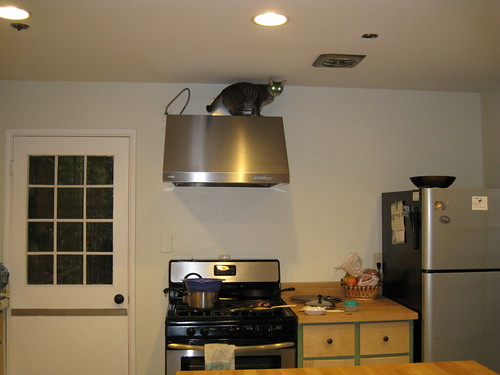
She has since "graduated" to such feats as jumping at door handles (she knows exactly what they are for and how they work -- it seems to be only a lack of opposable thumbs that thwarts her in using them), scaling every vertical structure in the house (and getting to places I never expected to see a cat, such as the top of the stove's fume hood!), caching favorite toys under the rug, pulling my sweaters off their hangers and into the laundry basket (which she has claimed as a DIY cat-bed) and so on. So yeah. I would honestly only be half surprised to come home and find her using my computer to order "supplies" (fish, explosives, jet-packs, etc.) via the Internet.

And then there's Brodie.


While he looks nothing like any of the "Gamma-associated" breeds (Persian, Birman, etc.) listed in the aforementioned article -- if anything, as a feral-born mutt, he resembles a short-haired variant of Maine Coon crossed with an Oriental Shorthair -- his overall bearing is very much along the lines of what I'd definitely term "sweet" (though I don't mean that in a patronizing or infantilizing sense at all).

He also has this quality of seeming to sort of...fade into the background, for lack of a better phrase. It's not like I ever forget he's there, it's just that he generally isn't making a point of announcing his presence constantly. He reminds me a little bit of my brother Paul (I actually have four younger siblings; Paul is closest in age to me), who has a similarly "unobtrusive" character about him. If Brodie were a child attending school, he would be one of the quiet kids in the back of the class who just sort of did his work and was described as "no trouble" -- despite being perfectly capable of the occasional bit of mischief! He also has the (apparently) "Gamma" trait of being initially shy, but extremely affectionate once he knows and trusts you.

Oh, and the bit in the article about how you (meaning you, human) need to be the one to make time for [GammaKitty] is definitely true in Brodie's case. He is quite content to nap off in a corner somewhere for hours (the unobtrusiveness thing again), but if I go find him, pet him a bit, and then walk off somewhere else and sit down, he will more than likely come find me in a matter of minutes, mew at me, jump up, and settle into my lap and purr for as long as I'm willing to sit there.

(Hogwarts-wise he'd be a Gryffindor of the Neville Longbottom variety, in the sense that a lot of people might wonder what he's doing there at first, but then when it really comes down to taking a stand, he astounds people.)

...so, yeah, I definitely live with a very interesting mix of feline characters here. I know I am very lucky that they all get along reasonably well, as it's always such a crap-shoot (thankfully not a literal one in our case -- everyone here is great about litterbox use) bringing a group of small carnivores together under one roof. And I also feel privileged to have this opportunity to watch a very particular group of individuals each seeing, feeling, and generally experiencing life and reality in his or her own way, thus helping do justice to an amazing universe containing far too much for any one person to possibly perceive, let alone comprehend.